Those mechanisms solve different problems. A chute improves transfer, a gate can portion by volume only if it fills consistently, and a storage chamber simply reduces the number of separate containers.
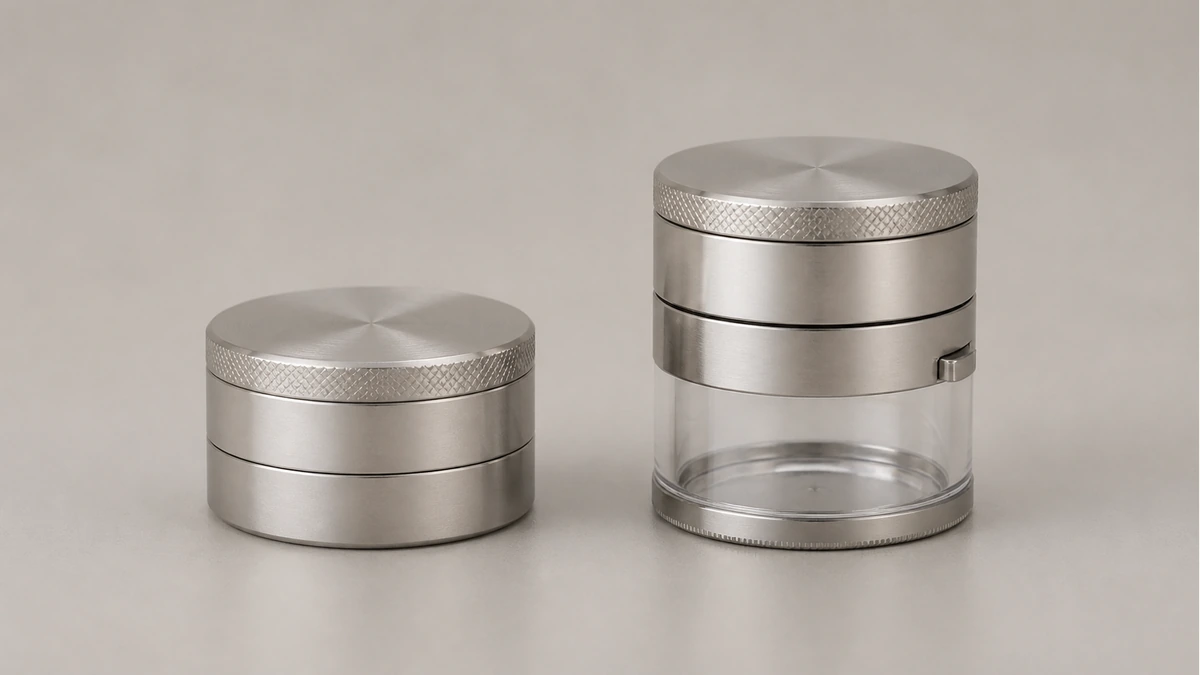
An herb grinder with a dispenser should move ground material from the cutting chamber into storage or through a controlled outlet without requiring the whole grinder to be opened. Before buying, find out whether “dispenser” means a chute, a rotating gate, or merely a storage cup bundled with the grinder.
⚙️ 1. Dispenser can mean three different mechanisms
The first mechanism is a true metering gate: a small door or wheel at the base of the bottom chamber that opens briefly when pressed, letting a portion of ground herb fall through before closing again. This design requires a spring or a rotating disc with a cutout, and its main engineering challenge is sealing well enough between uses that material doesn’t leak out on its own from vibration or tilt.
The second mechanism is a chute or funnel — a fixed opening, sometimes with a flip cap, that lets material fall out when the grinder is inverted and tapped. There’s no metering here; the amount that comes out depends entirely on how hard you tap and how long you hold the position. It’s a controlled way to empty the chamber, not a controlled dose.
The third is simply a storage compartment, usually the bottom chamber below a mesh screen, that you access by unscrewing the base. Kief collects there over time, and ground herb from the grind chamber above may or may not pass through the screen depending on mesh size. Calling this a “dispenser” stretches the word, but it’s common in product listings because the compartment does eventually release its contents — just not on demand and not in a controlled amount.
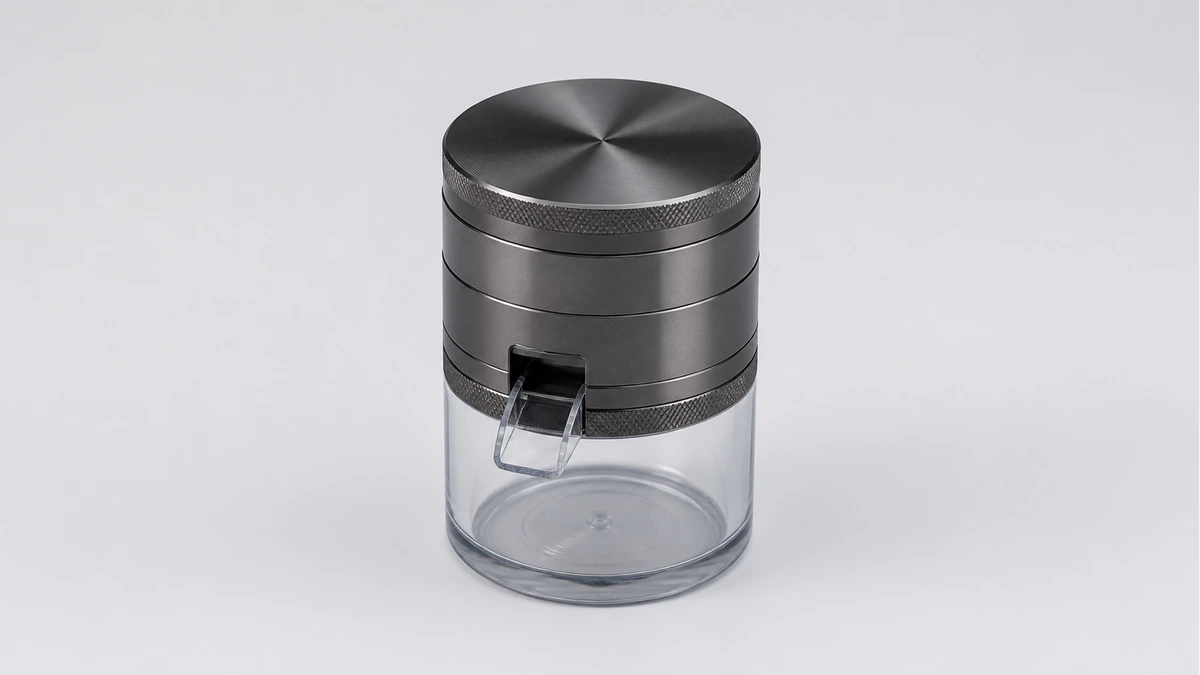
Knowing which of these three you’re looking at before you buy avoids most of the disappointment people report. If you want a measured amount per use, only the first mechanism delivers that. If you just want ground material to fall out cleanly rather than needing to be scraped out with a pick, the chute is sufficient. And if what you actually want is a place for kief to accumulate over weeks, that’s the plain storage chamber, and no gate or chute is necessary at all.
🌿 2. The grind must move without bridging in a chute
Any dispensing path, whether it’s a gate or a plain chute, depends on ground material actually flowing through it. This is where a design that looks fine on paper fails in practice. Ground herb is not a free-flowing powder — it’s irregular in size, slightly sticky from plant resin, and prone to clumping. When enough of it collects at a narrow opening, it can arch across the gap and hold itself in place, a phenomenon called bridging. The chute looks empty from the outside, but the material above it is stuck in a self-supporting arch, and nothing comes out until that arch is broken, usually by tapping or shaking the grinder.
Bridging gets worse as the opening narrows and as the grind gets finer. A coarse grind with larger particles tends to flow more like gravel; a fine grind, especially one ground long enough to release resin, behaves more like damp sand and clumps more readily. This is a physical property of the ground material itself, not a flaw specific to any one grinder, and it applies to any mechanism — teeth grinder or electric — that funnels output through a narrow path.
The practical fix is mechanical, not chemical: a wider chute opening reduces bridging risk simply because it takes a larger, more stable arch to span it, which is statistically less likely to form. A funnel shape that widens gradually rather than stepping down abruptly also helps, because sudden narrowing is where bridges tend to lock in. None of this eliminates the need to occasionally tap the grinder, but it changes how often that’s necessary.
📦 3. Integrated storage changes freshness and cleanup
A sealed bottom chamber does more than catch kief — it changes how the ground material ages between uses. Ground herb has more exposed surface area than whole flower, so it loses moisture and volatile compounds faster when left open to air. A chamber with a tight-fitting lid or gasket slows that exposure, which is one real advantage of an integrated storage design over grinding straight onto an open surface.
The tradeoff is that the same sealed environment makes cleaning harder to skip. Resin and fine particles that accumulate in a storage chamber don’t go anywhere on their own, and because the chamber is enclosed, you can’t easily see how much has built up until you open it. A grinder used regularly without ever being opened for cleaning will eventually have a layer of packed residue at the bottom that reduces effective storage volume and can affect how new material moves through the chute or gate above it.
This is a genuine tension in the design: the features that make storage useful for freshness — a tight seal, a small opening, minimal air exchange — are the same features that make it easy to forget the compartment exists. A grinder with a separate storage chamber is really asking for two different maintenance habits: one for the grinding surfaces, which get visible use every time, and one for the storage chamber, which doesn’t announce that it needs attention.
For a broader look at how chamber count and screen mesh affect what ends up where, the breakdown in our 2-piece herb grinder guide covers the tradeoffs between simpler designs and multi-chamber ones with dedicated kief catches.
⚡ 4. Static and fine particles undermine neat dispensing
Fine ground herb and kief both generate static charge easily, especially in dry conditions or when the grinder itself is plastic or has plastic internal parts. That static is what makes fine particles cling to chamber walls, screens, and the underside of lids instead of falling cleanly toward an outlet. It’s a separate problem from bridging — bridging is about particles locking against each other, while static is about particles clinging to a surface — and a dispenser mechanism can suffer from both at once.
Metal chambers tend to hold less static charge than plastic ones, partly because metal dissipates charge rather than accumulating it, which is one reason all-metal internals show up as a preference in more detailed grinder discussions. This isn’t a claim that metal eliminates static entirely — moisture content in the herb and ambient humidity both matter more than material alone — but it’s a real factor in why some designs empty more cleanly than others of similar mechanical layout.
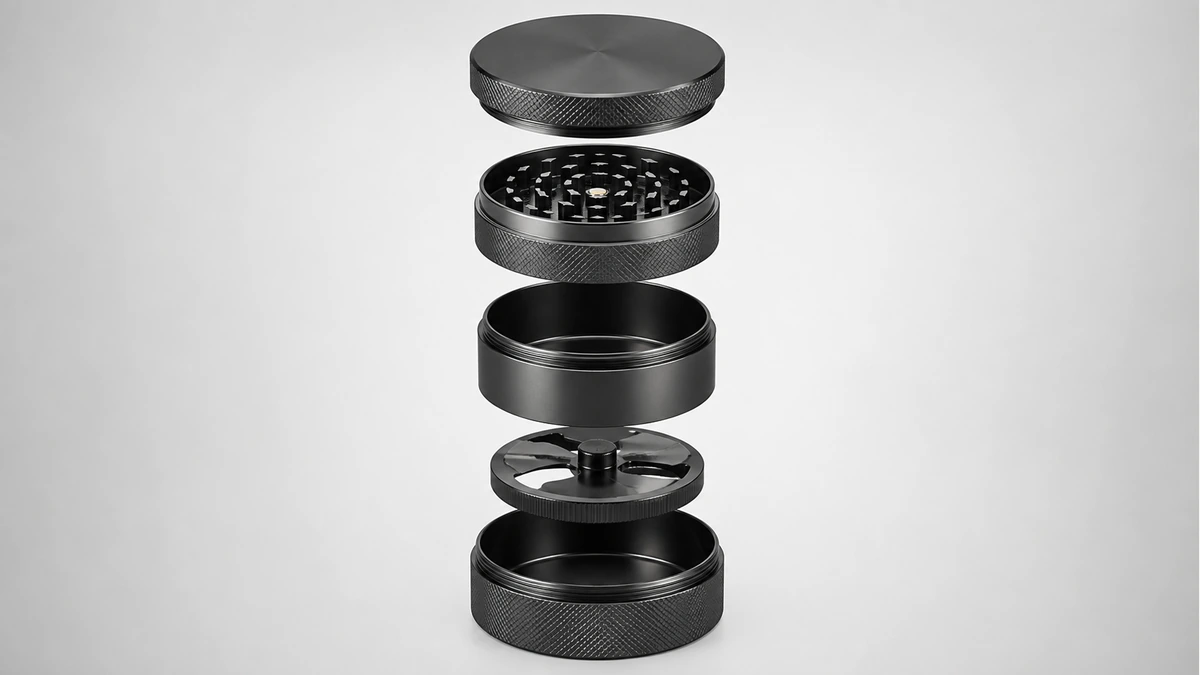
The practical effect on dispensing is that even a well-designed gate or chute can underperform if static causes material to stick to the walls just above the opening rather than falling through it. A brief tap or a light shake usually dislodges statically-clinging particles the same way it breaks a bridge, which is part of why almost every dispensing grinder design still assumes some manual tapping rather than fully passive gravity flow.
📏 5. A measured dose claim needs a repeatable mechanism
Any claim that a grinder delivers a consistent, measured amount per press or per twist depends entirely on the gate mechanism behaving the same way every time — same opening size, same spring tension, same closing seal. That consistency is mechanically harder to achieve than it sounds, because ground herb’s flow behavior changes with grind fineness, moisture, and how full the chamber is above the gate.
A gate that releases a small, repeatable volume when the chamber is nearly full may release a different amount when the chamber is nearly empty, simply because the weight and pressure of material sitting above the gate changes how readily it flows through when the gate opens. This is a basic property of granular materials under gravity, not a defect unique to any product, but it means “measured dose” claims should be read as approximate rather than exact unless the mechanism explicitly controls for fill level.
Spring tension and gate seal wear matter too. A gate that relies on a spring to snap shut will, over enough open-close cycles, likely loosen slightly, which can change both how much material escapes per press and whether the gate seals fully between uses. None of this makes a metering gate useless — it’s still meaningfully more controlled than an open chute — but it explains why “measured” in this context means “more consistent than pouring freely,” not “precise down to a fixed amount every time.”
🧼 6. Every chamber should open for cleaning
Whichever dispensing design you’re evaluating, the deciding factor for long-term usability is whether every chamber the material touches can actually be opened and reached. A gate mechanism that’s molded as a sealed unit, with no way to access the space directly behind the gate, will accumulate residue in exactly the spot most likely to affect flow — and there’s no way to clear it once it builds up.
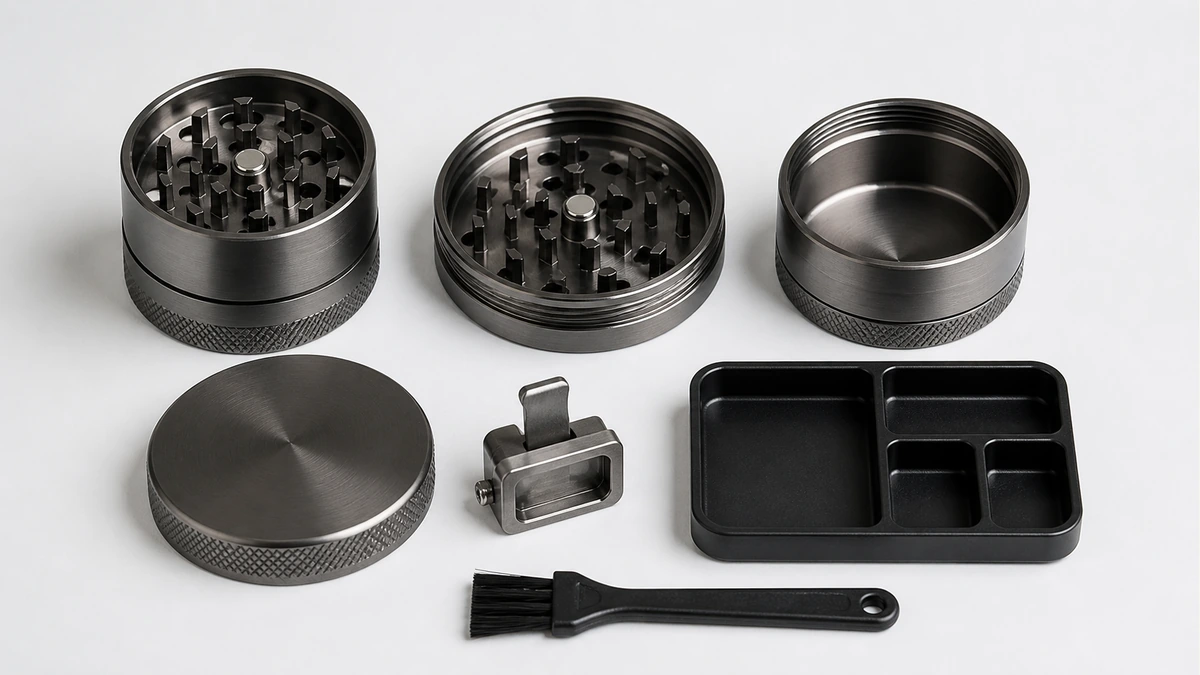
Removable screens matter for the same reason. A screen that lifts out lets you clear packed material from both sides; a screen that’s fixed in place, especially in a chute or gate design, becomes a bottleneck that’s invisible until dispensing gets noticeably slower or stops working consistently. This is worth checking before buying, not after: a design with more moving parts inside a dispensing mechanism is only a good tradeoff if those parts are also accessible.
Cleaning cadence also depends on which of the three dispenser types you have. A plain storage chamber needs periodic emptying but tolerates buildup reasonably well since nothing depends on precise clearance. A chute needs to stay clear enough that gravity alone can move material through it. A metering gate has the tightest tolerance of the three, since even a small amount of packed residue around the gate’s edge can prevent it from closing fully, which then lets material leak out on its own between intended uses.
✅ 7. Choose the simplest path that solves your actual routine
The honest way to evaluate “herb grinder with dispenser” listings is to match the mechanism to what you’re actually trying to solve, rather than assuming more features mean more convenience. If the goal is simply not scraping ground herb out with a pick, a wide chute with a removable screen solves that with the fewest moving parts to maintain. If the goal is keeping kief separate and reasonably fresh between uses, a sealed storage chamber with a gasket does that without needing a metering mechanism at all. Only if the goal is a genuinely controlled, repeatable release amount does a spring-loaded gate earn its added complexity — and even then, expect “consistent” rather than “exact.”
It’s also worth separating manual and electric designs when judging dispenser claims, since the internal geometry and flow paths differ. Our electric weed grinder guide covers how motorized grinding changes chamber design and cleaning access, and for grinders built around finer, more varied material like tobacco blends, the custom tobacco grinder guide goes into how mesh size and chamber shape are adapted for that use case.
None of this requires the most complex option available. A grinder with fewer chambers and simpler geometry, but every part removable and washable, will generally serve a daily routine better than one with a built-in gate that can’t be reached for cleaning. The real question to ask before buying isn’t “does it have a dispenser,” but which of the three mechanisms it actually is, and whether that mechanism’s tradeoffs — flow reliability, cleaning access, dose consistency — line up with what you need it to do.