Foam is useful when it supports broad, strong surfaces with clearance around stems, handles, and welded arms. A tight outline that presses on fragile geometry can turn the case itself into the source of damage.
A bong travel case should hold clean, completely dry glass so it cannot move, collide with accessories, or carry pressure on a joint. Measure the main body after removing the bowl and downstem, then plan separate protected spaces for every loose glass part.
📏 1. Measure the glass after removing loose accessories
Take the bowl, downstem, and any percolator attachments out before you measure anything. A bong’s travel dimensions are the dimensions of the base and tube alone — the accessories need their own space, which we’ll get to in a later section. Measure height from the base to the top of the mouthpiece, then measure the widest point of the base separately from the widest point of the tube, since on beaker-style pieces those two numbers can differ by an inch or more.
Write down the diameter at the joint too. This is the number that matters most when you’re comparing case interiors, because a case that fits the base but pinches the joint opening will still crack glass, just in a different spot. If the piece has an ice pinch or a splash guard bulge partway up the tube, measure across that bulge as well — it’s often the true widest point of the whole piece, wider than either the base or the mouthpiece.
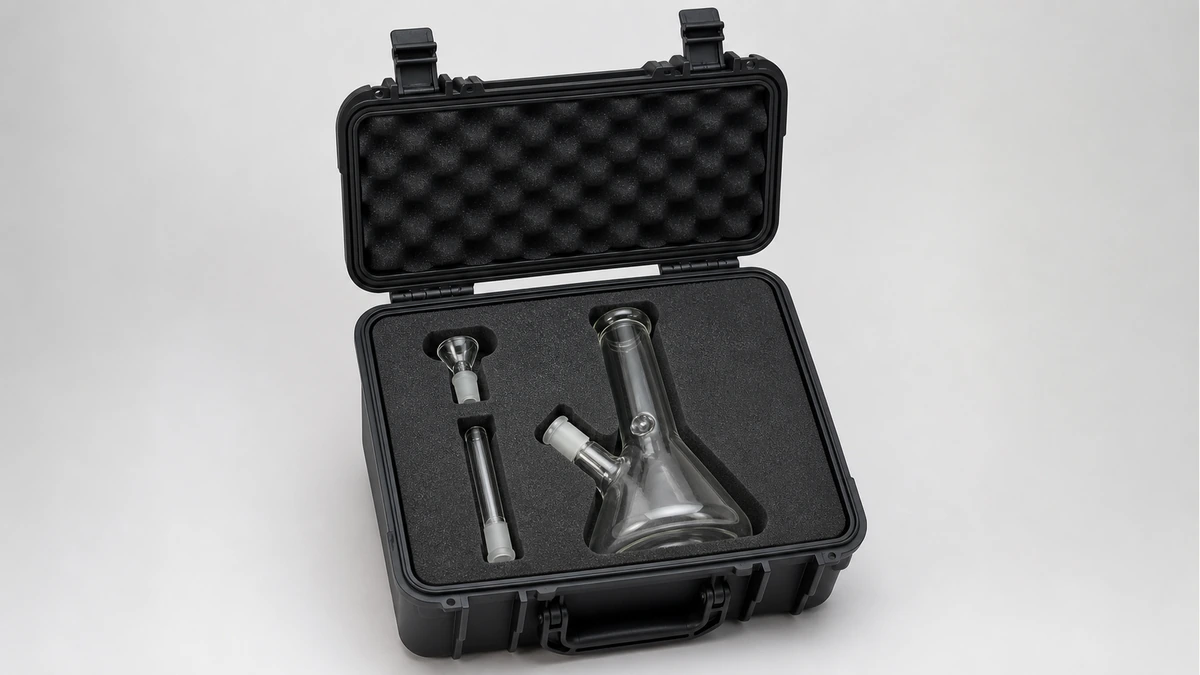
Once you have height, base diameter, tube diameter, and joint diameter, compare them against the interior cavity of the case — not the exterior dimensions printed on the box. Exterior measurements tell you whether the case fits in a bag or overhead bin; interior cavity measurements tell you whether your glass fits in the case. These are frequently confused on product pages, so when in doubt, measure a case you already own and use that as a reference point.
🧽 2. Foam should immobilize without pressing on joints
The goal of foam padding is to remove all axial and lateral play so the glass can’t travel even a few millimeters when the case is shaken or tipped. If you can hear or feel the piece shift when you gently rock the closed case, the foam cavity is too large for that piece, regardless of how thick or dense the foam itself is.
At the same time, foam should never be the thing making contact pressure at a joint, a ground-glass connection, or a thin blown-glass wall. Those areas are the most stress-concentrated parts of the piece — thin, often hand-blown, and shaped in a way that distributes load unevenly. A cutout that’s carved to hug the base and the lower tube, while leaving a small buffer of open space around the joint itself, protects the glass better than a cutout that presses foam against every surface equally. Some cases achieve this with a two-piece foam insert: a bottom layer shaped tightly to the base, and a top layer that closes down without ever touching the neck or joint directly.
Reddit threads on this topic consistently mention the same improvised fix — people wrapping a piece in a towel or hoodie and wedging it into a backpack pocket because they don’t have a case yet. That approach can work in a pinch precisely because soft fabric distributes pressure the same way good foam does: gently, around the sturdy parts, and never concentrated on a joint. It’s not a substitute for a properly sized case, but it explains the underlying physics that a case is trying to formalize.
🛡️ 3. Hard and soft cases protect against different forces
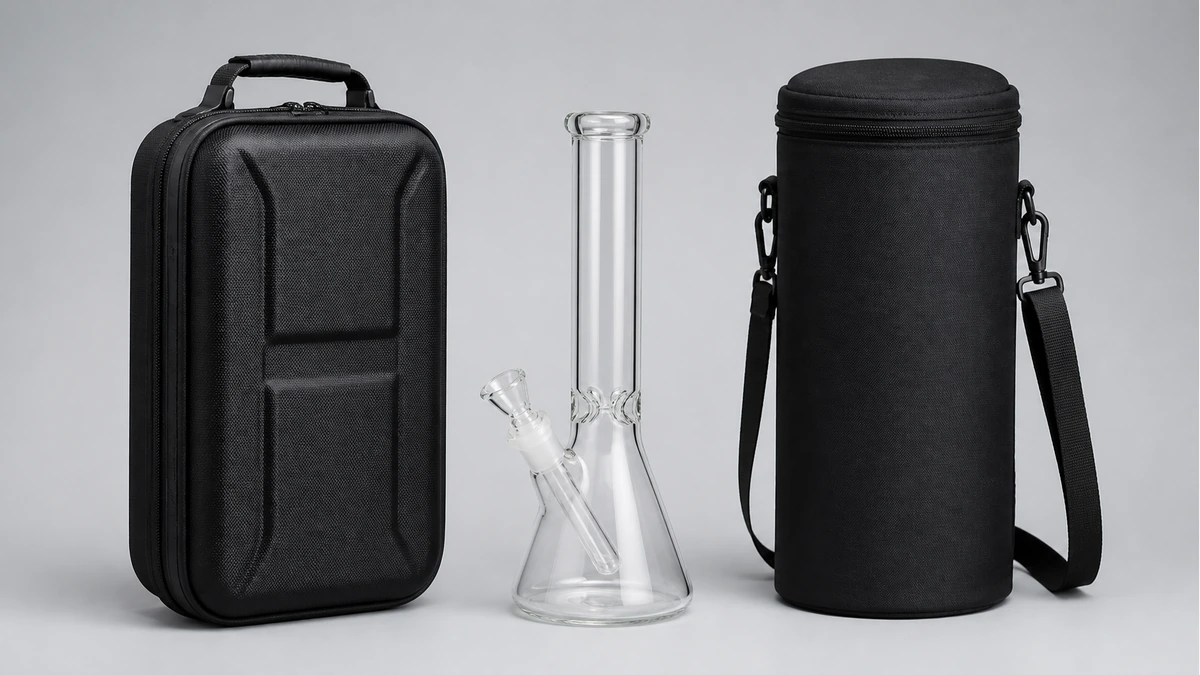
Hard-shell cases and padded soft bags aren’t just different price points on the same idea — they’re built to resist different kinds of force. A hard shell resists crushing: something set on top of the case, a car door closing against it, or a bag stacked underneath other luggage. The rigid exterior spreads that compressive load across the whole shell instead of letting it concentrate on the glass inside.
A soft, padded case doesn’t resist crushing the same way. Its foam or quilted lining absorbs shock from drops, bumps, and knocks, but if something heavy is set directly on top of it, that weight can still transfer through to the glass. Soft cases tend to be lighter and easier to fit into a backpack or duffel, which is part of why they’re popular for day trips, but they put more responsibility on the person carrying them to keep weight off the top and handle the bag carefully.
Neither style is universally better — they’re suited to different situations. A hard case makes more sense for checked luggage, shipping, or anywhere the case might get stacked under other items. A soft case makes more sense when you’re carrying it yourself and can control how it’s handled the whole way. If you’re weighing options for a dab rig instead of a bong, the same hard-versus-soft logic applies, and our portable dab rig guide goes into how rig height and torch storage affect that choice specifically.
🧩 4. Pack bowls and downstems in separate cutouts
Downstems and bowls are usually the first thing to break, and it’s rarely because of a hard hit — it’s because they were left loose in the same compartment as the tube and body. A downstem is long, thin, and often ground glass at both ends, which makes it fragile in exactly the direction it’s most likely to be jostled inside a shared cavity. A loose bowl piece rattling against the base of the bong can chip either surface within minutes of casual movement.
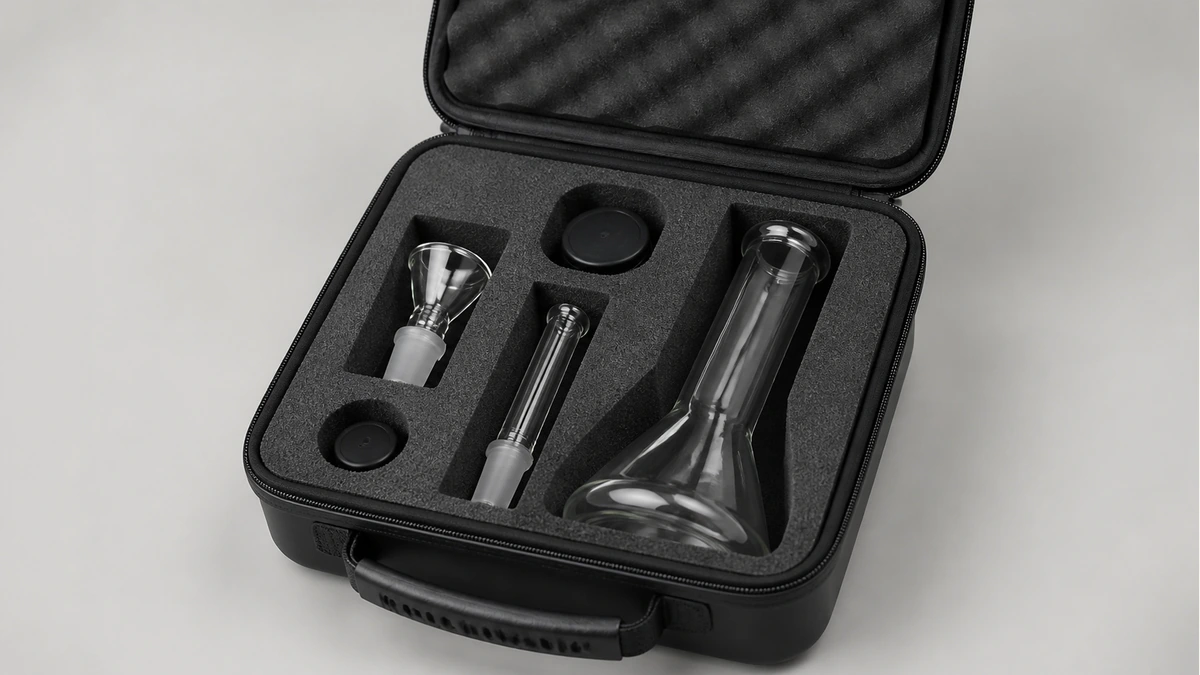
The fix is straightforward: separate cutouts, sized individually, so the downstem and bowl can’t contact the main body or each other. Cases built specifically for bongs usually include a narrow foam channel for the downstem and a small round cutout for the bowl, positioned away from the main cavity. If your case doesn’t have dedicated slots, a small padded pouch or a rolled cloth wrap inside a side pocket does the same job — the point is isolation, not any specific product.
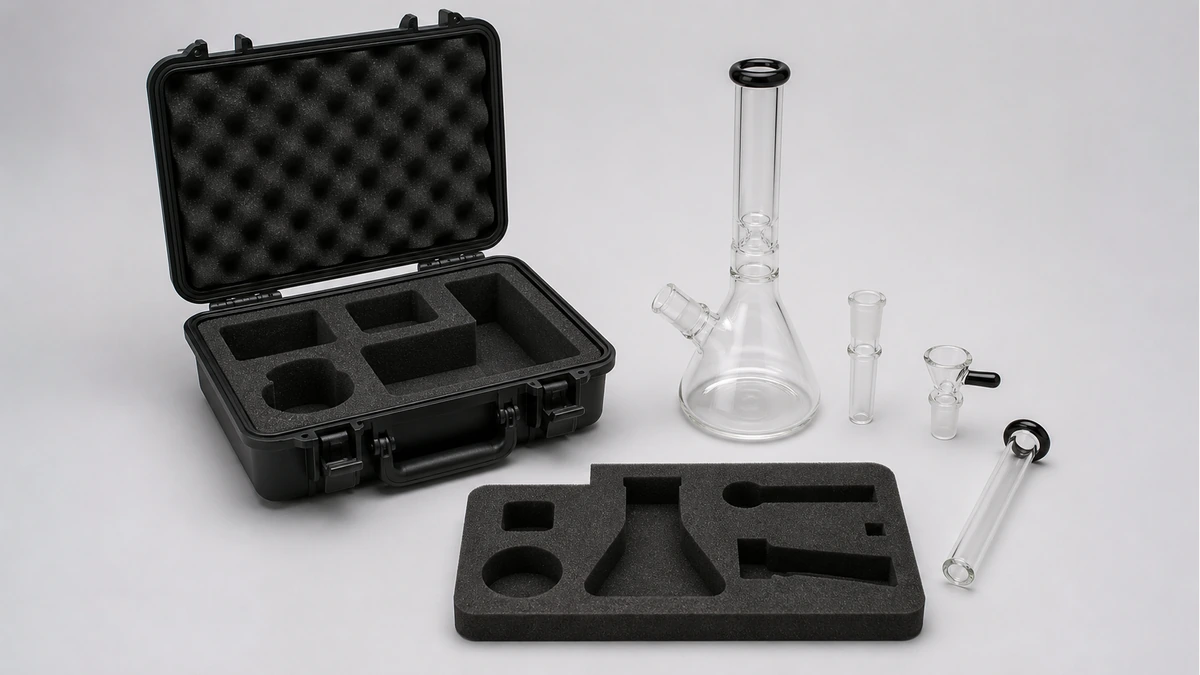
This is also where general hardware principles diverge from any single case’s instructions. The physical rule — isolate small, thin, ground-glass parts from the main body and from each other — applies across brands and styles. How a specific case implements that (a zippered mesh pocket, a foam-lined tube, a drawstring bag) is a design detail that varies, and it’s worth checking a case’s actual interior layout rather than assuming every model handles accessories the same way. For accessories that live at home between trips rather than traveling every time, a dedicated dab storage box keeps loose parts organized without needing a full travel case.
🧼 5. Only clean and fully dry glass belongs in the case
Packing a piece while it’s still wet — from a rinse, from resin buildup, or from leftover water in the base — creates problems that have nothing to do with impact protection. Trapped moisture inside a sealed foam cavity doesn’t evaporate; it sits against the glass and the foam lining for the duration of the trip. Foam that absorbs water can also lose some of its shock-absorbing structure over repeated soakings, which means a case that got packed wet once can protect less effectively the next time you use it.
Dry the piece fully before it goes in the case, including tipping out any residual water from the base and letting the joint area air out. This is a basic hardware-care habit, not something specific to any case brand, and it applies whether you’re using a hard shell, a soft bag, or a simple padded sleeve.
👃 6. Odor control is not the same as impact protection
A case marketed as smell-proof and a case built to protect glass from impact are solving two different problems, and a product that does one well doesn’t automatically do the other. Odor control depends on sealed seams, an airtight closure, and sometimes an activated-carbon lining — none of which has anything to do with how well the interior cushions a fragile object. A bag can be completely airtight and still let a bong knock against its own hard exterior with every step.
If odor containment is a priority alongside protection, look at the two features separately: does the case have a real foam-lined cavity sized to the glass, and separately, does it have a genuine sealed closure. Our guide to smell-proof bags for bongs covers what actually makes a bag airtight, which is a useful companion check if you’re evaluating a case that claims both properties. Treating “smell-proof” as a stand-in for “well-padded,” or vice versa, is a common assumption that doesn’t hold up once you look at how each feature is actually built.
✅ 7. A good case makes safe handling boring and repeatable
The best sign that a case is doing its job is that packing and unpacking becomes routine — the same piece goes into the same cavity, the accessories go into the same separate slots, and nothing shifts no matter how the case gets carried that day. That repeatability is what actually prevents damage over months of regular use, more than any single feature on a spec sheet.
Experienced owners who’ve cracked a joint or chipped a base once tend to describe the same pattern afterward: they stop treating the case as an afterthought and start treating the packing sequence itself as part of caring for the glass. Loose parts get separated every time. The piece is dry before it goes in. Nothing gets set on top of a soft bag. None of that requires an expensive case — it requires a case sized correctly for the piece and a habit of using it the same way every trip.
If you’re shopping for a case, start with the measurements from section one, decide whether crushing or dropping is the more realistic risk for how you’ll actually carry it, and confirm the accessory storage is separated from the main cavity before you commit. Everything else — color, brand, exterior styling — matters far less than whether the interior fits the glass you actually own.
📐 8. Build the foam layout around failure points
Place the clean, dry piece beside the case and identify its strongest broad surfaces and its weakest projections. The base and main tube can accept gentle support; a downstem joint, decorative arm, mouthpiece lip, or welded perc connection should sit in open clearance. Foam should stop movement before the glass reaches the case wall without squeezing those details.
For pluck foam, remove less than you think you need and test gradually. Leave an even buffer between the cutout and every outside wall. A narrow foam bridge can tear and let two accessories collide. If the lid foam compresses heavily to close, the cutout is too shallow or the case is undersized.
📦 8.1 Loose glass gets its own compartment
Remove bowls, downstems, bangers, and adapters that can lever against the main joint during a bump. Wrap or cushion each in a dedicated recess so parts cannot touch one another. Caps, tools, and cleaning accessories belong in separate washable containers, especially if they may carry residue.
Do a gentle movement test with the case closed and held over a soft surface. Nothing should rattle or shift. Open it and check for fresh pressure marks in the foam, which can reveal a stem or handle carrying the load.
🧼 8.2 Pack only after cleaning and drying
Foam is difficult to clean once it absorbs water or residue. Empty the bong, clean it according to its material, rinse completely, and allow hidden chambers to dry before packing. A case is not a substitute for cleaning and should not be treated as an odor-proof seal unless the manufacturer specifically defines and tests that function.
For lawful transport or storage, check the rules that apply where you are. The protective goal is straightforward: immobilize clean glass and handle it predictably, not conceal used equipment or evade inspection.