🧭 1. Why Mushroom Shapes Change More Than the Look
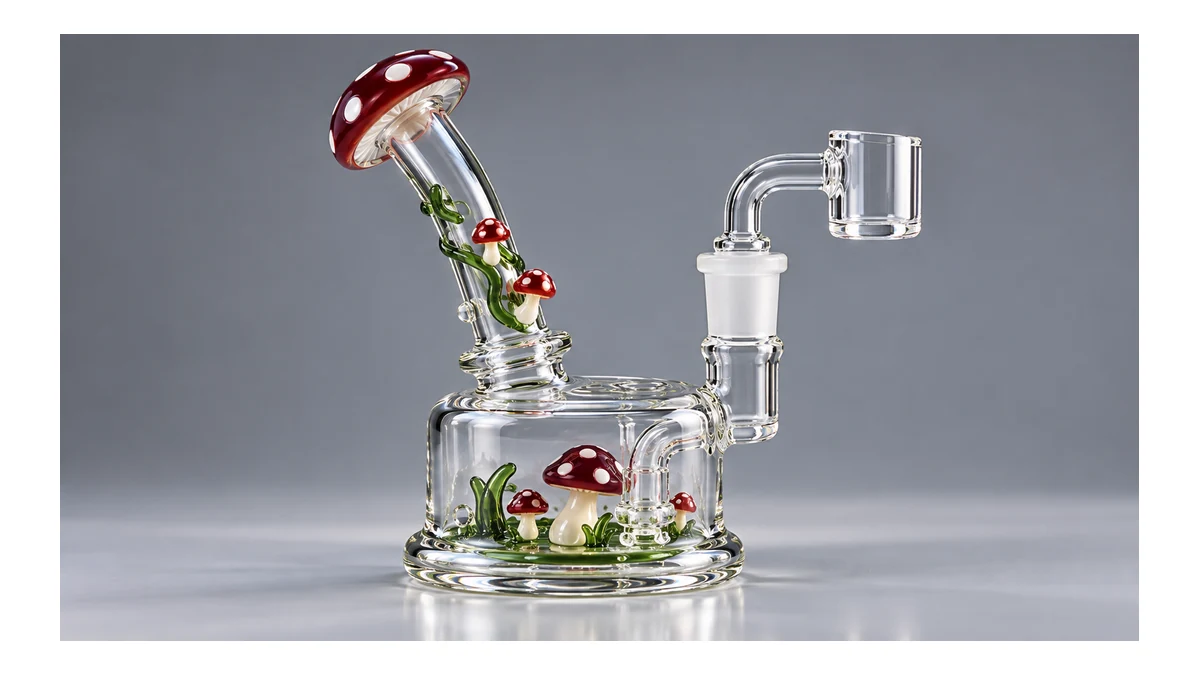
A mushroom dab rig starts as a normal piece of scientific glass and then gets a sculpted cap, stem, and sometimes a textured “gill” ring blown or cold-worked onto the outside. The decorative shell sits over a standard percolator tube or straight tube, so the piece reads as novelty glass to a shopper but still behaves as functional hardware once oil hits the nail. That distinction matters because buyers often assume the mushroom shape itself does something to vapor, when in most builds it is cosmetic glass wrapped around an ordinary chamber.
A final inspection should be done with the piece empty, cool, and viewed from several angles. Confirm that decorative glass does not hide a stress line, block the joint, or prevent the base from sitting flat. These observations keep the visual theme separate from measurable hardware details.
People shopping this style frequently run into the same confusion: what part is actually the “cap” in glassblowing terms, where does the functional joint sit relative to the decorative dome, and whether the rounded mushroom top changes how a banger or carb cap seats. None of that is answered by looking at a photo. It requires tracing the inner tube from the joint down to the water chamber and ignoring the outer sculpting entirely when judging fit.
🧩 1.1. Where the Decorative Shell Meets the Functional Tube
On most mushroom rigs, the cap is a separate bubble of glass fused around the neck, and the stem below it is the actual diffuser or straight tube carrying smoke down to the water. The mushroom “gills,” when present, are usually just raked or combed color work on the surface of the cap and carry no airflow function at all.
This is the terminology gap that trips up new buyers: calling the whole piece a “cap” when only the top dome is the cap, or assuming the widest point of the mushroom shape marks the chamber’s true volume. Chamber volume is set by the inner tube diameter and water line, not by how wide the glass flares out for visual effect.
🧩 2. Balance and Handling When the Cap Overhangs the Base
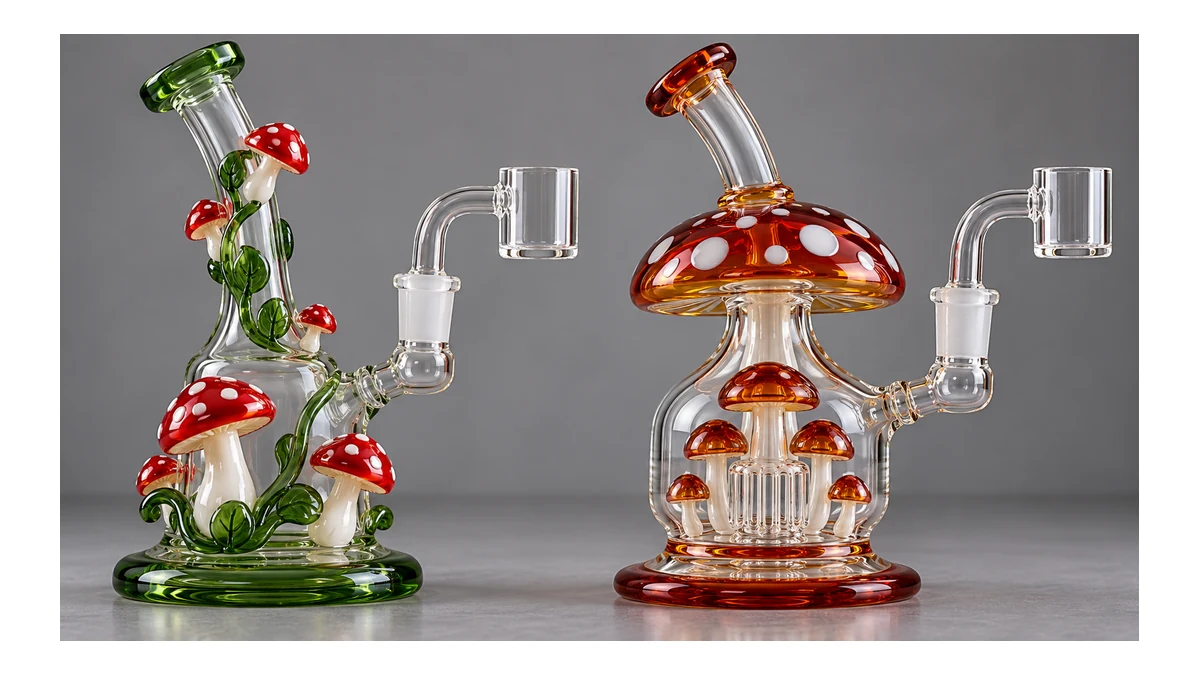
A mushroom cap that flares wider than the base foot shifts the piece’s center of gravity upward and outward. Add a banger, a carb cap, and a dabber resting on top during a session, and the top-heavy geometry becomes noticeable the moment the rig is bumped or set down off-center.
This is a straightforward physics problem rather than a design flaw, but it means the base diameter relative to cap diameter is a real functional spec, not a cosmetic detail. A base that looks proportionate in a product photo can still be unstable if the cap overhang extends well past the foot’s edge.
📏 2.1. Grip Points and Tipping Risk During a Session
Because the cap is the widest and often heaviest section, it’s tempting to grip the rig there, which raises the hand’s leverage point above the center of mass and makes tipping more likely rather than less. The more stable habit is gripping low, near the base or the neck just above it, where the leverage arm is shortest.
A few practical handling points worth checking before buying or using a mushroom rig:
- Base diameter should be close to or wider than the cap’s widest point for tabletop stability.
- A flat, thick foot resists tipping better than a rounded or narrow pedestal base.
- Rigs with an especially broad cap benefit from a felt-lined stand rather than sitting directly on a hard surface.
📏 3. Airflow Paths Through a Sculpted Chamber
The sculpting around the joint is where mushroom styling most often intersects with actual function. Some cap designs wrap glass close enough to the joint that a torch has less clearance to heat a banger evenly, or that a carb cap’s flat underside can’t sit flush because the decorative dome is in the way.
Airflow itself, once smoke reaches the inner tube, works the same as any other rig of that percolator type. The mushroom shape doesn’t add diffusion; it just determines how much room is left around the joint for tools and heat to operate without interference.
🌬️ 3.1. Joint Clearance and Percolator Placement
Standard joint sizes still apply to mushroom rigs, so checking 14mm versus 18mm and male versus female fit before buying accessories is unchanged from any other rig type. What does change is the working space immediately around that joint. A cap that curves in tight overhead can limit how far a carb cap’s handle swings or how close a torch tip can get without scorching decorative glass nearby.
For buyers comparing joint specs across pieces, a general reference like this joint-size and fit guide is useful for confirming compatibility before assuming a mushroom cap’s shape has changed the underlying standard.
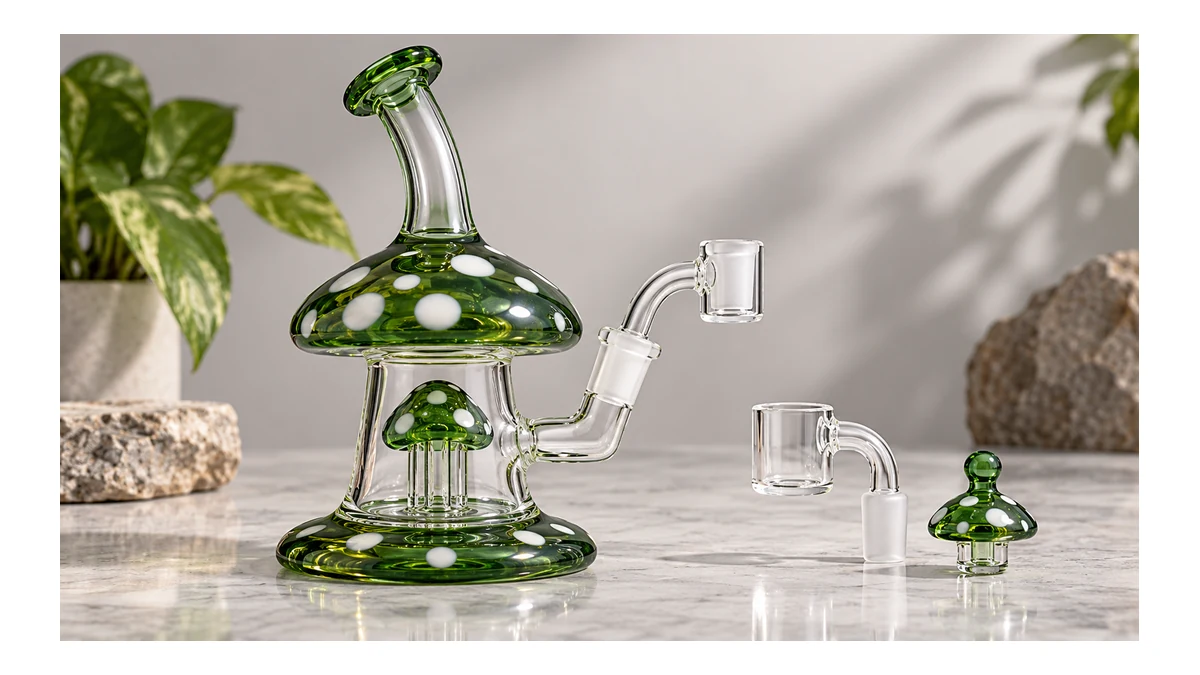
Percolator placement inside the stem is worth checking separately from the cap design. A mushroom rig with a simple straight tube will pull differently than one built around a showerhead or honeycomb percolator, and that choice sits in the hidden inner tube, not in the visible sculpted shell.
🌬️ 4. Cleaning Access in Curved, Narrow Necks
Sculpted necks that taper in under the mushroom cap restrict how far a cleaning brush or pipe cleaner can reach. Buildup tends to collect right at that narrowing point, where a straight brush stroke turns into an awkward angled scrub.
Marbled or dusted decorative coatings, common on this style, are on the outside of the glass and don’t affect residue buildup inside the tube, but they do make it harder to see discoloration building up through the wall from the outside, since the surface pattern hides staining that would otherwise be an obvious cue to clean.
⚖️ 4.1. A Practical Cleaning Sequence for Sculpted Necks
| Step | Action | Why it matters for mushroom shapes |
|---|---|---|
| 1 | Empty and rinse with warm water immediately after use | Prevents residue from setting in the narrow neck taper |
| 2 | Add isopropyl alcohol and coarse salt, cover joint and mouthpiece | Salt abrasion reaches curved sections a brush can’t access directly |
| 3 | Shake gently, tilting to cover the cap interior and stem equally | An off-axis cap shape needs more tilting angles than a straight tube |
| 4 | Rinse thoroughly and check the narrowest neck point for residue | This is the point most likely to trap buildup unnoticed |
For pieces with an especially tight neck under the cap, a flexible bottle brush reaches further than a rigid one and is worth the switch. More general upkeep steps are covered in this rig cleaning walkthrough, which applies the same logic to any narrow-neck design.
⚖️ 5. Storage, Transport, and Stand Compatibility
A top-heavy mushroom rig needs a stand or case built around its actual weight distribution, not just its footprint. Generic pipe stands sized for straight tubes can leave an overhanging cap unsupported, letting the piece rock on a single contact point.
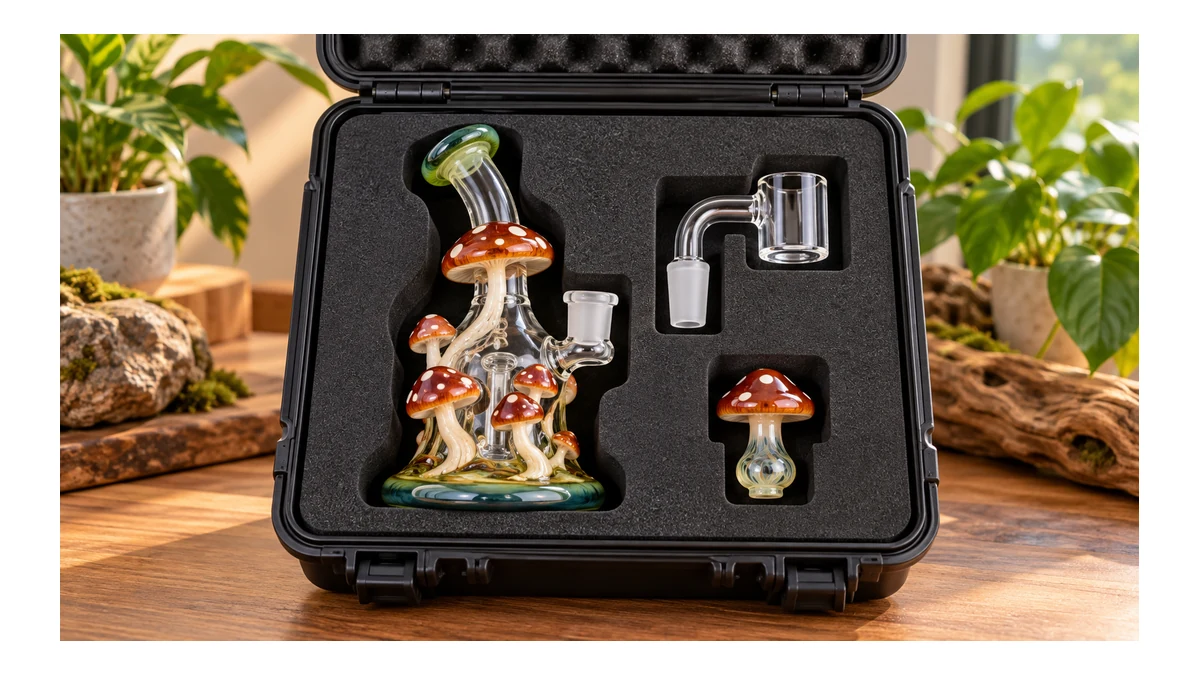
Transport cases have a similar issue: padding designed for a uniform cylindrical rig may not account for a wide cap that needs its own cradle space separate from the base.
🧼 5.1. Matching a Stand or Case to Cap Diameter
Before assuming a stand designed for straight tubes will work, measure the mushroom cap’s widest point and compare it against the stand’s cradle opening. A cradle that’s too narrow forces the cap to rest on its edge rather than sitting level, which reintroduces the tipping risk from section 2 even when the rig is technically “in” a stand.
A soft-sided case with adjustable dividers, rather than a fixed foam cutout, tends to handle irregular mushroom silhouettes better since the cap and base rarely share the same centerline in a rigid cutout. Reference specs for stand and case sizing are laid out in this storage compatibility overview for readers comparing options across different mushroom cap widths.
🧼 6. Practical Checklist for Identifying Functional Mushroom Hardware
Sculpted mushroom glass can be well-built functional hardware or a piece where decoration has outpaced practical clearance. The difference shows up in a handful of measurable details rather than in how elaborate the cap artwork looks.
| Check point | What to look for |
|---|---|
| Base-to-cap ratio | Base diameter at or near the cap’s widest point |
| Joint clearance | Enough open space around the joint for a torch and carb cap to move freely |
| Neck taper | Wide enough to pass a flexible brush for cleaning |
| Inner tube type | Confirmed separately from the outer mushroom shell, since it determines actual airflow behavior |
| Stand or case fit | Cradle or cutout sized to the cap, not just the base footprint |
Judging a mushroom dab rig by these five points, rather than by the sculpting alone, is the most reliable way to tell whether the decorative shape sits on top of solid functional geometry or was fused on without much thought to the hardware underneath it.
🔍 7. 🍄 Decorative Volume Can Hide the Functional Chamber
A mushroom silhouette may be formed by the chamber, the neck, an external sculpture, or all three. Only the internal air and water path determines function. Trace the route from the inlet joint through the diffuser, water volume, neck, and mouthpiece. Decorative lobes that do not participate in that path add mass and cleaning surfaces without adding diffusion.
That distinction matters when two rigs share a similar theme but behave differently. One may use a simple round chamber with external colored glass; another may route air through a sculpted cap or stem. Photographs show the outline, but a side view and a clear view of the internal tube are needed to identify the actual chamber.
🧲 7.1. ⚖️ Sculpture Changes the Center of Gravity
Glass caps, stems, and applied details can place weight above or beside the base. Add the quartz banger and cap while everything is cold, then confirm that the completed assembly rests flat. Rotate the joint accessory through its normal positions. A visually wide shape is not necessarily stable if its contact footprint is narrow.
🌊 7.2. 🧩 Clearance Is a Three-Dimensional Fit
The banger must clear decorative glass during insertion, heating, capping, and removal. Check joint angle, bucket diameter, neck height, and cap overhang together. If an adapter is required, remember that it raises the load and increases leverage on the joint. The shortest compatible stack usually places less stress on compact sculptural glass.
✅ 7.3. 🧼 Cleaning Access Should Be Visible Before Use
Deep grooves and narrow decorative cavities can trap liquid or residue even when they are outside the primary chamber. Look for a direct drain path and openings large enough to rinse. Avoid forcing tools around delicate applied details. A protective case needs clearance for the sculpture as well as separate spaces for rigid heat parts.
🧲 8. 🔍 Treat Theme and Hardware as Separate Descriptions
“Mushroom dab rig” describes visual language, not a joint standard, heater, or airflow specification. A useful listing still needs the joint size and gender, base dimensions, chamber path, material, accessory clearance, and included components. Those details let the reader evaluate the hardware without assuming that a decorative theme predicts performance.
Color also deserves a separate check from construction. Colored borosilicate, surface-applied decoration, painted accessories, and removable silicone accents age differently and tolerate different cleaning methods. A photograph may not show which technique was used. Product documentation should identify the glass and any non-glass surface treatment, especially around the joint, mouthpiece, and areas handled during cleaning.
Finally, check how the piece can be set down between cleaning steps. A sculpted chamber with an uneven exterior may roll or rest on delicate details when the joint is empty. A stable cold-service position reduces accidental contact between the glass and hard surfaces. This practical detail belongs in the hardware evaluation even though it rarely appears in a front-facing product image.