🧭 1. Why a Mason Jar Can Double as a Water Pipe Chamber
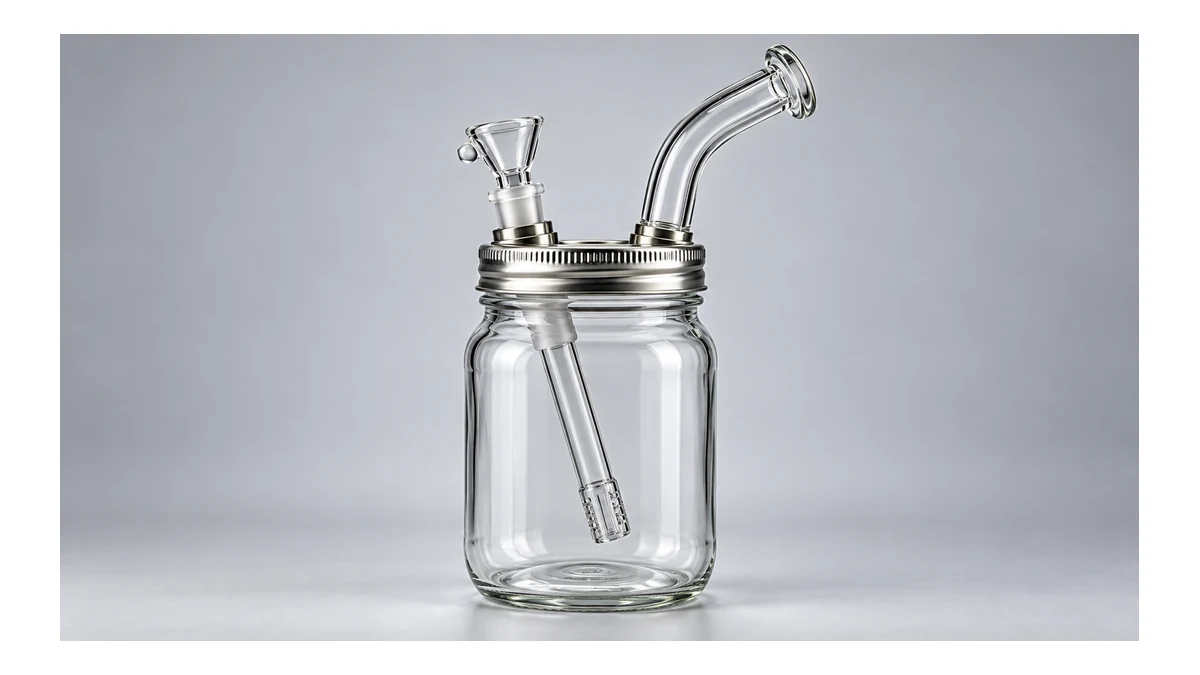
A recurring point of confusion in home-built water pipe projects is why a mason jar that looks identical to another one on a shelf performs completely differently once it’s fitted with a lid and a downstem. Some builds hold a seal and pull smoothly. Others leak air at the lid, wobble on the table, or clog with residue within a few uses. The jar itself is just a glass chamber — it has no inherent “water pipe” function. What actually determines performance is the hardware bolted onto it: the lid, the gasket inside that lid, the downstem that carries air into the water, and the base that keeps the whole thing upright.
Open-source and hobbyist builds, including 3D-printed lid adapters and pint-sized portable versions, all wrestle with the same four physical problems: how to seal a threaded jar mouth without cracking the lid, how to angle a downstem so it clears the glass without hitting bottom, how to diffuse air into small bubbles without choking airflow, and how to keep a round-bottomed or shoulder-tapered jar from tipping. None of these are jar problems. They’re hardware-fit problems, and each one has a mechanical cause.
🧩 2. The Lid Is the Control Point: Threads, Gaskets, and Seal
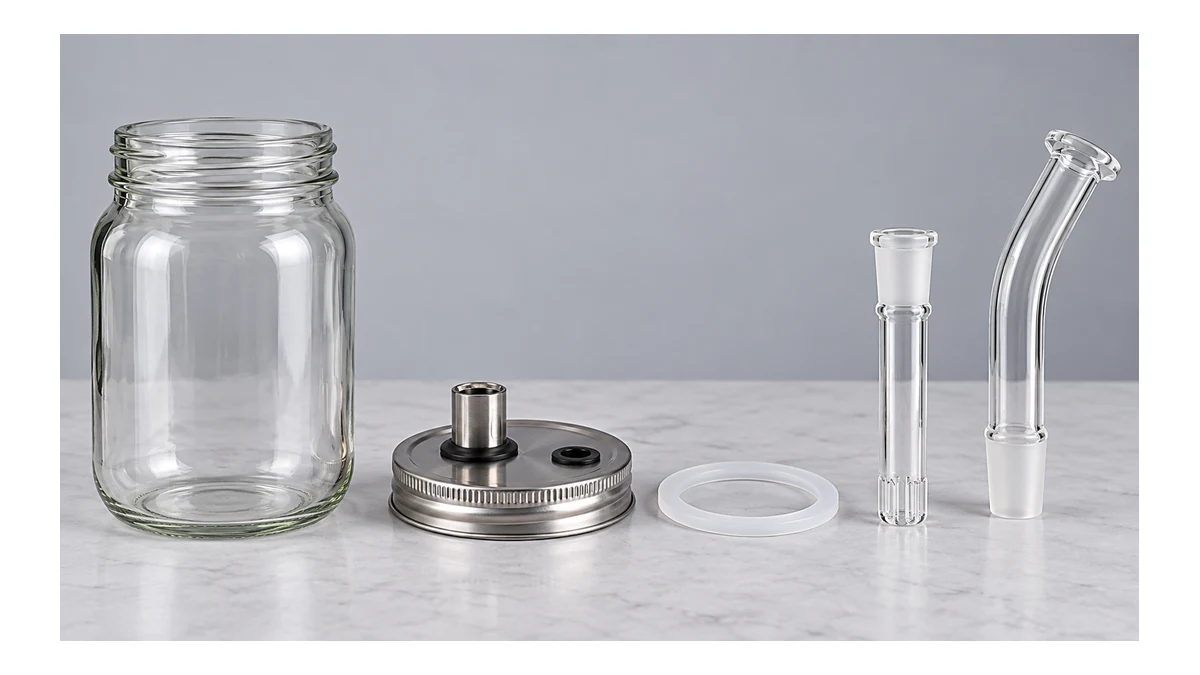
The lid is where a mason jar either becomes a functional chamber or fails outright. Canning jars come in a narrow set of standard thread patterns — regular mouth and wide mouth — and the lid has to match that thread exactly. A lid that’s slightly off-pattern will thread partway, feel tight, and still leak, because the sealing ridge never lands flush against the jar’s rim.
📏 2.1. Two-Piece Bands vs. One-Piece Lids
Standard canning lids are a two-piece system: a flat metal disc with a rubber compound ring around its underside, held down by a separate threaded band. That disc was engineered to flex slightly under vacuum pressure during food preservation, not to hold a drilled port under repeated mechanical stress. When builders drill a hole in the disc for a downstem or grommet, the thin metal around the hole is prone to flexing, cracking, or losing its flat seating surface over time.
A one-piece lid — thicker plastic or metal, molded or machined with a pre-formed port — distributes stress more evenly around the opening. It holds its shape under the twisting and pulling that happens every time a downstem is inserted or removed, which is why most purpose-built adapters use this style instead of a modified canning disc. For a breakdown of lid types and their compatible thread patterns, see bong water-level guide.
🌬️ 2.2. Gasket Material and Seal Fatigue
The gasket, usually a silicone or rubber grommet seated in the lid’s port, is what actually seals against the downstem’s shaft. Silicone tolerates repeated flexing and mild heat better than standard rubber, which stiffens and cracks after enough insertion-and-removal cycles. Even a correctly sized grommet will eventually fatigue at the exact point where the downstem pivots during use, since that’s the spot under the most repeated mechanical load.
Fit matters as much as material. A grommet with an inner diameter even slightly larger than the downstem’s outer diameter won’t compress enough to seal, and air gets pulled in around the joint instead of through the water. This shows up as a weak, airy draw that has nothing to do with the jar and everything to do with a half-millimeter mismatch at the lid.
📏 3. Downstem Angle, Length, and Diffuser Placement
Once the lid seals, the downstem determines whether the water actually does anything. Downstems are rigid, so their angle and length have to be matched to the specific jar’s interior dimensions — there’s very little room for adjustment after the fact.
🌬️ 3.1. Angle and Clearance Inside the Jar
Most downstems use a fixed bend, commonly somewhere between 45 and 90 degrees, to route air from a centered lid port down toward the jar’s interior wall or base. In a mason jar, the lid opening is dead center, but the jar’s usable water sits below the shoulder taper on a standard jar or straight down on a wide-mouth jar. A downstem angled for a straight-sided jar can jam against the shoulder curve of a regular mason jar, or fall short of the water line entirely, leaving air to bubble out above the surface instead of through it.
Length is just as constrained. A downstem cut too long hits the jar’s flat bottom, which can crack glass under torque or block the diffuser openings against the base. Cut too short, and the diffuser sits above the water line, doing nothing but venting air straight into empty headspace.
⚖️ 3.2. Slit Count and Bubble Behavior
The diffuser end of the downstem — the slitted or holed section submerged in water — controls bubble size. More slits generally produce smaller, more numerous bubbles, which increases the surface area of air in contact with water. That added contact comes with a tradeoff: more slits also means more resistance to airflow, since the air has to squeeze through smaller openings. A downstem with too few slits produces large, fast-rising bubbles that barrel through the water with minimal contact time; one with too many can make a jar feel difficult to draw through. Builders working with printed or improvised diffusers are effectively balancing these two variables against each other every time they change the hole pattern.
🌬️ 4. Base Geometry and Stability on a Flat Surface
A mason jar’s base geometry is fixed by its manufacturing shape, and that shape interacts directly with how top-heavy the finished piece becomes once a lid, downstem, and any added fittings are attached. Wide-mouth jars have a larger base diameter relative to their height than many regular-mouth jars of the same volume, which gives them a lower center of gravity and more resistance to tipping. Tall, narrow pint or half-pint jars sit higher and narrower, so the same amount of added weight at the lid has a proportionally bigger effect on balance.
The shoulder taper common to classic mason jar shapes also matters. A tapered shoulder shifts the widest point of contact with a hand or surface away from the true base, which can make the jar feel less planted even when the base itself is stable. Flat-bottomed, straight-sided jars — the shape used in most wide-mouth pint and quart jars — tend to sit more predictably because the entire base ring makes contact with the surface, rather than a narrower curved foot. For more on matching base shape to stability needs, see bong cleaning kit guide.
⚖️ 5. Cleaning Around Threads, Corners, and Grommets
Residue buildup in a mason jar water pipe concentrates in a few predictable spots: the threads at the jar’s mouth, the underside of the lid where the grommet seats, and — on jars with shoulder tapers rather than straight sides — the curved transition where the shoulder meets the body. Threads trap residue in their grooves, which is difficult to reach with a straight brush and often requires a pipe cleaner or cotton swab worked around the spiral.
The grommet itself is a common trouble spot because residue can work its way between the grommet and the lid port, where it’s hidden from view and harder to flush out with a simple rinse. Straight-sided jars are comparatively easier to clean end-to-end than shoulder-tapered ones, since a brush or cloth can reach the full interior surface without navigating a curve.
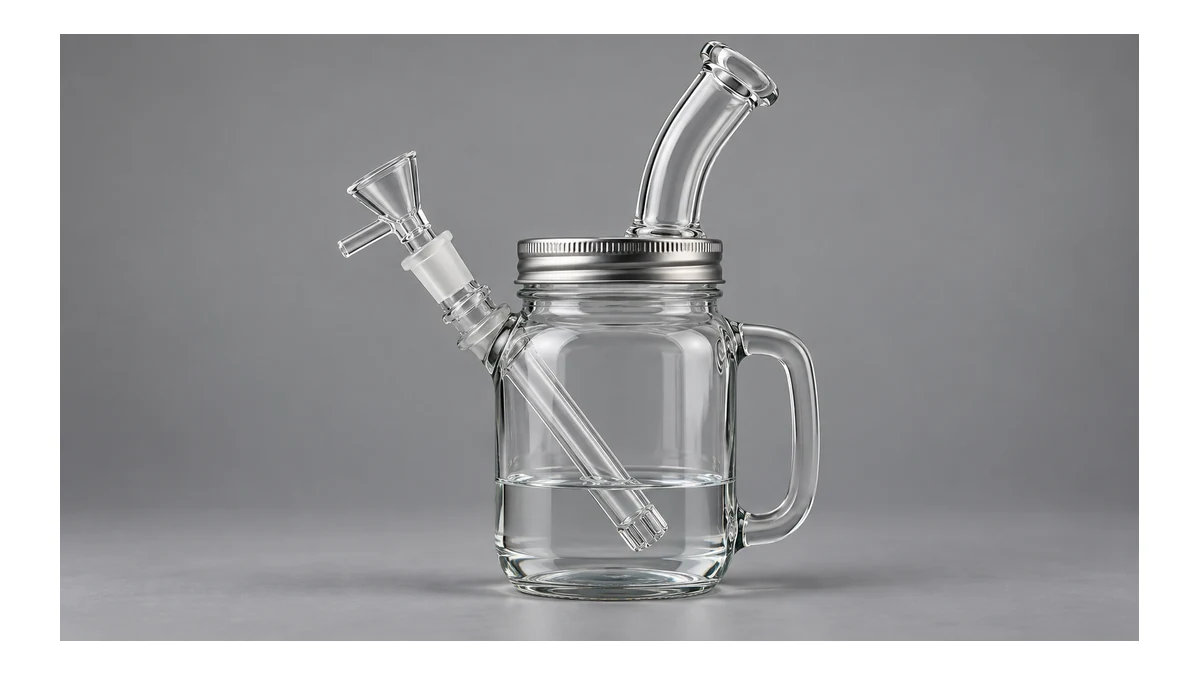
One advantage of using glass mason jars specifically is visibility — residue buildup is easy to spot through clear glass, which makes it obvious when cleaning is overdue in a way that opaque materials don’t.
🧼 6. Sorting Out the Terminology: Jar Sizes, Grommets, and Fittings
A lot of fit confusion in mason jar builds traces back to inconsistent terminology rather than the hardware itself. The table below lays out the distinctions that matter most when matching a lid, grommet, or downstem to a specific jar.
| Term | What It Refers To | Why the Distinction Matters |
|---|---|---|
| Regular mouth vs. wide mouth | Two standard thread-and-opening diameters used across most mason jar brands | Lids and bands are not interchangeable between the two; a regular-mouth lid will not seal on a wide-mouth jar |
| Grommet | A flexible ring, usually silicone or rubber, seated in a drilled or molded port to seal around a downstem | Often confused with a gasket, which seals flat surfaces rather than around a shaft passing through a hole |
| Gasket | The flat sealing ring under a canning lid disc, or any flat-surface seal | Provides a flat seal between lid and rim, not a seal around an inserted stem |
| Downstem | The rigid tube carrying air from the lid port into the water | Distinct from the diffuser, which is only the slitted or perforated end of the downstem |
| Diffuser | The perforated section at the submerged end of a downstem | Slit count and size, not overall downstem length, control bubble size |
Getting these terms straight matters most when sourcing replacement parts, since a search for “gasket” when the actual failed part is a grommet — or vice versa — leads to buying the wrong component entirely. A reference chart of standard jar thread diameters by size is available at glass screen guide.
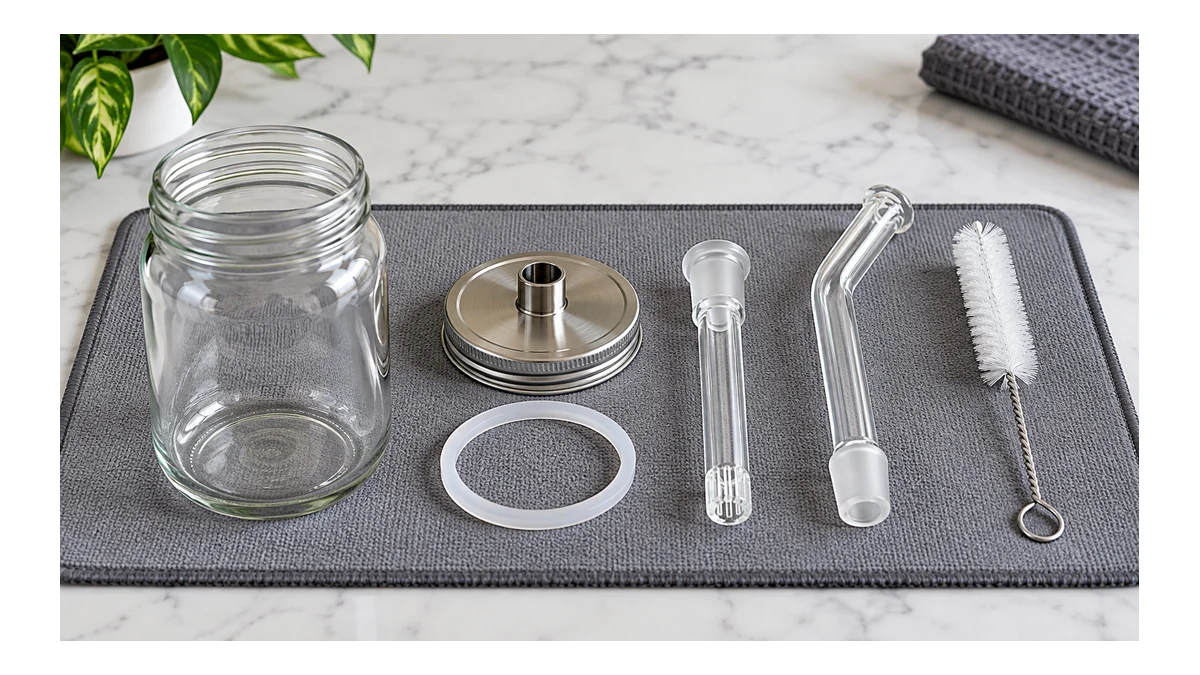
When evaluating any mason jar water pipe setup, the fastest way to identify what’s actually wrong — or what to look for before assembling one — is to check each hardware point in order: confirm the lid’s thread pattern matches the jar exactly, verify the grommet’s inner diameter compresses snugly around the downstem’s outer diameter, check that the downstem’s angle and length clear the jar’s interior shape without hitting the shoulder or base, and assess whether the jar’s base diameter relative to its height gives it a stable, low center of gravity. A problem traced to one of these four points, rather than to the jar itself, is almost always fixable without replacing the jar at all.
🔍 7. 🧩 The Lid Is the Structural Interface
A mason jar contributes a stable vessel and standardized screw thread, but the lid converts that container into a water pipe. The lid must locate the downstem and mouthpiece, keep them from rotating, and maintain a seal without sending excessive clamping force into the glass rim. A loose opening leaks air; an over-tight or poorly supported fitting can load the lid unevenly.
Inspect the gasket as a separate part. It should sit flat, remain compatible with routine cleaning, and avoid protruding into the air path. If the lid is metal, its cut edges and coating deserve attention because condensed moisture collects underneath. If it is polymer, stiffness around the stem opening matters more than a soft feel elsewhere.
🧲 7.1. 📐 Downstem Angle Controls More Than Appearance
The lower end of the stem must stay submerged when the jar sits on its actual base. A steep angle can push the diffuser close to the wall; a shallow angle may demand more water before every opening is covered. Either case changes drag and splash. Assemble the cold parts, add water gradually, and use a dry pull to establish the lowest complete-coverage level.
🌊 7.2. 🧼 A Replaceable Jar Does Not Eliminate Cleaning
The jar may be easy to swap, but the lid, gasket, stem, and mouthpiece still collect residue. Clean those interfaces separately and let them dry before reassembly. Trapped moisture beneath a threaded lid can create odor and makes it harder to see whether a seal is actually clean.