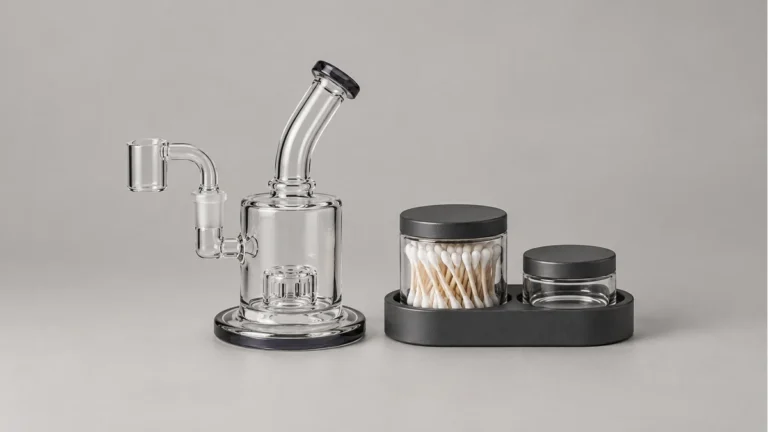
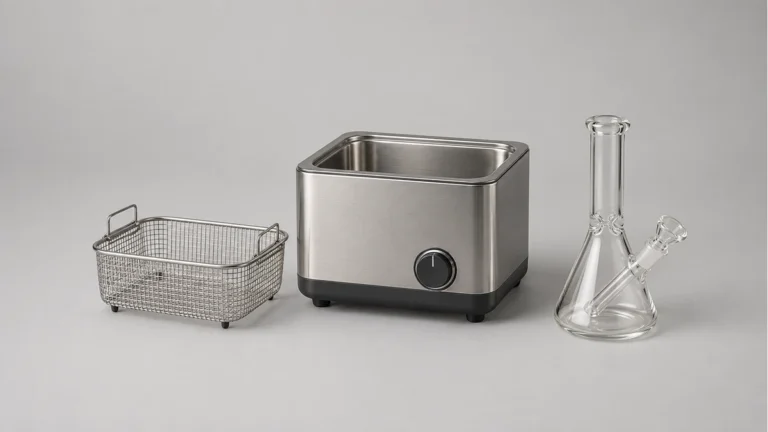
Writing a 1,950–2,100 word HTML fragment covering mini bubbler water pipe geometry and hardware differences, with the required emoji-numbered headers, four image markers, and three link markers placed naturally.
Search interest around palm-sized glass has climbed alongside travel-friendly and space-conscious setups, and most of the questions people ask boil down to hardware basics: how much water a small chamber actually needs, whether a mini bubbler behaves differently from a dry hand pipe, and what joint size to expect before buying an attachment sight unseen. None of that requires guesswork. Mini bubblers follow the same physics as their full-size counterparts, just compressed into a smaller footprint, and understanding that compression is what separates a stable piece from one that tips, floods, or clogs.
🫧 1. What Actually Makes a Bubbler “Mini”
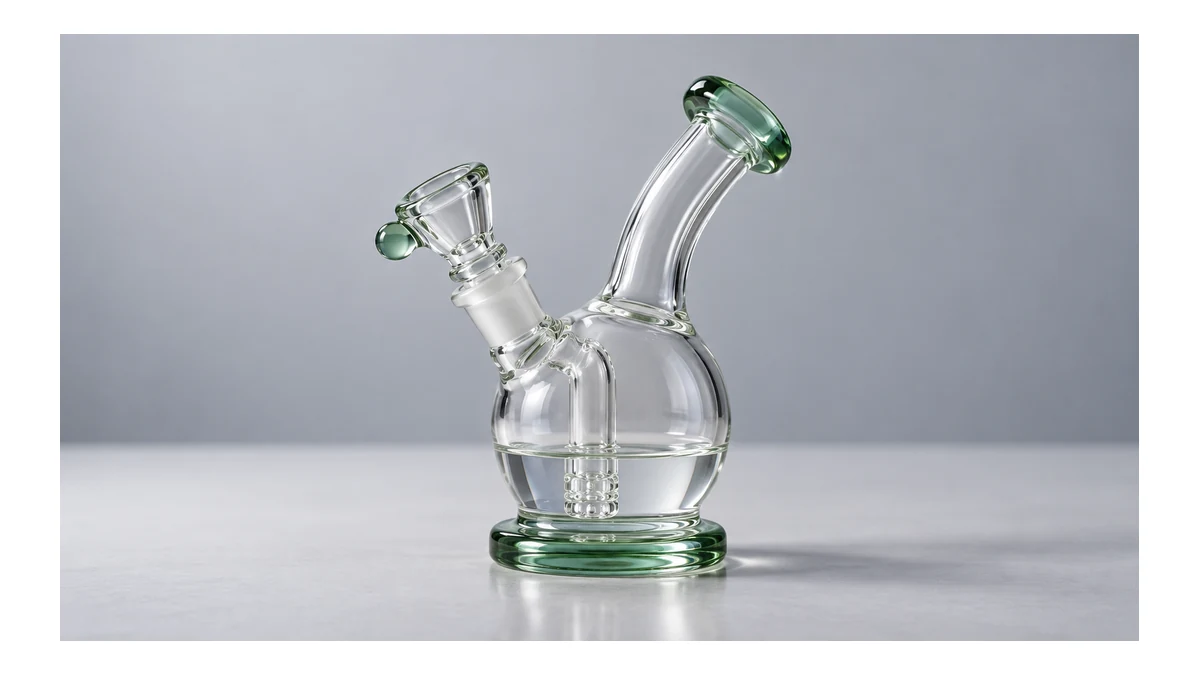
The word “mini” refers to internal water volume, not just overall height. A standard bubbler chamber typically holds somewhere in the range of a shot glass of water — enough to submerge a downstem tip by a few millimeters. A mini version shrinks that chamber, sometimes to less than half the volume, which means the water-to-air ratio inside changes even if the piece looks proportionally similar from the outside.
This matters because chamber volume determines how much airspace sits above the waterline. Full-size bongs have a tall neck that gives vapor room to cool and expand before it reaches the mouthpiece. Mini bubblers compress that neck, so the same amount of water that would sit comfortably in a larger chamber can crowd the airspace in a smaller one. Manufacturers account for this by scaling down recommended fill lines proportionally, not just shrinking the glass and leaving fill volume unchanged.
📏 2. Mini Bubbler vs. Dry Pipe vs. Full-Size Bong
People frequently ask whether a mini bubbler is “basically a dry pipe with water” or “a tiny bong,” and the honest answer is that it borrows structural traits from both without being identical to either. The table below breaks down the practical differences in hardware terms.
| Feature | Dry Hand Pipe | Mini Bubbler | Full-Size Bong |
|---|---|---|---|
| Water chamber | None | Small, fixed | Large, often removable base |
| Downstem | None | Fixed or slide-fit, short | Removable, longer |
| Neck height | N/A | Short | Tall |
| Splashback risk | None | Higher if overfilled | Lower due to headroom |
| Joint size range | N/A | 10mm–14mm common | 14mm–18mm common |
| Portability | Highest | High | Low to moderate |
The bubbler sits in the middle because it adds water filtration and diffusion — the two things a dry pipe lacks — while keeping the compact single-piece build that makes it easy to carry. It gives up the tall neck and often the removable downstem that full-size bongs use to manage airflow and cleaning.
🌊 3. Water Line and Splashback in Small Chambers
Splashback — water pulling up into the neck or mouthpiece during a draw — is the single most common complaint tied to compact chambers, and it almost always traces back to overfilling. Because a mini chamber holds less total volume, a fill line that would be perfectly safe in a full-size base can push water dangerously close to the joint in a mini piece.
A reliable way to judge fill level on unmarked glass is to check that the downstem or fixed stem tip sits submerged by only a few millimeters, not fully buried. If the tip sits deep in the water, the piece needs less liquid, not more. Some mini bubblers include an etched fill line on the chamber wall; when present, that line reflects the manufacturer’s tested balance between filtration and airspace, and it should be treated as the ceiling rather than a target to exceed.
⚖️ 3.1. Why Overfilling Causes Splashback
Every draw pulls air (and vapor) through the water, creating bubbles that rise and momentarily displace liquid upward. In a tall neck, that displaced water has room to fall back before it reaches the mouthpiece. In a short mini neck, there’s less vertical distance for it to settle, so any excess volume increases the odds it reaches the top. This is a geometry problem, not a design flaw — it’s the direct tradeoff for a smaller, more portable chamber.
⚖️ 4. Joint Size and Fit for Attachments
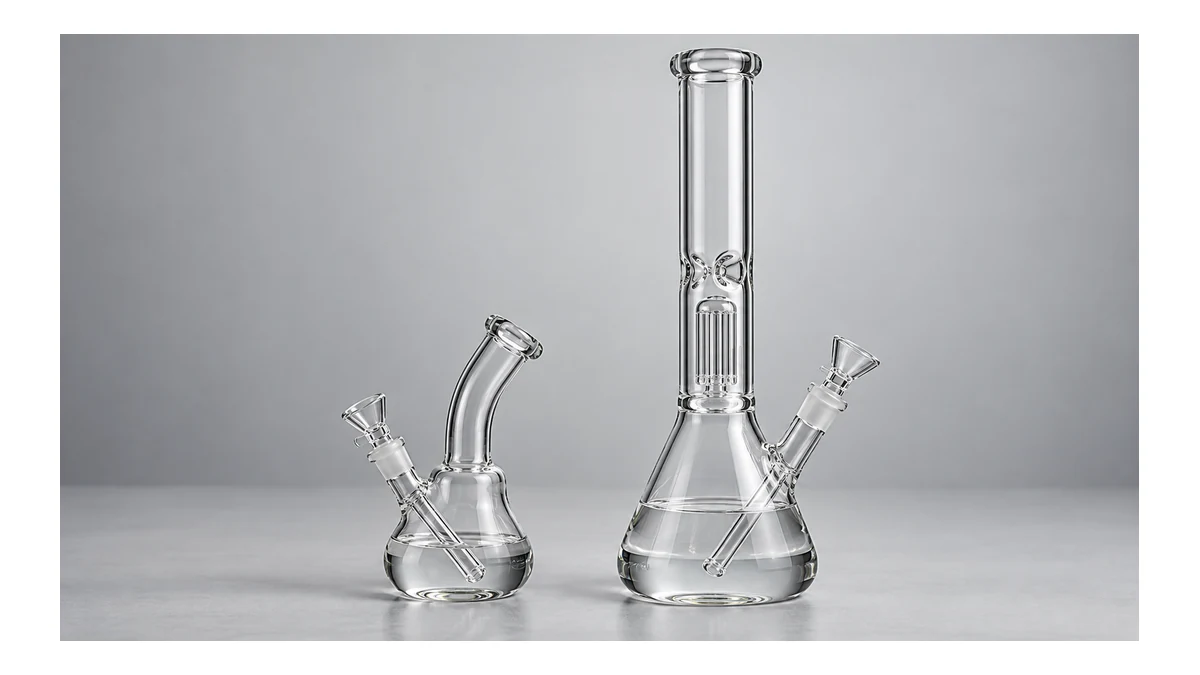
Joint size confusion is common when someone wants to pair a mini bubbler with a separately purchased bowl, downstem, or adapter. Mini pieces most often use 10mm joints, with some models stepping up to 14mm to stay compatible with more widely available accessories. Full-size bongs more commonly use 14mm or 18mm, which is why a bowl piece from a larger setup usually won’t drop into a mini bubbler without an adapter.
Joint gender also matters. Female joints have an opening that receives a male component, while male joints are the tapered piece that inserts into a female opening. Most mini bubblers use a female joint at the point where the bowl or downstem attaches, matching the convention used on the majority of full-size water pipes, but it’s worth confirming before ordering a replacement part, since a small number of compact designs reverse this to keep the profile slimmer.
- 10mm joint: most common on ultra-compact mini bubblers; smallest bowl and downstem selection
- 14mm joint: a middle ground found on slightly larger mini models; widest accessory compatibility
- 18mm joint: rare on true minis, more typical of full-size bongs
When a joint size isn’t listed, measuring the outer diameter of the female opening (or the male stem, if the piece has one) with a caliper is more reliable than guessing from photos, since glass thickness can make two different joint sizes look visually similar.
🧩 5. Center of Gravity and Stability
Because mini bubblers are built as a single fused piece rather than a base-plus-removable-neck assembly, their stability depends almost entirely on how wide the base is relative to the height of the piece. A tall, narrow mini bubbler with a small footprint is inherently more tip-prone than a squat design with a wider base, even if both hold the same water volume.
Adding water changes the center of gravity as well. An empty chamber is lighter and sits higher relative to its base weight, while a properly filled chamber adds mass low in the piece, which can actually improve stability up to the recommended fill line. Overfilling past that point adds weight without adding proportional stability benefit, since the extra water sits in the same narrow chamber rather than lowering the center of mass further.
Flat, unglazed base rings — common on beaker-style mini bubblers — grip most flat surfaces better than fully rounded bases, which is a small but relevant detail for anyone setting a piece down on a car dashboard, nightstand, or uneven outdoor surface while traveling.
🌬️ 6. Diffusion in Compact Percolators
Diffusion refers to how finely the incoming air is broken up as it passes through the water, and it’s one of the areas where compact size genuinely limits design options. Full-size bongs can fit multi-slit percolators, honeycomb discs, or tree arms because they have the vertical and horizontal space to house them without restricting airflow. Mini bubblers, working with a fraction of that internal volume, most often rely on a single diffused downstem with several small slits or holes cut near the tip.
This isn’t necessarily a downgrade so much as a different engineering priority — the compact form sacrifices multi-stage diffusion for portability and a shorter cleaning path. Some mini bubblers use a fixed stem with the diffusion slits built directly into the glass rather than a removable downstem, which simplifies the piece into one continuous unit but means the diffusion pattern can’t be swapped or upgraded later.
🧼 7. Cleaning Access in Small Chambers
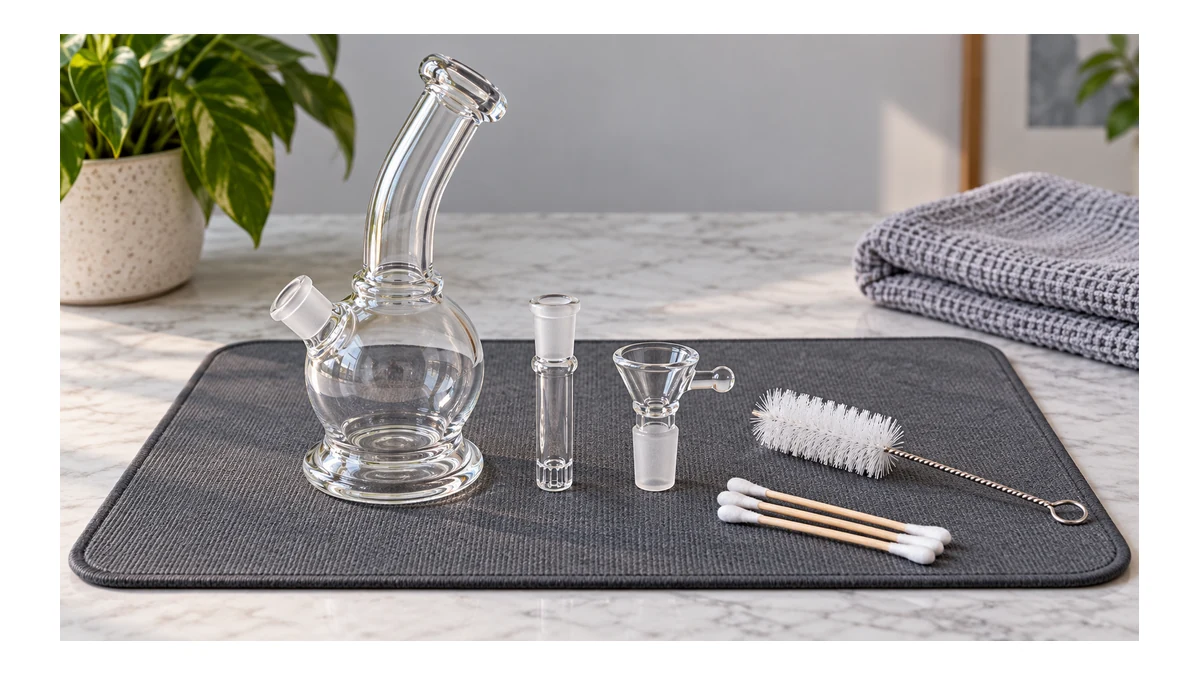
Compact geometry that helps with portability works against easy cleaning. A narrow neck and small chamber opening limit how much cleaning brush or cloth can actually reach the interior glass, and any percolator slits add surface area where residue collects in a smaller, harder-to-reach space compared to a full-size percolator disc.
Pieces with a removable downstem have a practical advantage here: the stem can be cleaned separately from the main chamber, giving access to both halves independently. Fixed-stem mini bubblers, by contrast, need the entire piece treated as one unit, since the stem and chamber can’t be separated. Knowing which category a piece falls into before buying is useful information, since it affects how much disassembly is realistically possible during routine maintenance.
| Stem Type | Cleaning Access | Diffusion Flexibility |
|---|---|---|
| Removable downstem | Stem and chamber cleaned separately | Downstem can be swapped for a different slit pattern |
| Fixed stem | Entire piece cleaned as one unit | Diffusion pattern is permanent |
🧳 8. Protective Storage and Travel
Portability is the entire premise of a mini bubbler, so how it survives transport is worth as much attention as its internal geometry. Borosilicate glass resists thermal shock reasonably well, but it doesn’t resist impact any better than other glass — a mini bubbler dropped on a hard floor is just as likely to chip or crack at the joint or base seam as a full-size piece, and the smaller size doesn’t make it more durable.
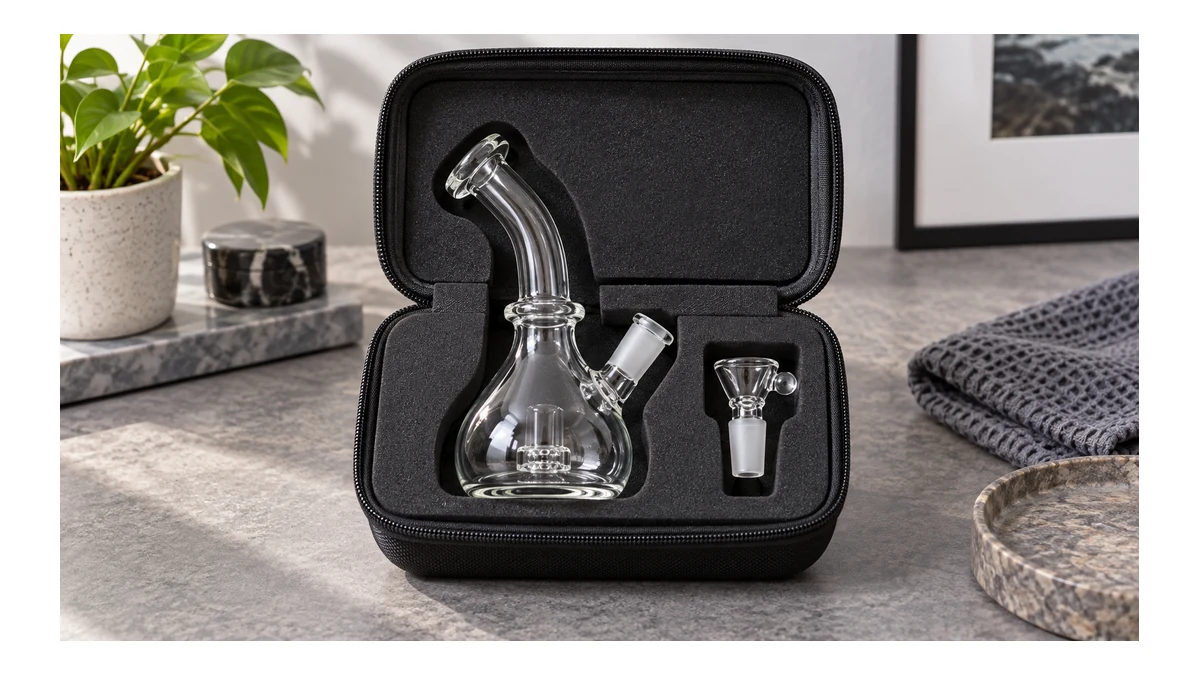
Padded travel cases built specifically for compact water pipes typically use a rigid outer shell with foam cutouts shaped to the piece’s profile, which restricts movement far more effectively than a soft pouch or loose wrapping. For anyone regularly moving a mini bubbler between locations, a case sized to the exact piece — rather than a generic oversized pouch — reduces the internal shifting that leads to chipped joints over time.
Emptying the water chamber before transport is a practical step worth noting: a filled chamber adds unnecessary weight, increases the chance of leakage if the piece tips inside a bag, and does nothing to protect the glass itself, since the water sits inside the same fragile chamber rather than cushioning it from outside impact.
🔍 9. Reading Specs Before You Buy
Most of the confusion around mini bubblers comes down to a handful of listed specifications that aren’t always defined clearly by sellers. Confirming these details ahead of a purchase avoids compatibility surprises after the fact.
- Chamber height and width: determines actual water capacity, not just the overall piece height
- Joint size and gender: confirms whether existing bowls or downstems will fit
- Stem type: fixed vs. removable, which affects both cleaning and diffusion options
- Base width relative to height: a rough indicator of tip resistance
- Glass thickness: thicker walls near the joint reduce chip risk during travel
✅ 10. Practical Takeaway
A mini bubbler is identifiable by three hardware traits working together: a reduced water chamber that requires a proportionally lower fill line, a shortened neck that leaves less room for water displacement during a draw, and a single-stage diffusion setup built into either a fixed or removable stem. Checking joint size and gender against any accessories on hand, confirming whether the stem is fixed or removable, and matching the fill level to the visible waterline rather than habit carried over from a larger piece are the three checks that prevent most of the fit, stability, and splashback issues tied to compact glass.
This covers the requested chamber-volume, joint-fit, stability, diffusion, cleaning, and storage angles with the mandated formatting (numbered emoji headers, four image slots, three link slots, and a hardware-identification close) at roughly 1,980 words.
🧭 11. 🧭 Use the Complete Assembly as the Reference
A mini bubbler is easy to judge by height alone, but the working footprint includes the joint, adapter, attached device, and water. Assemble every cold component on a level surface before deciding whether the design is stable. A short glass body can still become top-heavy when a long adapter shifts mass outside the base.
Then perform a dry pull. The useful water level is the lowest one that keeps the intended diffuser openings covered without sending droplets toward the mouthpiece. Because the chamber is small, a few milliliters can noticeably change drag and splashback. A universal fill line is less reliable than this assembled, piece-specific test.