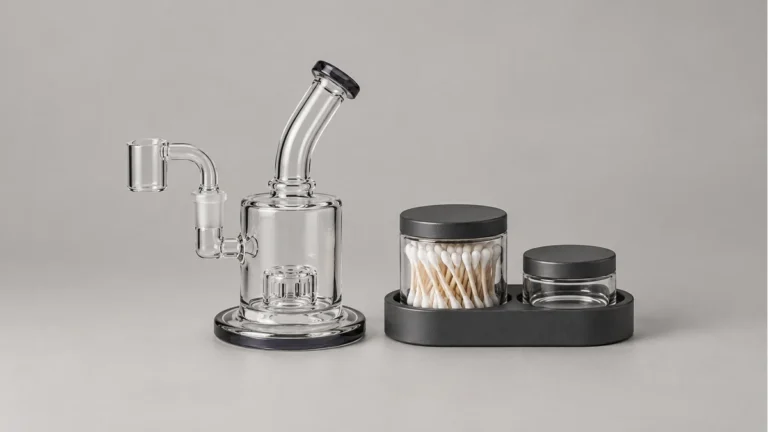
Search for “quartz banger and carb cap” and you will find plenty of the site’s 90-degree banger guide and other general buying guides. What is harder to find is a plain explanation of why two individually well-made pieces can still fail to work together. The short answer is geometry. A banger and a carb cap are not judged separately; they are judged as a pair of shapes that either interlock cleanly or do not. This article walks through the dimensions that actually determine fit, the airflow logic behind them, and how to record what you own so you stop guessing.
🔍 1. Why “Fit” Is the Real Question
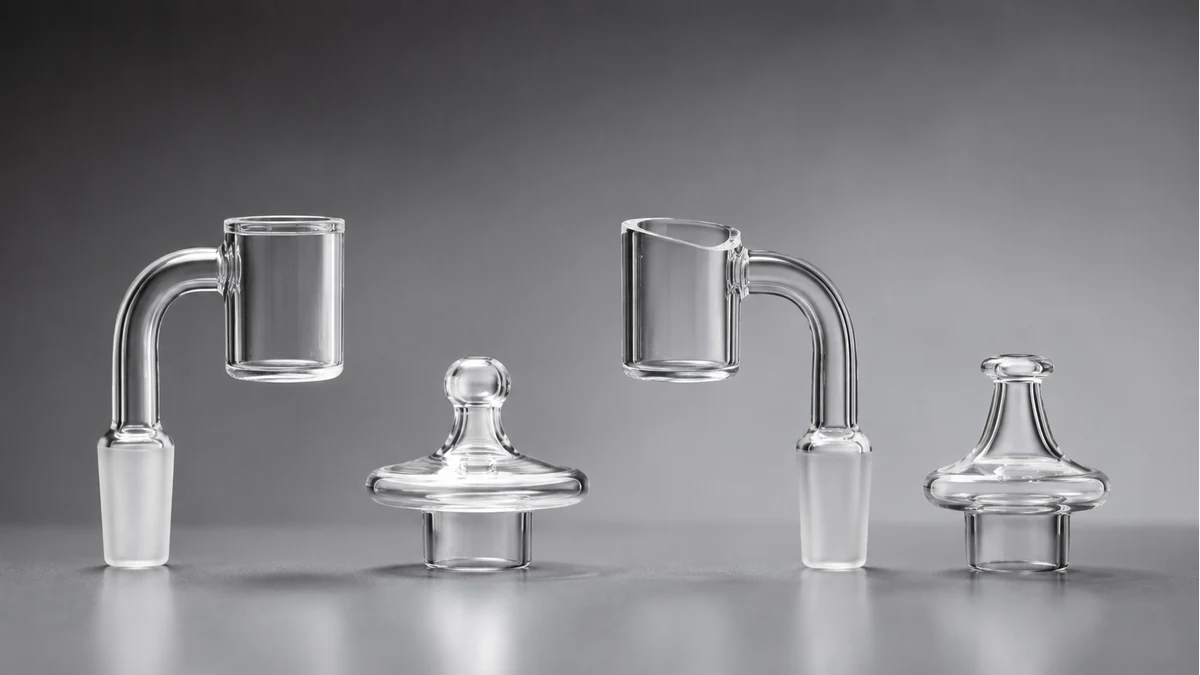
It is common to hear that a cap “basically” fits, even when it visibly rocks, tips to one side, or leaves a gap along part of the rim. The instinct to shrug this off is understandable — the cap sits on top, it is not glued in place, and a small gap does not look dramatic. But a cap that does not seat evenly is not making consistent contact with the bucket’s rim, and that inconsistency is exactly what changes how air moves through the joint. Visual “close enough” and mechanical “seated correctly” are different standards, and only one of them is measurable.
The confusion is worse for people who have bought and returned several caps trying to find one that sits right. Each return usually confirms the same underlying issue: the rim or contact profile of the cap does not match the rim profile of the specific banger, even if both pieces are labeled as fitting “standard” joints. There is no single standard rim, so trial and error without measurement tends to repeat the same mismatch in a different color.
📐 2. Two Separate Geometries: Banger and Cap
A banger and a carb cap each have their own set of dimensions, and none of those dimensions are guaranteed to correspond just because both items are sold for the same general purpose.
📏 2.1 Joint Size and Angle Live on the Banger
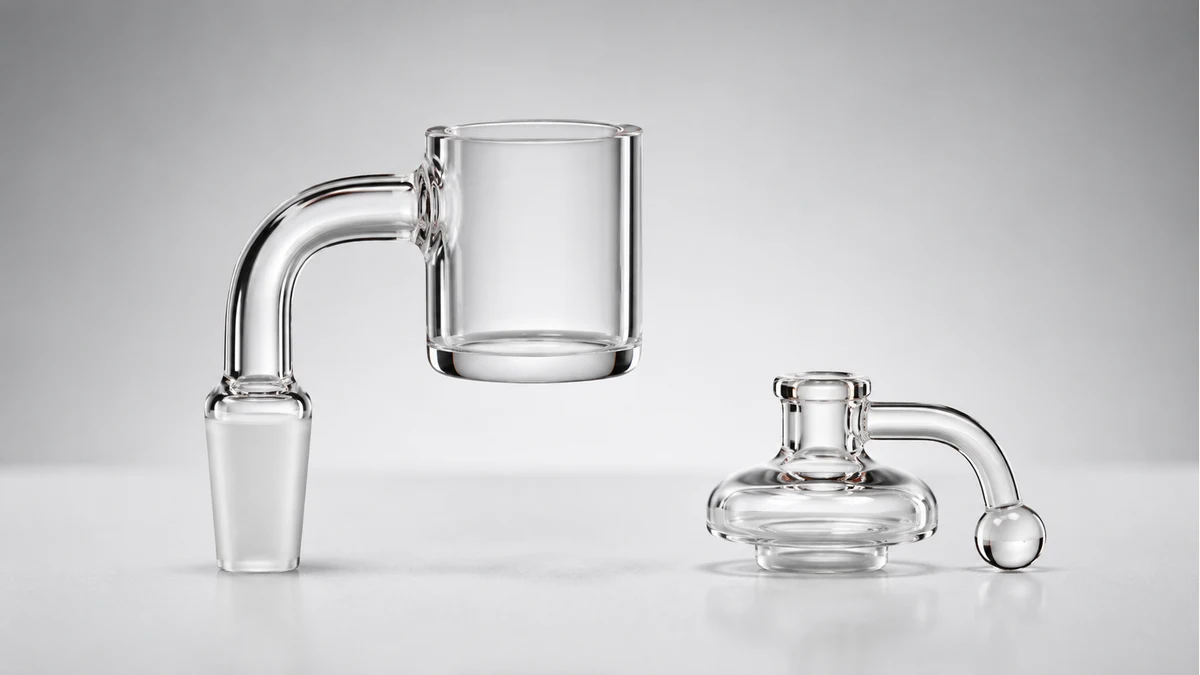
The banger’s joint size (commonly described in millimeters) and joint angle determine how the banger attaches to the rig. These numbers matter for rig compatibility, but they say nothing about the bucket — the open, upward-facing well where material sits. Joint size is a mounting spec; bucket geometry is a fit spec. Confusing the two is one of the most common reasons a cap purchase disappoints.
⭕ 2.2 Bucket Diameter and Rim Profile Set the Target
What a carb cap actually has to match is the bucket’s inner or outer diameter (depending on cap style) and the shape of its rim — flat, rounded, beveled, or stepped. Two bangers with identical joint sizes can have noticeably different bucket diameters and rim shapes, especially across different manufacturers or quartz styles. This is the target the cap needs to hit, and it is a separate measurement from anything printed on a joint-size label.
🎯 3. What the Cap’s Contact Surface Actually Does
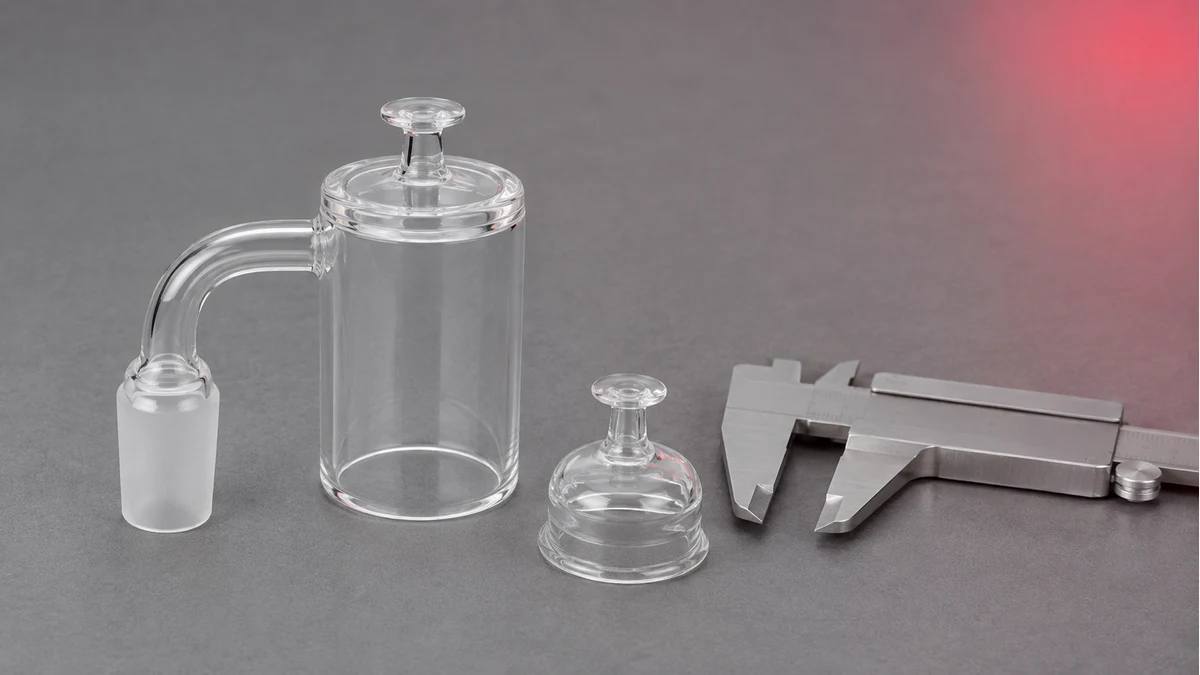
The part of the cap that touches the bucket is called its contact surface, and its shape needs to correspond to the rim it is resting on. Two general contact styles are worth understanding conceptually.
🔵 3.1 Flat Contact
A flat-bottomed cap is meant to rest evenly on a flat or near-flat rim. If the rim it is placed on is actually rounded or beveled, a flat cap will only touch at a narrow line or a single point rather than along its full circumference, which is a common cause of visible wobble.
🔺 3.2 Beveled or Rounded Contact
A cap with a beveled or curved underside is shaped to nest against a matching angled or rounded rim. Placed on a flat rim instead, it can rock or seat off-center, because the two surfaces are not sharing the same contact angle.
Neither style is inherently better; the point is that contact surface and rim profile are a matched pair, not interchangeable defaults. A cap that looks like a universal fit in a product photo is still built around one specific contact geometry.
🌀 4. Airflow Depends on More Than Owning the Right Parts
A directional design, including the type discussed in the bubble carb-cap guide, still needs a matching contact surface and clear vent path. Some people put together a full new setup — banger, cap, and related accessories — and still feel that airflow is not behaving the way they expected, even though every individual piece was purchased new and described as compatible. The site’s carb-cap guide explains the component category; fit still depends on this particular pair. The general physics idea behind this is straightforward: the rate at which air (or any fluid) moves through an opening is directly related to the size and shape of that opening, a relationship covered in OpenStax’s introduction to flow rate and velocity. A carb cap’s vents, and the gap left between the cap and the bucket rim, form exactly this kind of opening.
If a cap sits unevenly because of a rim mismatch, the effective opening around its edge is no longer uniform — it may be nearly sealed on one side and unusually open on the other. The cap’s own vent holes or channels then interact with that uneven gap in ways that are hard to predict just by looking at the parts individually. This is a geometric explanation, not a performance claim: the point is that airflow behavior is a product of how the pieces sit together, not a guaranteed outcome of owning correctly labeled parts.
⚖️ 5. Wobble, Overhang, and Side-Load
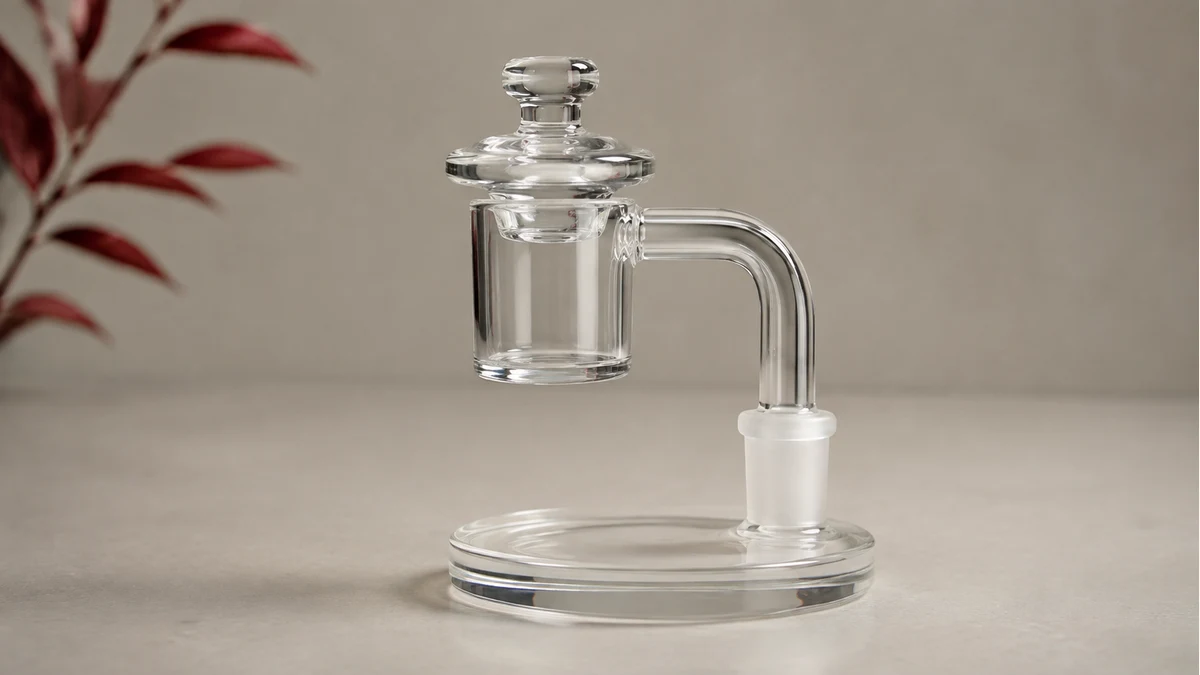
Three related terms are useful for describing fit problems precisely instead of just saying something “feels off.”
- Wobble — the cap rocks or spins unevenly because its contact surface touches the rim at only one or two points instead of continuously.
- Overhang — the cap’s body extends noticeably beyond the bucket’s diameter, so its weight is not centered over the point of contact.
- Side-load — sideways pressure created when a cap’s handle or body pushes at an angle rather than straight down, often a result of overhang or an insertion depth that seats the cap higher or lower than intended.
These three issues compound each other. A cap with overhang is more likely to wobble, and a wobbling cap is more likely to transmit side-load into the banger’s neck, particularly on a rig that is already top-heavy.
| Fit dimension | What to check | Why it matters |
|---|---|---|
| Bucket diameter | Cap body sits inside or over the bucket without excess gap | Excess gap changes the effective opening around the cap |
| Rim profile | Cap’s contact surface matches flat, rounded, or beveled rim | Mismatched profiles cause point contact instead of even contact |
| Insertion depth | Cap rests at a consistent, repeatable height each time it’s placed | Variable depth changes vent alignment and cap angle |
| Vent direction | Vent openings are not blocked by the bucket wall or handle | Blocked vents defeat the cap’s intended airflow path |
| Handle clearance | Handle does not contact the rig, table, or other accessories | Contact here creates side-load and instability |
🧭 6. Cap Position and Leverage on Small Rigs
On a small or lightweight rig, the carb cap’s position changes the leverage acting on the joint far more than it would on a heavier, larger piece. A cap with a long handle, held or rotated at an angle, effectively becomes a lever arm. Even modest pressure at the far end of that handle is magnified at the point where the banger meets the rig’s neck. This is one reason a cap that seems to “work fine” when handled carefully can still contribute to a joint feeling stressed or a small rig tipping — the leverage math does not change just because the pressure feels light in the hand.
Cap weight matters here too. A heavier cap sitting off-center due to overhang adds more leverage than a lighter one in the same position, independent of how well its contact surface otherwise matches the rim.
✋ 7. Stability for Simple, Low-Dexterity Movement
For anyone who needs to place, rotate, or lift a cap with limited fine motor control, geometry has a direct practical consequence: a cap that requires precise angling to seat correctly is harder to use reliably than one that seats the same way regardless of small variations in approach angle. A wide, evenly matched contact surface is more forgiving of an imprecise placement than a narrow point-contact fit, because there is more room for a slightly off-angle motion to still land correctly.
Base stability of the rig itself is part of the same picture. A wide, low base resists tipping from the same amount of side-load that would unbalance a narrow or tall base. When dexterity is limited, a stable base and a forgiving cap fit reduce the number of things that have to go right at once during a simple movement.
🧪 8. What a Product Photograph Cannot Confirm
A top-down photo can show the cap’s outline and a side photo can show handle clearance, but neither proves that two circular surfaces meet evenly. Reflections can hide a small bevel, and camera perspective can make an overhang look smaller than it is. Even a photograph of the cap sitting on the banger confirms only that those pictured samples can be placed together; it does not publish the dimensions of either one.
For that reason, pair descriptions should identify bucket opening, rim profile, cap contact diameter and intended bucket style in words or a drawing. A generic phrase such as “universal cap” is a category claim, not a dimensional record. Where tolerances matter, the useful question is which surfaces are intended to touch and how much variation the design accepts.
🧊 9. The Cold Dry-Fit Check
Every dimension described above can be inspected while everything is at room temperature, before any material is involved. Placing the cap on the empty, room-temperature banger and checking the following gives a clear read on fit:
- Does the cap rest level, or does it visibly tip to one side?
- Rotate the cap slowly — does it spin smoothly, or catch and skip at certain points?
- Lift the cap straight up — does it come free evenly, or does one side lift before the other?
- With the cap seated, does the handle clear the rig’s neck and any nearby accessories?
- Does the total height of banger plus cap feel proportionate to the rig, or does it feel top-heavy?
A cold dry-fit does not require any special tools, and it separates fit problems from anything related to technique or timing, since nothing is happening except two pieces of quartz and glass resting together.
📋 10. A Fit-Record Template You Can Reuse
Because bucket and rim dimensions vary between individual pieces even within the same nominal category, it helps to write down what you actually have rather than relying on memory or a listing’s general description. A simple record, kept for each banger and cap you own, can include: the banger’s joint size and angle; the bucket’s approximate diameter and rim profile (flat, rounded, or beveled); the cap’s contact surface style and body diameter; the insertion depth at which the cap sits level; the direction its vents face when seated; and the result of a cold dry-fit check — level or tipped, smooth or catching, clearing the rig or contacting it. Noting the rig’s base width and overall height alongside this record makes it easier to judge whether a given cap’s leverage is appropriate for that specific setup. Over time, this kind of record turns “this cap doesn’t feel right” into a specific, comparable description you can check against the next piece you consider, rather than starting the guesswork over each time.
For white unpowered attachments and their care questions, see our ceramic banger guide.