Make the whole comparison while every component is cold. A banger that technically enters the joint but leans, crowds the glass, or puts a torch path against another component is still the wrong match.
A 90-degree banger is designed so its bucket can sit upright when it enters an upright, 90-degree rig joint. The angle label describes the neck geometry; it does not confirm joint gender, joint diameter, bucket clearance, cap fit, or safe distance from the rig body.
📦 1. -Degree Label Describes the Neck Bend, Not the Bucket
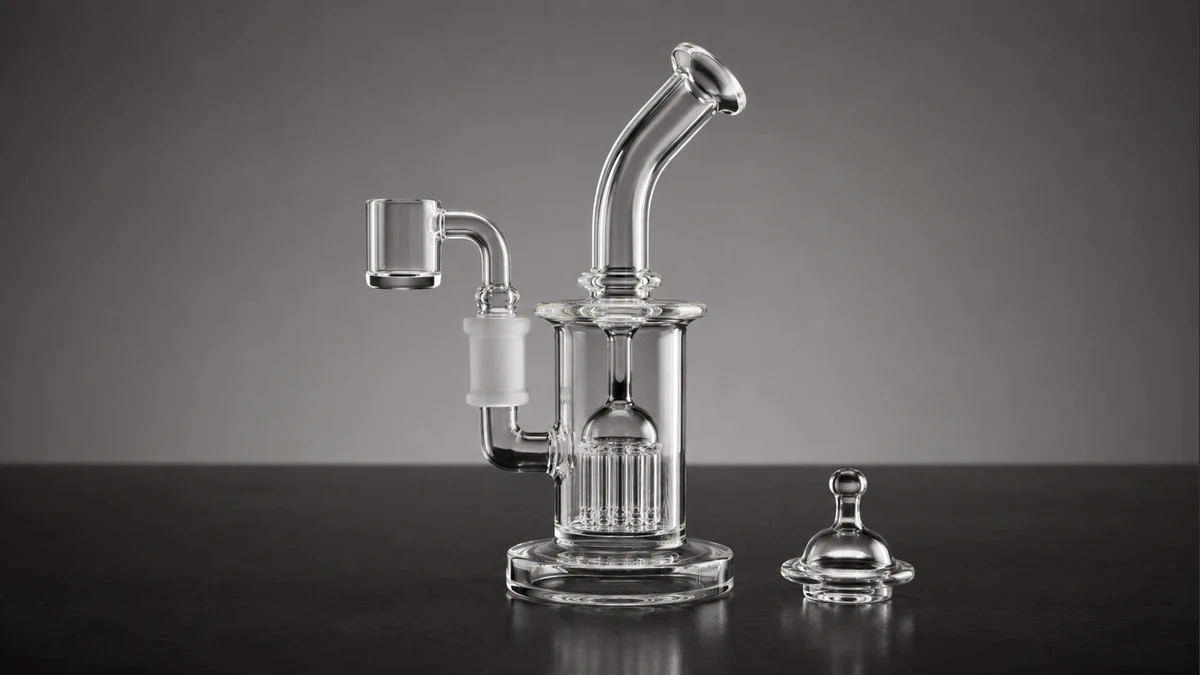
When a listing says “90-degree banger,” it’s describing the angle of the joint itself relative to the neck of the rig, not some universal orientation for the bucket. A 90-degree joint exits the rig at a right angle, so the neck goes straight up and the joint sticks out horizontally before the banger’s neck bends back upright. A 45-degree joint exits at a shallower slant, which changes how far the bucket sits from the body of the piece and how it needs to angle to stay level.
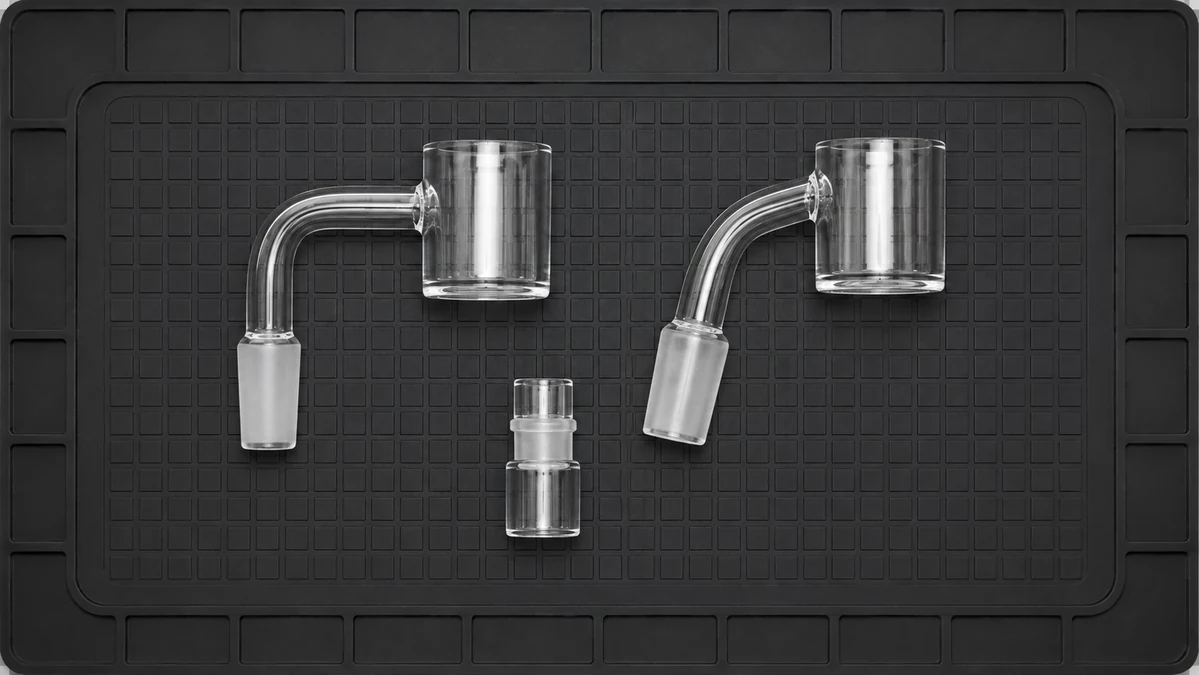
The banger itself is manufactured to match one of these two geometries. A 90-degree banger has a neck built with a bend calculated to bring the bucket back to level when it’s seated in a 90-degree joint. Put that same banger in a 45-degree joint and the bucket won’t sit level anymore — it’ll tilt toward the joint because the compensating angle no longer lines up with how the joint is angled off the rig.
This is why two bangers can look almost identical in a product photo and behave completely differently once installed. The bucket diameter might match, the frosted joint might match, but the neck bend is cut for a different starting angle. If you’re unsure which angle your rig uses, look at where the joint exits the chamber. A joint that comes straight out to the side, perpendicular to the tube, is typically 90 degrees. One that angles upward at a slant, closer to 45 degrees off the tube, needs the other style.
📏 2. Match Joint Gender and Diameter Separately From Angle
Angle is only one of three specs that have to line up, and it’s easy to fix one variable while ignoring the other two. Gender and diameter are independent decisions that don’t care what angle the joint is cut at.
Gender refers to whether the joint is male or female. A male joint is the piece that inserts into another piece; a female joint is the piece that receives it. If your rig has a female joint sticking up from the chamber, you need a male banger to slide into it, and vice versa. Confusing these two won’t just cause a wobble — the pieces simply won’t seat together at all, or they’ll rest loosely without a real seal.
Diameter is measured in millimeters, most commonly 10mm, 14mm, or 18mm, and it has to match on both pieces regardless of gender. A 14mm male banger will not seat properly in an 18mm female joint no matter how careful you are about the angle. If you’re working with a smaller rig and want a deeper look at how male joint sizing plays out across common banger styles, the 14mm male banger guide breaks down sizing decisions in more detail.
The practical approach is to nail down gender and diameter first, confirm those two against your rig’s joint, and only then filter by angle. Trying to solve all three at once from a single product photo is how mismatches slip through, especially when a listing photo is cropped tight on the bucket and doesn’t show the neck angle clearly.
📐 3. The Bucket Should Sit Level in the Actual Use Position
A banger can be technically correct on paper — right gender, right diameter, right stated angle — and still sit crooked once it’s actually on the rig. That’s because “level” isn’t just a function of the banger’s neck bend; it’s also a function of how the whole rig sits when you’re using it.
Set the rig down on the surface where you’ll actually be using it, not propped against a wall or held at an angle in your hand. Slide the banger into the joint and look at the bucket from the side, at eye level with the table. If the front lip of the bucket sits higher or lower than the back lip, oil is going to run toward the low side instead of staying centered, and cleanup gets messier than it needs to be.
Some of this comes down to how the rig itself is balanced. A rig with a wide, heavy base sits differently on a table than a rig with a narrow foot, and that can shift how “level” reads even with an angle-matched banger. If the tilt seems severe rather than minor, double-check the joint angle assumption before blaming the banger — it’s the more common culprit.
📐 4. -Degree Joint Can Change the Answer
It’s worth stating plainly: if your rig has a 45-degree joint, a 90-degree banger is the wrong tool even if every other spec matches. The neck bend on a 90-degree banger assumes the joint is already contributing a 90-degree turn, so it only adds a modest correction to bring the bucket level. A 45-degree joint has already turned the neck less sharply, so the banger needs a more aggressive internal bend to compensate and land the bucket level.
This matters most for rigs that don’t look like the tall, straight-sided pieces people picture by default. Recyclers, tucked designs, and rigs built for a lower profile often use 45-degree joints specifically because the shallower angle keeps the banger closer to the body of the piece. If you inherited a rig or bought one secondhand without documentation, checking the joint angle before ordering a replacement bucket saves a return shipment.
A quick way to sanity-check this without measuring anything: hold the rig at the angle you’d actually use it, and look at where the joint points. If it points more toward the ceiling than toward the horizon, that’s leaning 45-degree territory. If it points nearly straight out to the side, that’s 90-degree territory. It’s not a substitute for knowing the actual spec, but it catches obvious mismatches before checkout.
📐 5. Adapters Add Height and Leverage
Adapters solve real problems — converting between diameters, changing gender, or adding a drop-down to reposition where the banger sits — but every adapter you add changes the geometry you’re solving for. An adapter isn’t a neutral pass-through. It has its own length and its own angle contribution, and that stacks with the banger’s neck bend.
A drop-down adapter, for instance, extends the joint downward or outward before the banger attaches, which shifts the bucket’s final position even if the banger itself is angle-matched to the rig’s stock joint. The bucket might sit level relative to the adapter but off-level relative to the rig once you factor in the extra length hanging off the side.
Leverage is the other issue adapters introduce, and it’s a physical one rather than a cosmetic one. Every joint added between the rig and the banger is another connection point that has to bear the weight of the banger, any accessories on it, and the torch or dabber pressing against it during use. A longer adapter stack means more leverage at that joint, which puts more stress on the glass at exactly the point where it’s already thinnest. If you’re building out a setup with multiple adapters, it’s worth reviewing how the pieces interact as a full attachment chain rather than checking each connection in isolation — the bong dab attachment guide walks through how these pieces are meant to stack together.
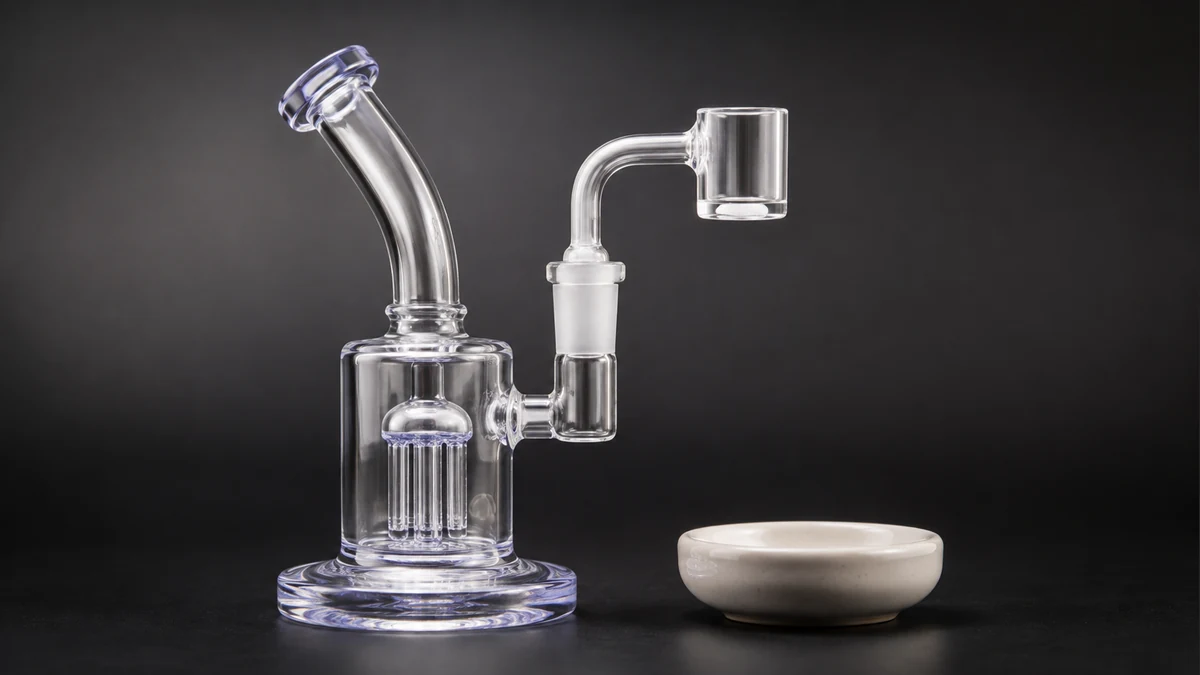
🔍 6. Cold-Check Cap and Torch Clearance Before You Ever Heat It
Fit isn’t just about the joint connection — it’s also about whether everything around the banger has room to move once it’s seated. This is easiest to check cold, before a torch is anywhere near the rig, because you want to catch clearance problems while you can still handle every piece freely.
Set the banger in the joint and then set your carb cap on top the way you normally would. Check whether the cap seats cleanly on the bucket lip without the cap’s stem or handle knocking into the neck of the banger or the body of the rig. On a rig with a tighter bend or a shorter neck, a cap that worked fine on your old banger can suddenly hit the glass at an odd angle once the bucket’s position has shifted.
Next, check torch access. With the banger in its resting position, mimic the angle you’d actually hold a torch at to heat the bucket evenly. If the neck of the rig, a nearby percolator, or another piece of glassware blocks that angle, you’ll end up compensating by heating the bucket unevenly or holding the torch at an angle that doesn’t reach the far wall of the bucket.
A short checklist covers most of what to verify before your first session with a new banger:
- Cap seats flat on the bucket lip without hitting the neck
- Cap handle has room to rotate for spinning during use
- Torch can reach the bucket at a low angle without hitting the rig’s body
- Bucket clears any nearby percolator or side arm
- Banger sits stable in the joint without wobbling when nudged gently
If any of these fail while everything is still cold and dry, they’ll only get more awkward once oil, a hot bucket, and a cap are all in play at once. It’s also worth thinking through this alongside the broader hardware picture — comparing how a banger’s geometry differs from a standard nail or an e-nail setup can clarify why clearance issues show up more with certain bucket styles. The dab nail vs banger vs enail comparison covers how these designs diverge structurally.
⏱️ 7. Save the Full Fit Specification So You’re Not Guessing Next Time
Once you’ve found a banger that actually sits level, seals properly, and clears your cap and torch, that combination of specs is worth writing down somewhere you’ll actually find it again. Rigs don’t announce their joint angle on the glass itself, and it’s easy to forget six months later whether you’re running a 45 or a 90, especially if you own more than one piece.
A simple note works fine — something like “main rig: female joint, 14mm, 90-degree, standard bucket depth, no adapter.” That single line answers every question a replacement listing will ask, and it means the next purchase is a quick spec match instead of another round of holding the rig up to the screen trying to eyeball the neck angle from a photo.
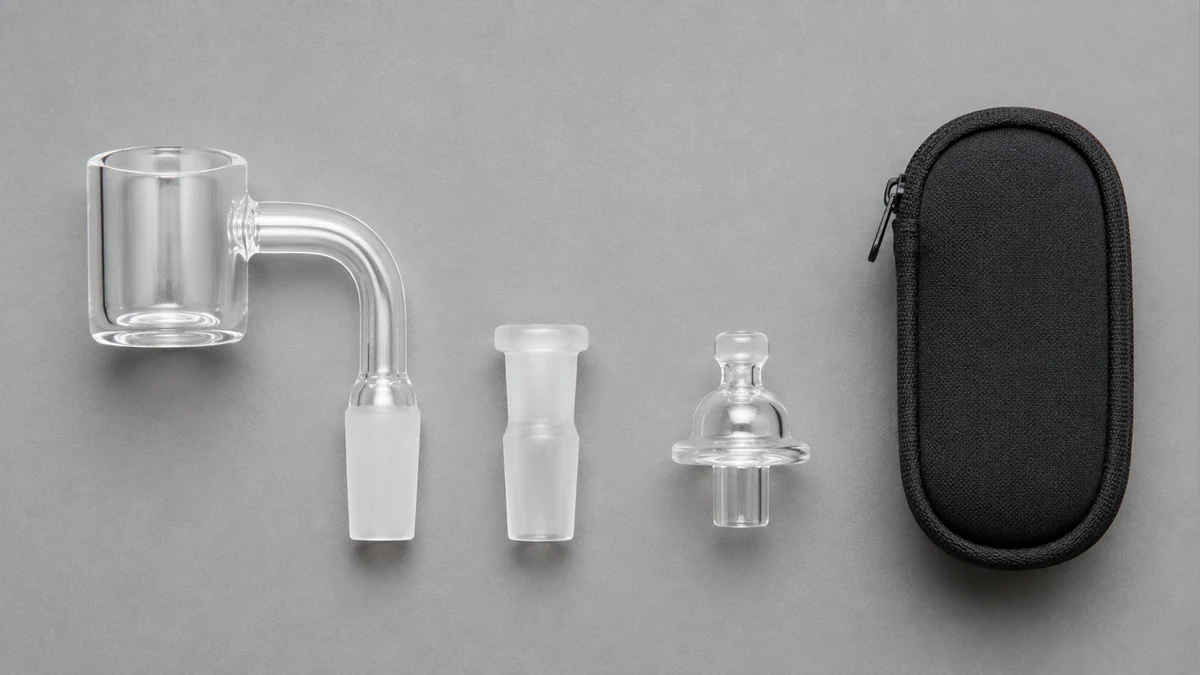
This matters more the moment a second rig enters the picture. A travel piece, a gift, or a rig picked up secondhand rarely shares specs with the one you’re used to, and assuming they match is exactly how a perfectly good banger ends up sitting crooked on the wrong joint. Treating angle, gender, and diameter as three separate checks — every time, for every rig — is the difference between a bucket that sits flat and one you’re constantly nudging back into place.
📝 8. Keep one compatibility note for replacement day
Save the full description—90-degree neck, joint gender and diameter, bucket dimensions, and the rig model—rather than recording only “90-degree banger.” A cold side-view photo of the correctly seated setup can also preserve the clearance and upright position you verified. That small record prevents a future replacement from becoming another round of visual guessing.