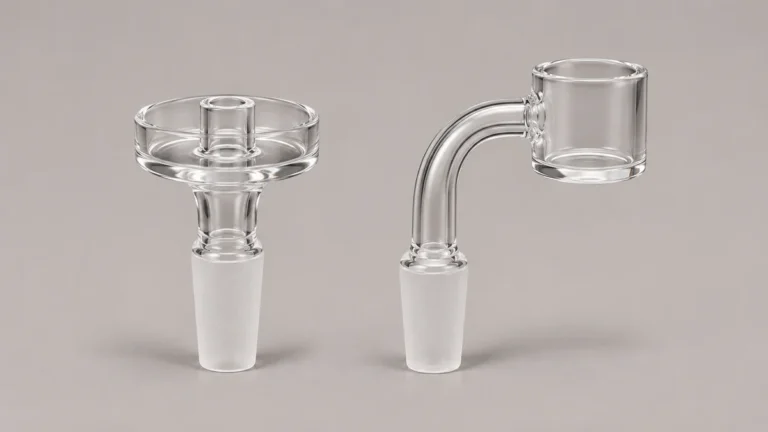
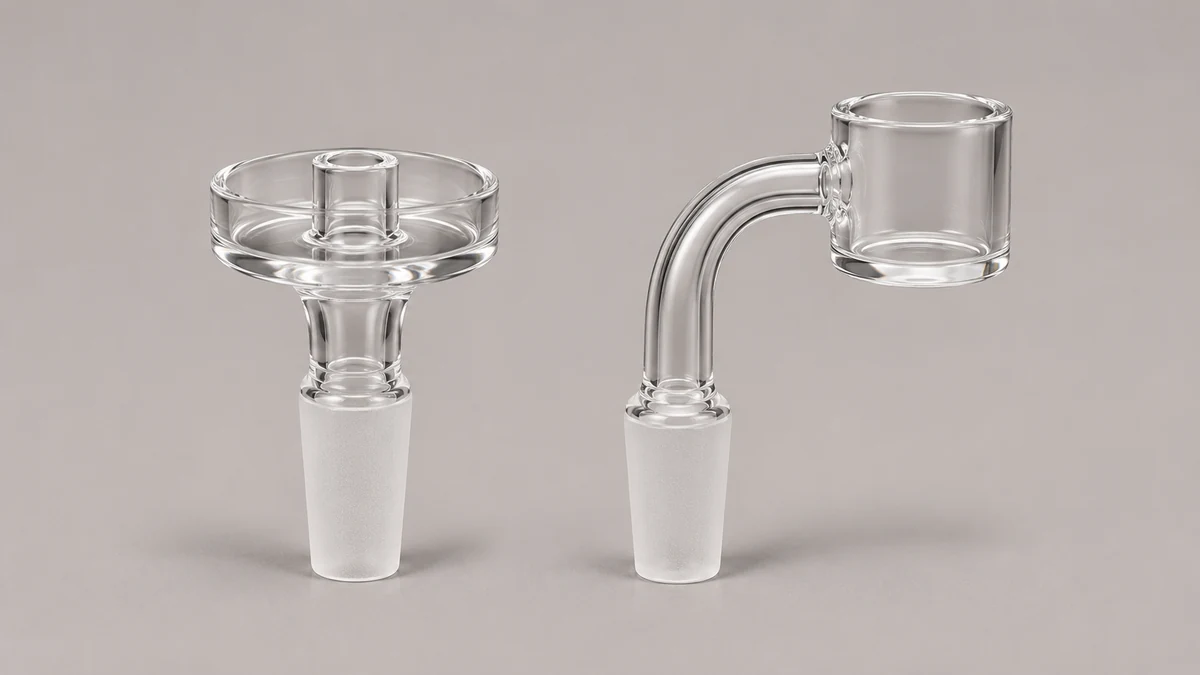
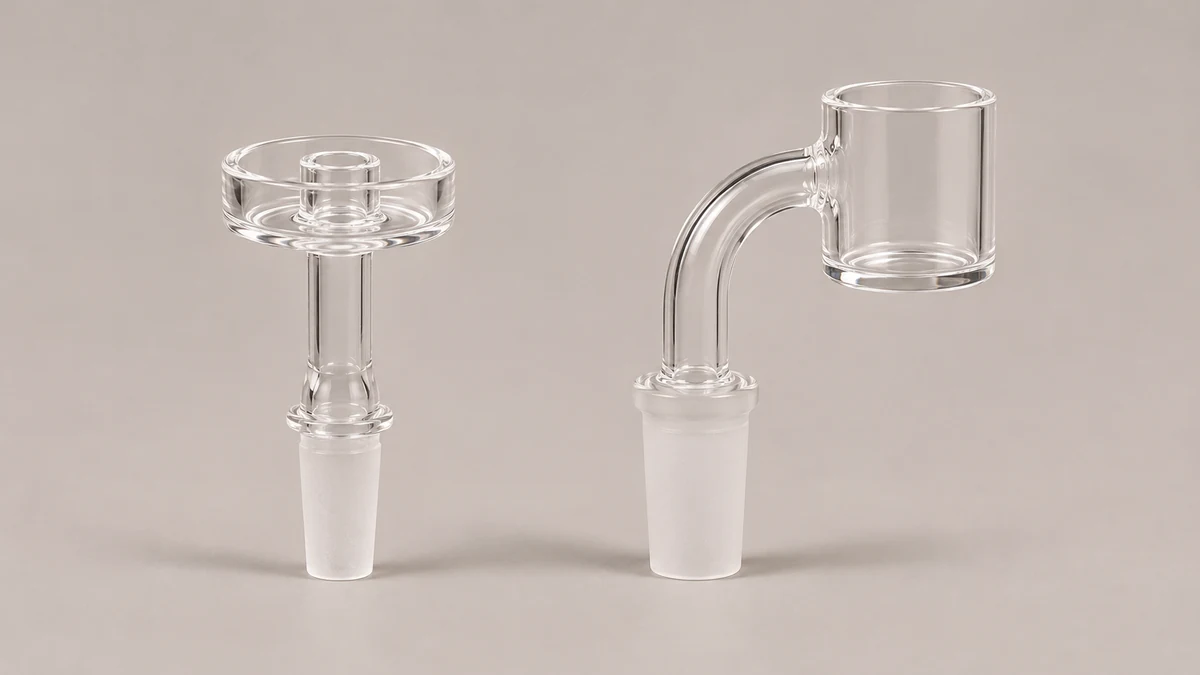
A quartz dab nail can have a shallow dish centered over its joint, or the label can refer to a banger with a bucket offset to the side. A loose dish can also be only one piece of a nail assembly. To tell them apart, follow the opening from the dish toward the joint and look at whether the dish, airway and mounting section form one continuous piece. Those observations give you a workable part name even when a catalog uses nail for several shapes.
🔎 1. Start With the Axes, Before Naming the Part
Place the cooled, empty part on a plain surface and look at the side profile. Imagine a line through the center of the joint. Does it continue through the middle of the dish, or does a connecting tube lead away to a bucket whose center sits to one side? You can often distinguish those layouts in a photo before you know the size of the joint. If the part has no obvious mounting section, it may be only an insert or a dish.
🧭 1.1 Use the Side View to Confirm the Top View
From above, a round dish and a round bucket can look alike. The side view shows which one has an outlet running down the center and which one narrows into a side tube. A camera held at an angle can project the top and lower joint to different places in the frame even if the geometry is centered. A side image with the joint visible establishes where the part changes direction and what the word offset is describing.
The existing overview of nails, bangers and e-nails explains how sellers use these categories more broadly. This closer inspection addresses a different problem: an owner is holding one loose part and needs to describe exactly which shape is in hand.
🧩 2. Identify the Dish and the Opening in a Centered Nail
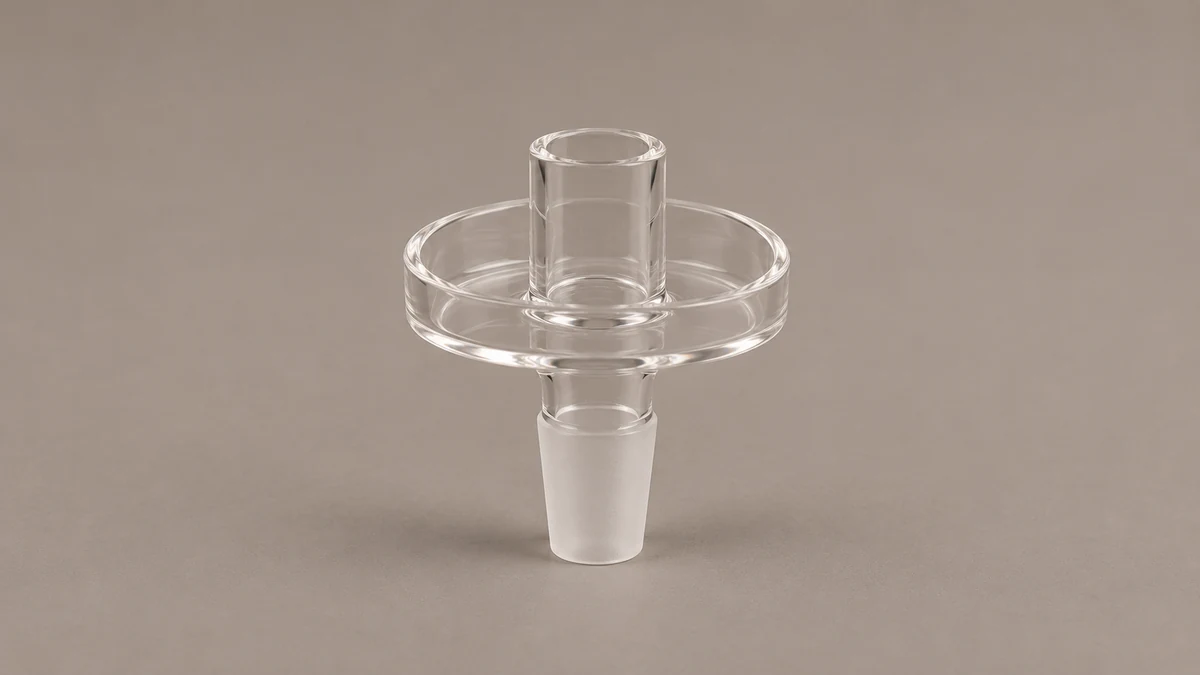
One centered design has a shallow ring-shaped area around a raised central opening. Viewed from above, it may resemble a small collar with a hollow center. The rim surrounds the dish while the center opening is a separate feature. Seen from the side, both sit above the same mounting axis. The joint shape below can still vary independently.
🔍 2.1 A Central Passage Is Different From a Separate Ring
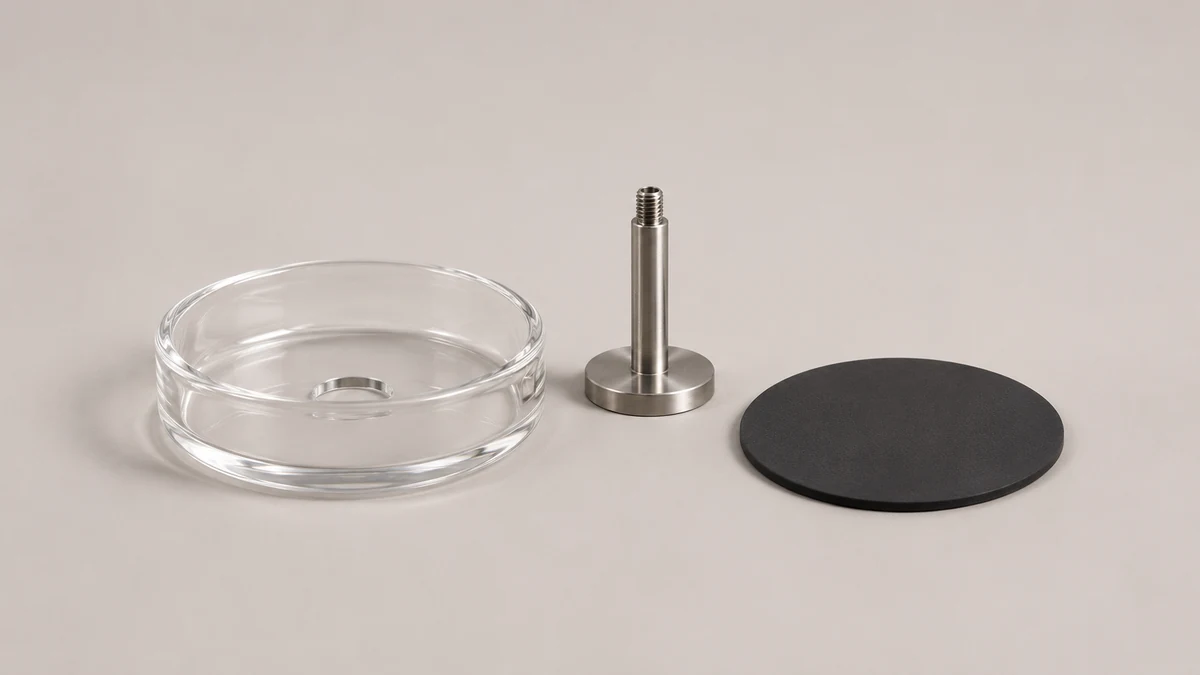
A hole in a loose ring doesn’t by itself make the ring a complete nail. Look at the underside and find out what continues below the dish. A long piece with its own visible joint is different from a shallow plate with a hole and a separate support underneath. A parts photo can show where the supporting stem meets the dish. If the catalog lists a separate dish part number, document what holds it and which assembly the part number names.
Yo Dabba Dabba’s catalog labels one specific part a domeless quartz nail and lists its joint options separately. The catalog image is an example of a centered shape. That example shows why one term can define the upper construction while a second field identifies the connection. The name domeless does not provide the joint size, the mounting orientation or the dimensions of the dish.
📐 3. Follow the Side Tube on an Offset Banger
An offset banger has a distinct bucket and a tube that leads toward the supporting joint. From the front, its outline can look like a little cup on a bent arm. The tube approaches the bucket from the side on many examples. The shape of that entry and the angle of the arm show up more clearly in a side profile than in a top-down product image.
↪️ 3.1 Bucket Shape and Joint Angle Answer Different Questions
The angle described in a listing refers to how the mounting stem and upper hardware are arranged. The bucket diameter, when named, describes the upper piece. A listing might show an angle next to a joint size and a third number for the bucket. Assign each value to the feature named next to it. Even if two values happen to be similar, they are measuring different items. A photo from the top can make a visibly wide bucket look like a wide joint behind it.
That distinction matters when only one piece is available for comparison. An owner may have a photograph of a matching-looking bucket but no picture of the mount on an existing rig. At that point the part family may be clear, while the exact joint is still an open question. The illustrated explanation of a female quartz banger joint shows how to keep socket and projecting joint terms attached to the correct piece.
⚙️ 4. Recognize a Removable Dish Above a Support
A two-piece dish assembly can look continuous when it is assembled. The dish may conceal most of the support beneath it, leaving only a narrow seam visible outside. The removable part could be listed by its own name, while the stem or base has a separate listing. Ask for a parts drawing before assuming a seam means a particular piece comes away. Some seams mark permanent construction and are not intended as a service boundary.
🗂️ 4.1 Separate the Replaceable Piece From the Assembly Name
For example, a loose shallow dish can have a center hole but no taper, because the mounting section is part of the support underneath. If the support is already present, the compatibility question is about the upper contact surface, seating geometry and documented pairing. If the support is missing, a replacement dish alone doesn’t provide a mounting joint. A good inventory marks the dish and support separately and records which components can be seen in the drawing.
When a photo shows a very small plate sitting beside a tall piece, it can be tempting to refer to both as a quartz nail. Start with neutral descriptions instead: shallow plate with a central opening, and tall stem with a tapered base. The guide to distinguishing slides, bangers and inserts helps put those pieces in the right category before assigning a replacement part number.
🧱 5. Note Whether an Outer Dome Belongs to the Design
Older assemblies may have a loose center piece and a separate surrounding cover. A detached dome photographed alone may be mistaken for a different glass component. Its relationship to the inner nail is more informative than any single opening. A centered dish with an exposed rim can belong to a different design. If you see an unusually tall cover in a parts set, check its relationship to the inner piece in a model photo before calling it part of a domeless assembly.
There are two separate identification questions here. The first is whether a cover should be present on a documented assembly. The second is whether an inner part is supposed to be removable. One answer doesn’t establish the other. In an inherited parts collection you may have a dome from one rig, a centered piece from another and a more recent banger. The outlines might make a plausible combination even though the parts never belonged together.
📷 5.1 Photograph a Loose Center Piece Before Moving It
If a small piece is sitting inside a larger component, take one photo of that relationship first. Include the bottom connection of the larger piece if the angle permits. Use a second view alongside the rest of the assembly to show scale. If the part is already loose, label it as found and avoid assuming how it was retained. A support desk can make more of a documented relationship than an unlabeled photo of separated pieces.
📝 6. Distinguish Material Claims From Shape
Clear, glossy hardware is not enough to establish the material. A part can be described as quartz in a catalog and look much like another clear part to the eye. A photo is usually stronger evidence of the geometry than of composition. Keep the model, catalog listing or packaging with the part if it came with one. A new identification based on the outline can be valid even when the material is unknown.
The images in this guide show representative geometry, so a pictured nail does not establish a product specification. In particular, a color tint, a rough band or a smooth surface should not decide what an unidentified part is made from. If a document covers only a similar model, note that the shape is comparable and leave the composition of the unknown piece open.
📏 6.1 Keep Three Measurements Separate
For a complete part, the size of the visible dish and the size of the mounting joint are separate measurements. For a removable dish, the documented contact profile with its support adds another measurement. A photograph against a ruler helps someone understand scale, but it is a poor substitute for a specification when the parts almost match. A clean side view can be more useful than a single number whose measuring points aren’t clear.
✅ 7. Sort Three Common Secondhand Listings
One listing shows a small centered dish, an exposed rim, and a single continuous stem below. A reasonable description is centered domeless-style nail, with the exact model and material dependent on documentation. A second listing shows a shallow plate and no stem. The better first question is what support the plate belongs to. A third shows a bucket attached to one end of a bent tube with the joint at the other. The broad description is an offset banger, even if the seller calls it a quartz nail.
Give yourself room to leave the exact match unresolved. A person sorting a set may know that a part is an offset banger but still lack its diameter or original supplier. That is useful progress. It means the next photo should show the joint and the side view instead of repeating the top view. If the shift from one description to the other changes which part would be replaced, record what evidence caused the shift.
💬 7.1 A Part Description That Travels Well
A clear message might describe a centered shallow dish with a raised opening, show the joint below in a profile photograph, and say whether any other parts were found. For a loose plate, it might describe the plate, the separate stem and the presence or absence of a model number. For an offset bucket it might identify the tube route and which part of the joint projects. These statements can be checked from a picture even when the person reading it uses a different word for nail.
If you have only a sales image, identify the feature that needs a second angle. With a centered-looking cup, ask for the joint position in a straight side view. With a loose plate, ask what shows the underside and the named support. The most useful new evidence is the view that separates two plausible shapes. A second picture from the same direction rarely resolves that question.
🔦 8. Read Reflections and Part Boundaries In Different Views
Clear hardware can make one tube look like two. In a side photograph, a polished inner wall and the far side of a cylinder can show up as parallel highlights. A faint reflection can appear to extend a hole to a part it never reaches. A second image with the camera moved around the object is often more informative than a sharper version of the first. The shape of a real opening remains at the boundary of the same part when the view changes. Reflections do not have to stay in the same place on the surface.
Consider a centered plate photographed on a shiny tabletop. A circular mark appears directly beneath it in the picture. If the part has no obvious stem, a matte background and a low-angle view can help separate the actual lower edge from the table reflection. You can now describe whether the transparent object includes its own support. That description still leaves the material and exact pairing unknown unless the part has a corresponding source.
🖼️ 8.1 Compare Similar Shapes Without Declaring a Match
A pair of photographs may show roughly the same dish outline. In one, the hole ends at the underside of a shallow plate. In the other, an opening continues into a central column. Write down that difference first. If the listing does not show the underside, keep both interpretations open. A seller’s choice of the name quartz nail won’t tell you whether the pictured item includes anything below the rim.
One final detail matters if a photo includes more than one part. Label which object faces up and which object lies on its side, because a catalog image may display parts in different orientations to show their profiles. A comparison made from the same view of each item reduces the risk of mistaking a mounting rim for a working dish. Keep the two view titles with the pictures when sharing them. If one view is missing, say which profile the comparison still needs.