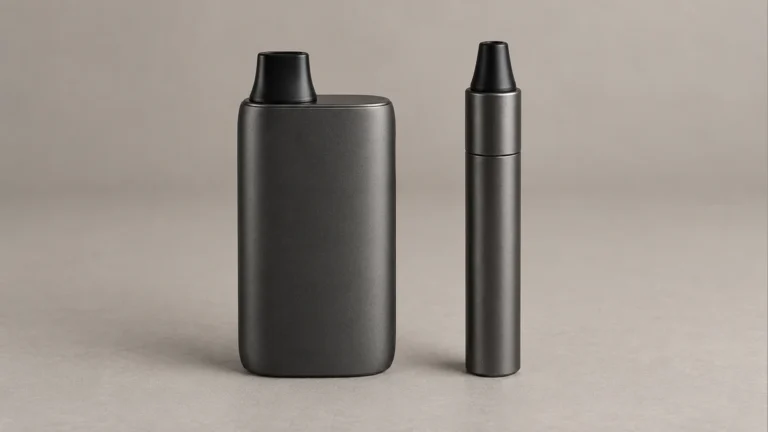
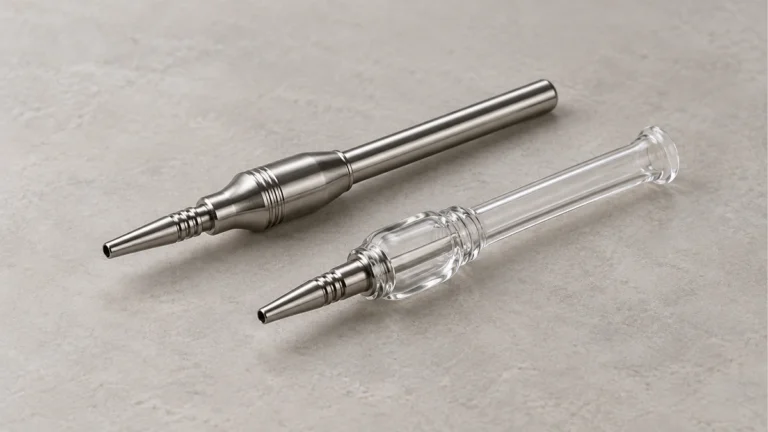
Picture the counter at a vape shop: two coil boxes side by side, one stamped 0.15Ω, the other 1.2Ω. A first-time sub-ohm buyer reaches for the lower number without hesitation, the same instinct that makes people grab the phone with more gigabytes or the router with the bigger number on the label. Lower ohms, the thinking goes, must mean a stronger, “better” coil. It’s an understandable guess, and it’s wrong often enough to cause burnt cotton, gasping hits, and a fair number of returned tanks. Resistance isn’t a quality score. It’s one variable in an electrical relationship, and it only means something once you know what else is in the equation — the voltage behind it, the wattage it produces, the mass of metal doing the heating, and the airflow carrying that heat to your mouth.
This piece isn’t a coil-building tutorial, and it isn’t going to hand you a formula to push past what your device or coil is rated for. It’s meant to do something more useful: help you read an ohm number the way an electrician reads it, as a description of resistance to current flow, so you can understand why two coils with wildly different resistance can produce a similar draw, and why two coils with the same resistance can feel completely different depending on the hardware around them.
🔎 1. The Number on the Box Isn’t a Score
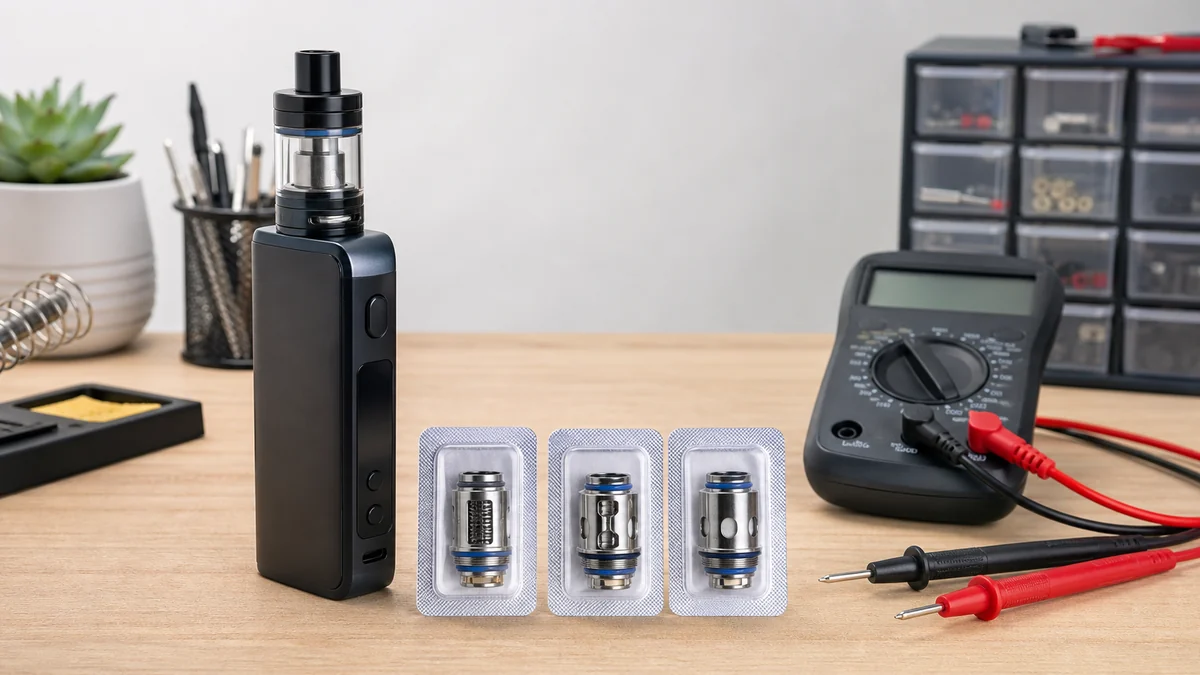
Ohms measure electrical resistance — how much a material or component opposes the flow of electric current. That’s the full definition, and it’s a neutral, descriptive one. It says nothing about flavor, cloud size, or whether a coil is “better.” A 0.15Ω coil resists current flow less than a 1.2Ω coil, which means more current moves through it for a given voltage. That’s a physical fact, not a performance verdict.
The confusion usually traces back to vaping’s own history. In the early regulated-mod era, before boards could safely manage high current at low resistance, going lower on ohms really was one of the few ways to push more power out of a fixed-voltage device. Sub-ohm coils became associated with “leveling up,” and the habit of equating low resistance with a better vape stuck around long after devices changed. Modern regulated mods manage wattage directly, which means the coil’s resistance is just an input the chip uses to calculate current — not the lever you pull for a stronger experience.
🔎 2. The Circuit Behind the Coil: Voltage, Current, Power
To make sense of resistance, it helps to see the three quantities it lives alongside: voltage, current, and power. The relationship between them is described by Ohm’s Law and the power equation, both foundational to how electrical current is defined and measured.
🧩 2.1 Ohm’s Law in Plain Terms
Ohm’s Law states that current equals voltage divided by resistance (I = V/R). Lower the resistance while holding voltage steady, and current goes up. That’s why a sub-ohm coil on a fixed-voltage device draws noticeably more current than a higher-resistance one — not because it’s more capable, but because the math forces more current through the path of least resistance. Current, measured in amperes, is one of the seven base quantities in the International System of Units, and it’s the variable a battery and its protection circuitry actually have to survive.
🧩 2.2 Why Wattage, Not Resistance, Is the Real Dial
Power — wattage — is what most people are actually chasing when they think “stronger hit.” Power equals voltage multiplied by current, and by substitution, it can also be expressed in terms of resistance and current, or resistance and voltage. The practical upshot: the same wattage can be produced by very different resistance and voltage combinations. A regulated mod set to 40W delivers roughly the same power whether the coil reads 0.2Ω or 1.0Ω, because the board adjusts voltage to compensate. This is the core reason experienced builders talk about wattage as the control that matters, while resistance is just one of the numbers the device uses to get there. Regulated chipsets calculate the safe voltage window for a given coil automatically — you’re setting the output, and the board is doing the resistance math in the background, similar in spirit to how a battery charging circuit manages voltage and current to protect a cell rather than leaving it to guesswork.
🔎 3. What Resistance Actually Changes Inside the Coil
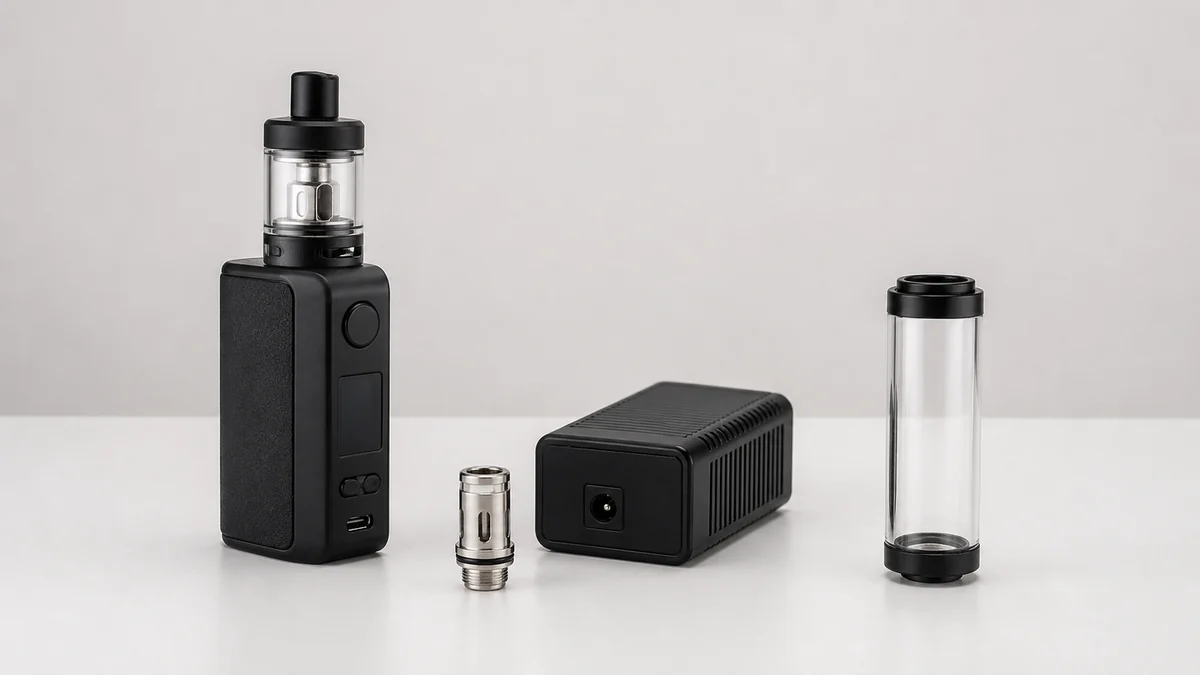
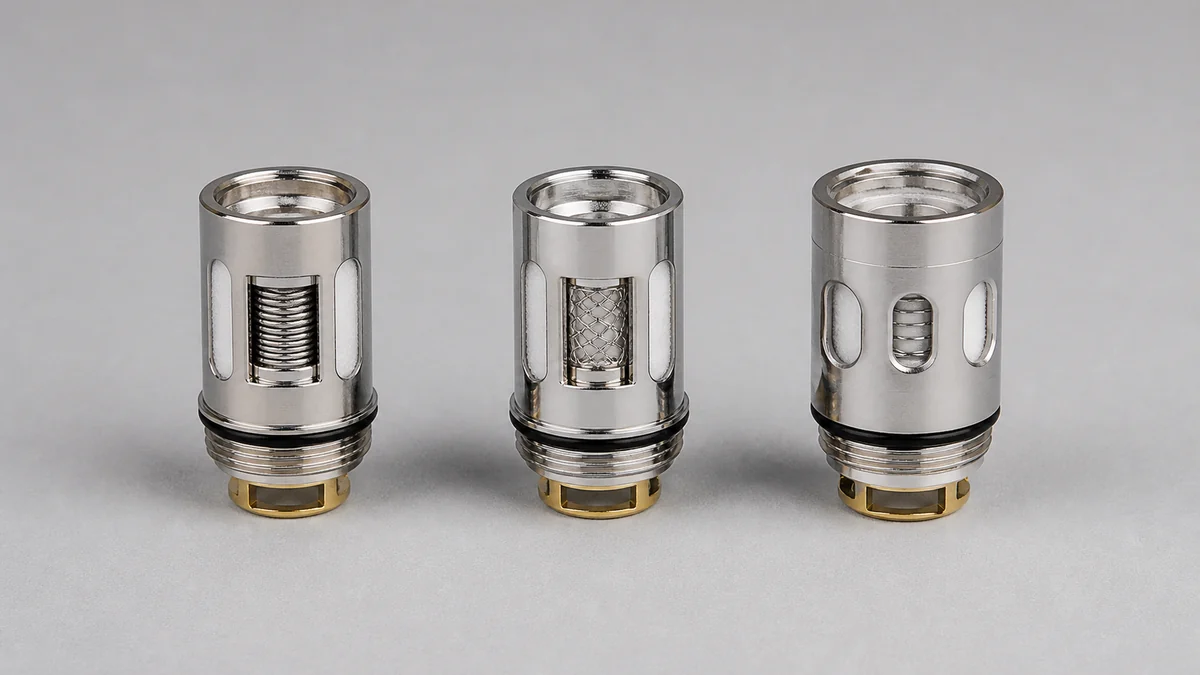
None of this happens in the abstract — it plays out inside a physical piece of resistance wire wrapped into a coil, sitting on a wick, inside an atomizer. Resistance is a product of the wire’s material, its length, and its cross-sectional area. Understanding that helps explain why coil resistance correlates loosely with build style, even though it isn’t a direct measurement of it.
🧩 3.1 Heater Mass and Wire Length
A thicker, longer, or multi-strand coil typically has lower resistance and more metal mass to heat up. More mass means the coil takes a fraction of a second longer to reach vaporizing temperature, but it also holds heat more steadily once it gets there — part of why some builders associate low-ohm, high-mass coils with a fuller, “creamier” vapor. A thin, short coil reaches temperature almost instantly and cools just as fast, which suits quick, tight-draw vaping. Neither is objectively better; they’re different thermal behaviors that happen to correlate with different resistance ranges. If you want the fuller mechanical picture of how a coil, wick, and airflow chamber work together to produce vapor, AOVAPE’s guide on how an atomizer works walks through that relationship in more depth.
🧩 3.2 Surface Area and Airflow Have to Match
Heater mass means nothing without airflow to carry the heat away from the coil surface. This is exactly the mismatch behind one of the most common new-vaper complaints: a hot drip tip at higher wattage. If airflow is restricted relative to how much heat a coil is producing, that heat has nowhere to go but up the airflow path and into your mouth. A lower-resistance, higher-wattage coil generally needs a wider air channel to stay comfortable; a tight, MTL-style airflow paired with a high-power sub-ohm coil is a recipe for a scorched drip tip regardless of what the ohm reading says. This is a system problem, not a resistance problem, and it’s a good reminder that resistance is only one part of a tank or pod’s overall design, alongside the other components covered in AOVAPE’s vape parts overview.
🔎 4. Device Limits, Protection Circuits, and Why They Exist
Every regulated device has a minimum resistance it’s rated to fire safely, and every coil has a resistance range the manufacturer designed it to operate within. These aren’t arbitrary caution labels. A board that fires below its rated minimum resistance can pull more current than its internal components — and the battery behind them — are built to sustain repeatedly. High-current, high-energy battery cells carry real risks when they’re operated outside their designed limits, which is part of why consumer safety guidance around high-energy batteries emphasizes using devices and cells within their intended specifications rather than pushing past documented limits. A device’s onboard protection circuitry and resistance floor exist specifically to keep current draw inside a range the battery and board can handle.
Coils have documented ranges for the same reason, and staying inside them protects more than the hardware — it protects the vaping experience itself. A coil rated for a certain wattage band that’s driven well past it will scorch cotton and degrade flavor long before anything fails outright. The fix isn’t a formula; it’s checking the printed range on the coil packaging or tank and the resistance floor listed in your device’s manual, and treating both as real limits rather than suggestions.
🔎 5. Matching Resistance to How You Actually Vape
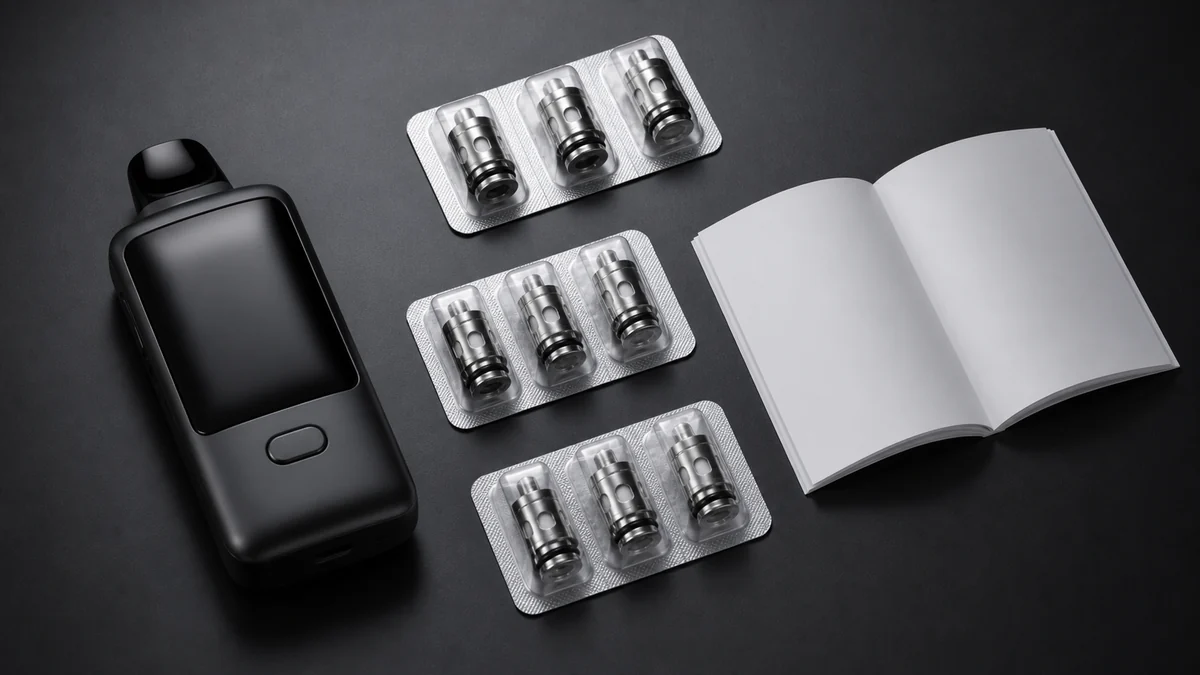
Resistance correlates with two very different inhale styles, which is a more useful lens than “high” versus “low.” Mouth-to-lung (MTL) vaping mimics drawing through a straw — a tighter, more restricted pull, generally lower wattage, and typically paired with higher-resistance coils. Direct-to-lung (DTL) vaping is a fuller, more open draw straight to the lungs, generally higher wattage, and typically paired with lower-resistance, sub-ohm coils. Neither style is more advanced than the other; they’re different mechanics that call for different coil and airflow combinations.
This is also where a lot of new-vaper frustration actually originates. Running a very low-resistance, high-wattage coil through a tight MTL airflow — or the reverse, a high-resistance coil starved of power through a wide-open DTL setup — produces exactly the kind of harsh, hot, or flavorless hits that get blamed on “bad juice” or “bad hardware” when the real issue is a mismatch between resistance, wattage, and airflow. If you’re chasing flavor specifically and finding higher-wattage sub-ohm setups run hot or harsh, that’s often a signal to look at MTL or restricted-DTL hardware rather than turning the wattage down further on an atomizer built for airier draws.
🔎 6. Reading a Resistance Label Without Guessing
The table below is a general reference for how resistance ranges commonly line up with inhale style and typical power needs. It’s meant to orient a purchase decision, not to replace the specific coil chart or manual for whatever tank, pod, or mod you actually own — those documented ranges always take priority.
| General resistance range | Commonly associated style | What to check before buying |
|---|---|---|
| Higher resistance (often above 1.0Ω) | MTL, restricted draw | Device’s supported wattage floor and the coil’s rated wattage band |
| Sub-ohm (below 1.0Ω) | DTL, airier draw | Device’s minimum resistance rating and battery/current handling |
| Very low sub-ohm ranges | High-airflow DTL, dual-coil builds | Manufacturer’s documented range and device’s max output — never exceed either |
A coil’s printed wattage range is the fastest sanity check available. If a coil lists a 25–45W range, firing it at 60W isn’t unlocking hidden performance — it’s operating outside the manufacturer’s tested envelope. The same logic applies to a device’s resistance floor: if a mod lists a 0.1Ω minimum, that number reflects what its board and battery pairing were engineered to handle, not a target to approach for bragging rights.
🔎 7. Quick Answers
Does a lower ohm reading mean a coil is higher quality? No. Resistance describes the wire’s electrical properties, not its construction quality or the vendor’s manufacturing standards. Two coils at the same resistance can differ meaningfully in wire quality and wicking.
Why did my coil’s resistance change after regular use? Resistance readings can shift as a coil ages or as wire and wicking conditions change with use. If a change comes with degraded taste or performance, that’s a signal to check the manufacturer’s guidance or replace the coil rather than to diagnose the exact cause yourself.
Can I use a lower-resistance coil than my tank recommends to get more vapor? Stay inside the coil and device’s documented ranges. Manufacturers test specific resistance and wattage combinations for a reason, and going outside them is a hardware and safety decision, not a flavor tweak.
🔎 8. Making the Decision That Actually Matters
The next time a resistance number is the only thing separating two coils on a shelf, the useful question isn’t “which one is lower.” It’s “which one matches how I actually draw, and does it fall inside what my device and the coil itself are rated for.” Resistance is real, measurable, and worth understanding — but it’s a description of one part of a circuit, not a scoreboard. Pair it with the wattage your device is set to, the airflow your tank or pod offers, and the ranges printed on the box, and the ohm number stops being a mystery and starts being just what it always was: one input in a system, not the whole system. When resistance, device specs, or replacement parts get complicated, AOVAPE’s contact page is available for hardware questions that go beyond what a label alone can answer.
📚 9. Sources
- National Institute of Standards and Technology — SI Units: Electric Current, https://www.nist.gov/pml/owm/si-units-electric-current
- U.S. Consumer Product Safety Commission — High-Energy Batteries, https://www.cpsc.gov/Safety-Education/Safety-Education-Centers/High-Energy-Batteries