🧭 1. Why People Build Custom Lighter Mounts
A lighter holder for a bong is not a factory-standard part. Most water pipes ship with nothing more than a bowl, a stem, and maybe a downstem grommet. Anyone who wants a dedicated place to keep a lighter has to add one after the fact, which is why so many of these holders show up as home projects rather than store-bought accessories. People print clips, glue on felt pads, or wrap bands around the neck because the piece they already own has no attachment point built in.
That gap creates a recurring question: what actually counts as a “holder,” and where should it go? A pocket clip meant for a shirt is not the same as a mount meant to grip a round glass tube. A holder that works on a straight-tube bong may not work on a beaker base with a flared bottom. Before comparing designs, it helps to break the problem into the physical variables that decide whether any given holder will actually stay put, hold the lighter securely, and not interfere with how the piece is used.
🧩 1.1. The Fit Question Behind Every DIY Mount
Almost every home-built holder starts from the same complaint: a bought accessory didn’t fit the user’s specific lighter, bong shape, or both. Fit has two independent parts. The first is how closely the clip or pocket matches the lighter’s outer dimensions. The second is how securely the mount itself attaches to the glass, given that bong surfaces are curved, tapered, and vary a lot in diameter. A holder can solve one problem and fail the other, which is the root cause behind most “it looked fine but didn’t work” results.
🧩 2. Clip Geometry and Lighter Size
Lighters are not a single standardized shape. The most common disposable butane lighters sold in North America are close to the same footprint, but “close” is not identical, and small differences compound once a rigid clip is involved.
| Lighter type | Typical body width | Typical body depth | Clip fit challenge |
|---|---|---|---|
| Standard disposable (e.g., Bic-style) | ~23 mm | ~12 mm | Baseline most clips are designed around |
| Mini/compact disposable | ~18 mm | ~10 mm | Loose fit in standard clips, can slide or rattle |
| Refillable butane lighter | Varies widely | Varies widely | Often too tall or too wide for snap clips |
| Torch-style lighter | Wider, often flared base | Deeper | Usually needs a sleeve or strap instead of a snap clip |
A clip engineered for the standard disposable size will grip a mini lighter loosely and may not open wide enough for a refillable or torch body at all. This is the practical reason so many homemade holders are sized around one specific lighter rather than built as a general-purpose fitting.
📏 2.1. Tolerance, Not Just Size
Fit is really about tolerance: the small gap between the clip’s inner dimension and the lighter’s outer dimension. Too tight, and the lighter is hard to insert or remove and the clip material is under constant stress, which matters more for printed plastic than for metal. Too loose, and the lighter rattles, tips forward, or falls free when the bong is picked up at an angle. A well-matched holder usually has just enough clearance to insert the lighter with light pressure and enough spring-back in the clip material to apply steady, even tension against the lighter’s flat sides rather than pinching only at two points.
🌬️ 2.2. Why “Universal” Clips Often Don’t Fit
A clip advertised as universal is typically sized for the most common disposable lighter and then given some flex to approximate other sizes. That flex has limits. Once a lighter is significantly narrower, wider, taller, or has a flared igniter housing, a “universal” clip either grips weakly or doesn’t close at all. This is also why several independent builders have arrived at nearly identical solutions: once someone owns a lighter that doesn’t match the common mold, a custom-fit clip becomes the only reliable option, rather than a preference.
📏 3. Center of Gravity and Mount Placement
Where a holder attaches on the bong matters as much as how well it grips the lighter. A full-size lighter is not light once combined with a rigid clip and possibly a magnet or adhesive pad. Adding that mass to the wrong spot changes how the whole piece balances, especially on tall or top-heavy bongs.
Mounting a lighter holder near the top of a long neck raises the combined center of gravity and makes the bong more likely to tip from a bump or an uneven surface. Mounting it lower, closer to the base, keeps the added weight near the piece’s natural balance point and has less effect on stability. This is a basic lever problem: the same mass causes more tipping force the farther it sits from the base.
🌬️ 3.1. Base-Level vs Neck-Level Mounting
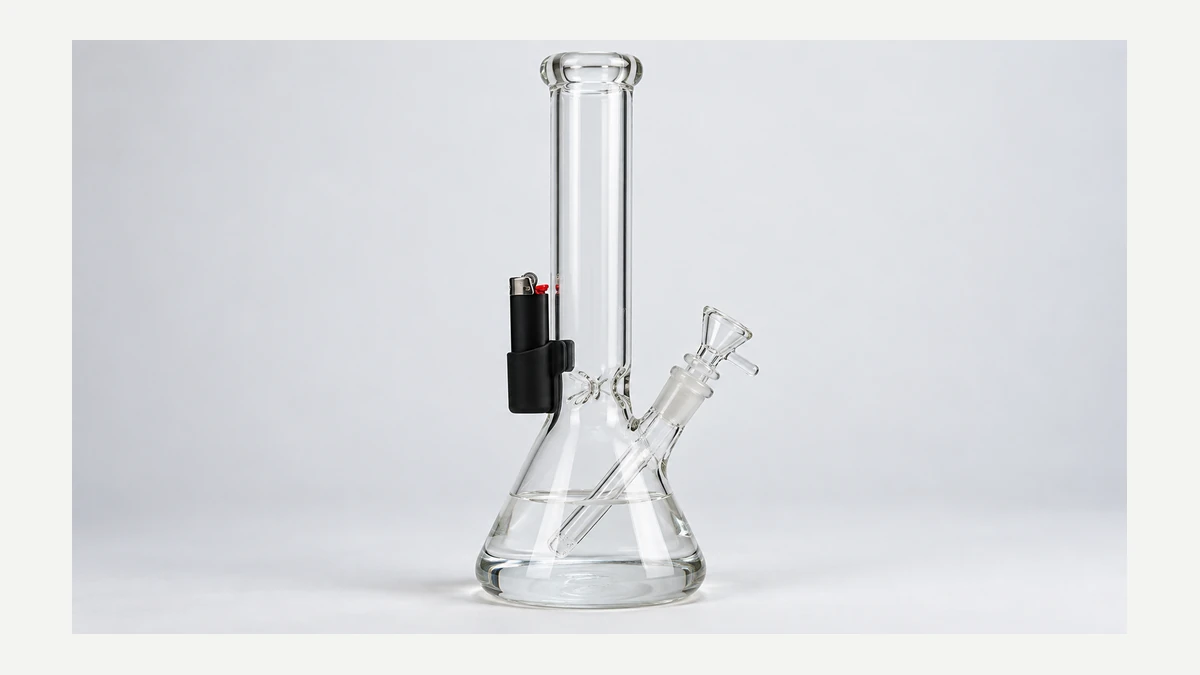
Base-level mounts, often wrapped around the lower chamber or built into a base pad, add stability-neutral weight because they sit close to where the bong already contacts the table. Neck-level mounts are more visually convenient and keep the lighter within easy reach, but they turn every lighter swap into a small balancing act, particularly on narrow-footed or beaker-style pieces that are already prone to tipping. Builders who’ve dealt with a knocked-over piece tend to shift subsequent designs toward base-level placement, less out of preference and more because the physics made the neck-level version impractical.
🌬️ 4. Surface Protection and Attachment Methods
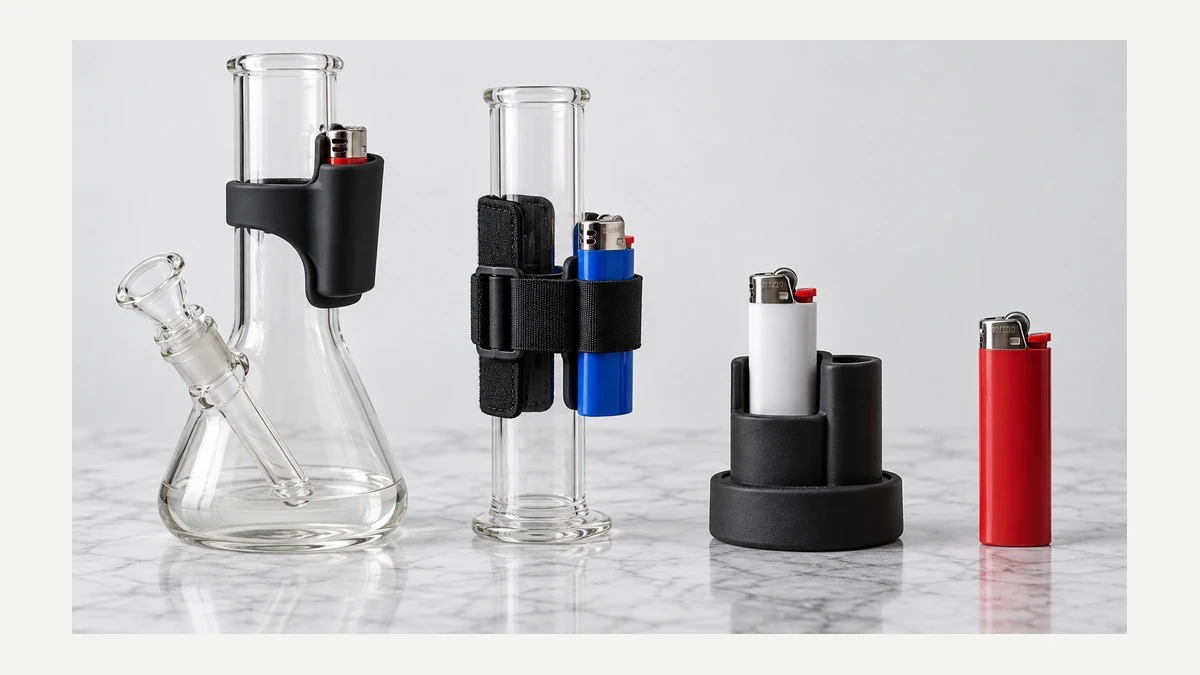
Any holder has to attach to the bong somehow, and that attachment is the part most likely to cause damage if it’s chosen poorly. The three common methods are adhesive pads, elastic or hook-and-loop bands, and rigid clip-on mounts that clamp directly onto the glass.
- Adhesive pads stick well but leave residue if the backing isn’t rated for the surface, and some adhesives degrade with repeated temperature changes near the bowl.
- Bands and straps avoid adhesive residue entirely and are easy to reposition, but they rely on tension, which can slip on smooth glass or loosen over time.
- Rigid clamp mounts hold their position reliably but concentrate pressure at a few contact points, which raises the risk of scratching or, on thin glass, stressing the surface if the clamp is overtightened.
⚖️ 4.1. Pads, Bands, and Sleeves in Practice
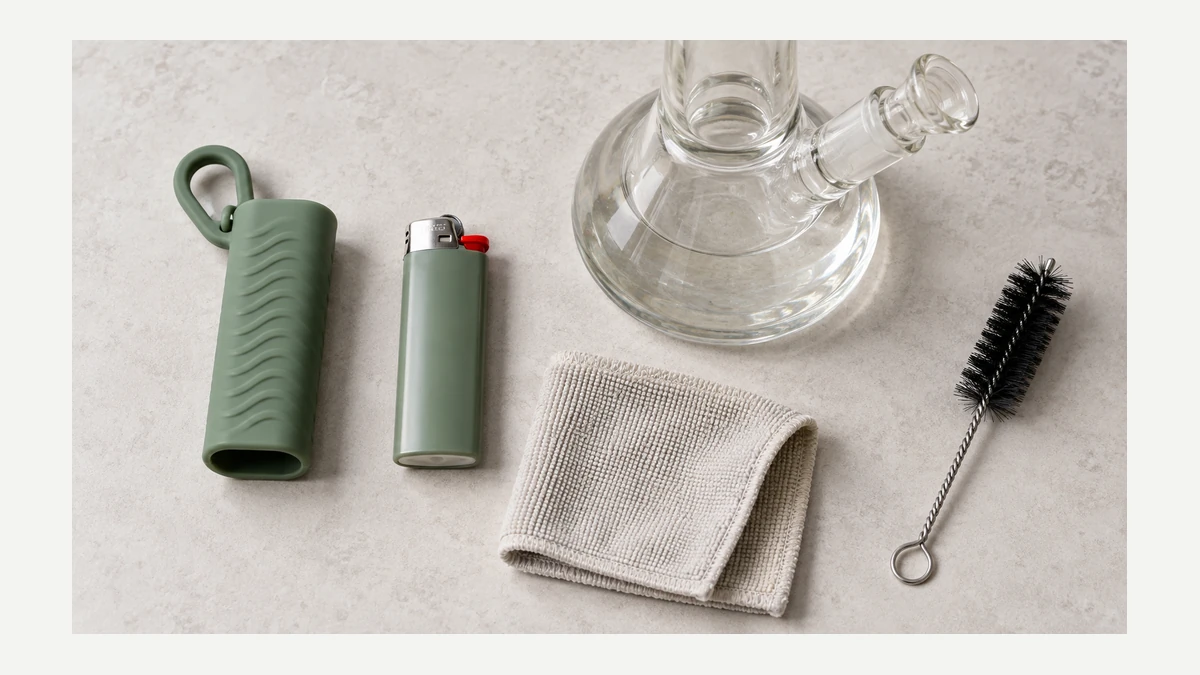
A silicone sleeve or pad distributes contact over a wider area than a hard plastic clamp, which is why many combined “bong pad and lighter holder” designs use a soft base layer with a separate, harder clip layer on top for the lighter itself. The soft layer protects the glass; the rigid layer handles the lighter’s weight and shape. Splitting those two jobs between two materials, rather than asking one material to do both, is a recurring pattern in the more durable designs.
🧼 4.2. Glass Contact Points and Pressure
Glass bongs vary in wall thickness, and a mount that’s safe on a thick-walled piece can be risky on a thin-walled one. Any attachment that clamps directly onto glass should spread its grip over a broad, flat contact area rather than relying on narrow pressure points, screws, or sharp-edged plastic ribs. A mount that needs to be forced into place to stay closed is applying more clamping force than a glass surface should regularly take.
⚖️ 5. Heat Separation and Flame Clearance
A lit lighter produces a flame and a hot metal or plastic body that stays warm for a short period after use. A holder positioned too close to where the lighter is actually struck and used creates two separate risks: the flame itself near plastic components, and residual heat transferring into the clip material after repeated use.
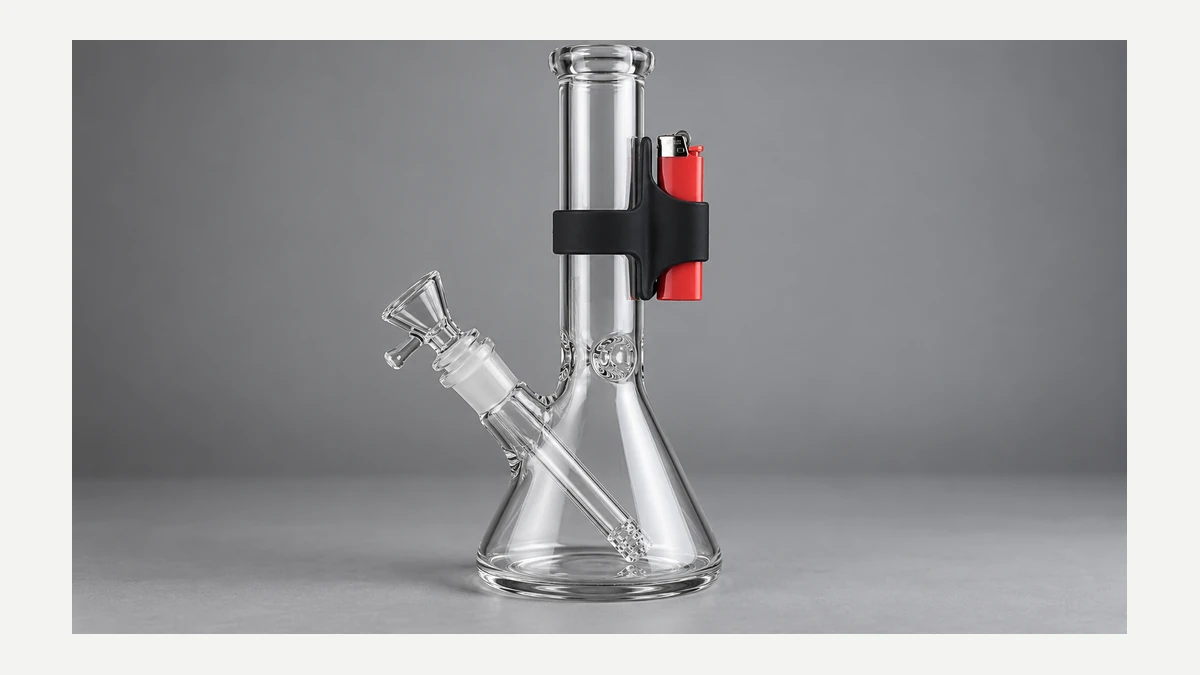
Holders made from standard PLA or similar low-temperature plastics are more vulnerable to this than metal or heat-resistant silicone mounts, because repeated brief exposure to flame or hot metal can warp or discolor the plastic over time, even without direct contact. The practical takeaway is that a holder’s position relative to where the flame is produced, not just its position relative to the bong, is part of its design. A mount placed well below the bowl, with enough clearance that the flame never passes near the clip material, avoids this wear path entirely.
This is also why metal clip hardware, even on an otherwise plastic or printed holder, shows up often in more heavily used builds: metal tolerates brief heat exposure that would eventually degrade plastic.
🧼 6. Removable Design and Cleanup Access
Bongs need regular cleaning, and a lighter holder that’s permanently fixed to the piece can get in the way of that process. A holder glued or clamped directly over an area that needs to be wiped down, or one that blocks access to a joint during cleaning, creates friction between two separate goals: keeping the lighter handy and keeping the bong clean.
Designs that solve this cleanly tend to separate the “holder” into two pieces, a base that stays attached and a clip or cartridge that detaches independently of the base. bong travel case guide That way the lighter and its clip can be pulled off entirely before the bong goes into a cleaning solution, without needing to peel off adhesive or unscrew a mount each time.
A band-style mount has an advantage here because it can usually be slid off and back on without tools. A glued pad has the opposite tradeoff: it stays in place reliably but is harder to remove temporarily, which is part of why several DIY builders mention redesigning an adhesive version into a strap or clip-based version after the first few cleanings.
🔍 7. Material Choices in Homemade and Printed Holders
Because lighter holders are rarely sold as standalone bong accessories, a large share of the ones in circulation are 3D printed or hand-fabricated from basic hardware store materials. Material choice affects grip, heat tolerance, and how the holder wears over time.
| Material | Grip behavior | Heat tolerance | Common failure mode |
|---|---|---|---|
| PLA (printed) | Rigid, holds shape well when new | Low; softens under sustained heat | Clip arms become brittle or warp near flame |
| PETG/ABS (printed) | More flexible, slightly more heat-tolerant than PLA | Moderate | Clip loosens with repeated flexing over time |
| Silicone | High-friction, conforms to lighter shape | Good | Can stretch out of shape with heavy daily use |
| Metal clip hardware | Firm, consistent spring tension | High | Can scratch glass or lighter finish if edges aren’t smoothed |
bong mouthpiece guide None of these materials is universally “best”; each one trades off differently between grip consistency, heat exposure, and long-term durability. A printed PLA clip is easy to size exactly to one lighter but is the most heat-sensitive option on this list, while a metal spring clip tolerates heat well but needs smoothed edges to avoid marking the glass or the lighter’s casing.
🧲 8. Reading a Lighter Holder Before You Trust It
Judging whether a given lighter holder will actually work doesn’t require guessing. The physical checklist is short and consistent across every design discussed above:
- Does the clip’s inner dimension match the specific lighter’s width and depth, not just a generic “standard” size?
- Is the holder mounted close to the bong’s natural base rather than high on the neck, so added weight doesn’t shift the center of gravity upward?
- Does the attachment method spread contact pressure over a broad area of glass rather than concentrating it at a few hard points?
- Is there enough physical separation between the mounted lighter and the bowl or flame path to avoid repeated heat exposure to the clip material?
- Can the holder, or at least the clip portion, be removed without tools when the bong needs to be cleaned?
glass screen guide A holder that answers all five points well is likely to hold up under regular use. One that only solves the fit problem, or only solves the attachment problem, is the kind of design that tends to get rebuilt a second time once its weak point shows up in practice.
🌊 9. ✅ A Holder Is Successful When It Disappears from the Routine
The practical test is simple: the lighter inserts and releases with one hand, the holder stays below hot components, and the bong remains stable with the lighter installed or removed. If the mount twists, rubs the glass, blocks the grip, or traps cleaning moisture, convenience has created a new maintenance problem.