🧭 1. The Fit Confusion That Starts Most of These Questions
Most people run into their first real question about hybrid bongs the moment they try to take one apart to clean it. A silicone base holds a glass bowl or downstem, and it isn’t obvious which parts are supposed to come apart, which ones are sealed by friction, and which ones were never meant to separate at all. That confusion is reasonable. A hybrid piece is doing two different engineering jobs with two different materials, and the line between them is exactly where most fit and seal questions come from.
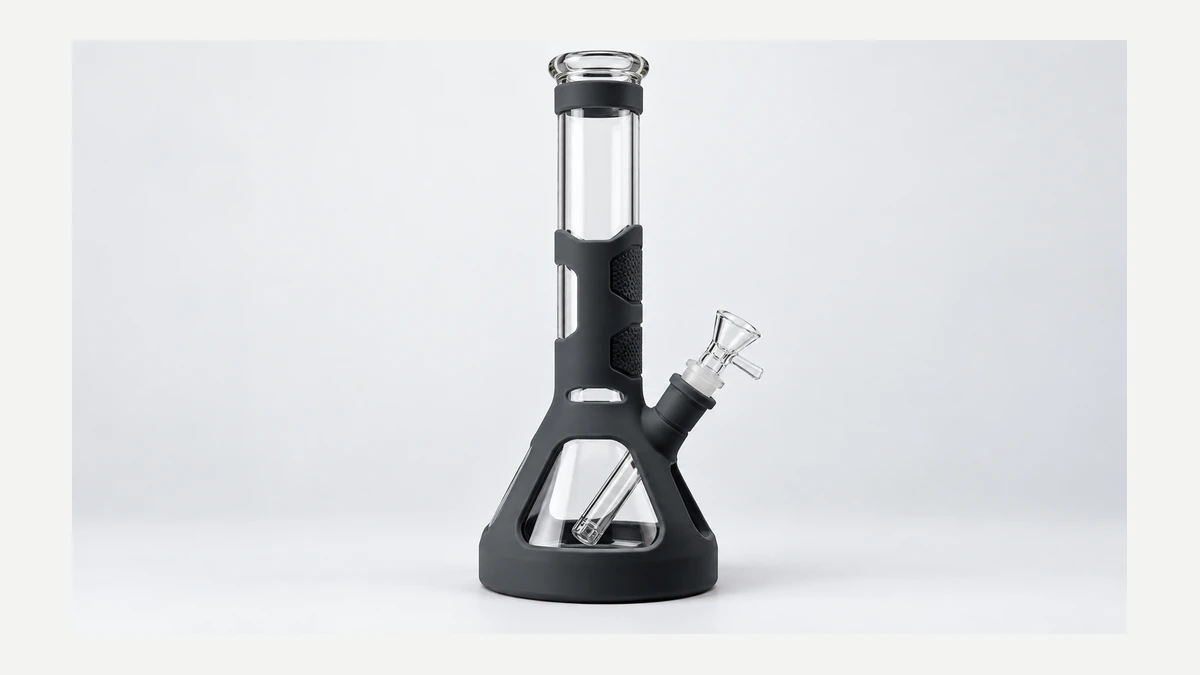
Understanding a silicone-and-glass bong starts with treating it as two separate systems joined at specific points, not as one material with a different finish. Each material is assigned to the job it’s physically suited for, and the places where they meet are the parts worth paying attention to.
The first inspection is easiest when the piece is empty, dry, and cool. Set it on a level surface and identify every point where rigid glass enters a flexible opening. A clean interface should sit evenly around its circumference, without a rolled lip, visible gap, or glass edge pressing against only one side. If the neck leans after assembly, the problem may be a folded seal or debris in the groove rather than the overall shape of the body.
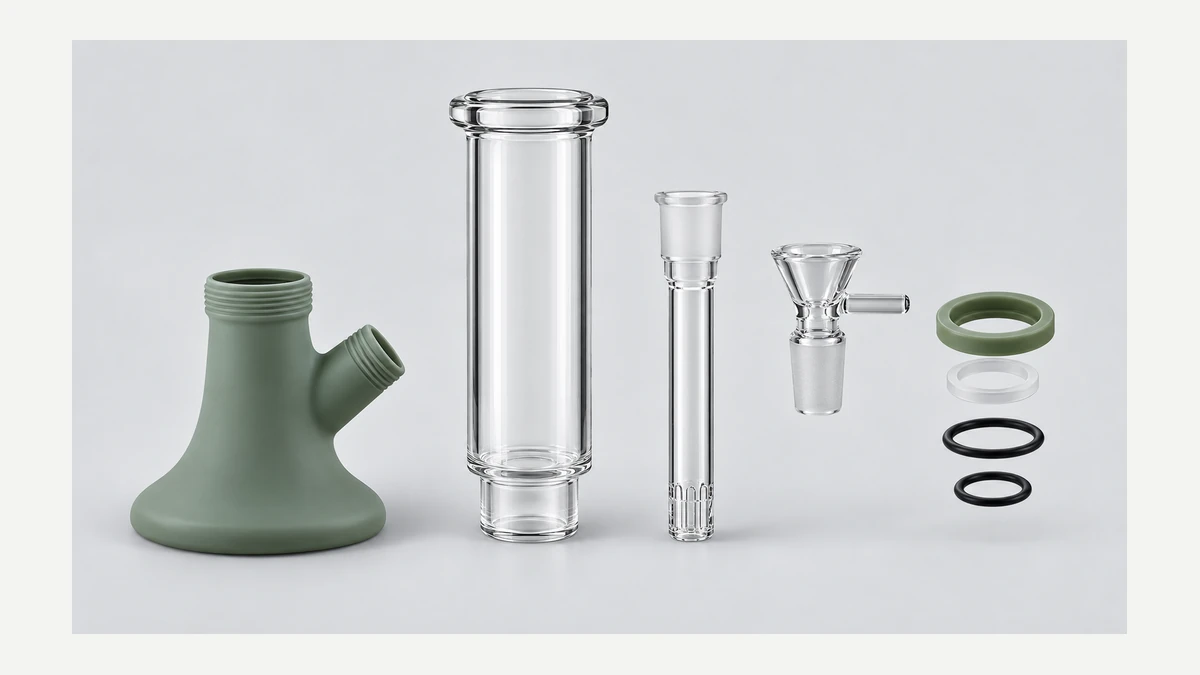
Next, hold the broad silicone section rather than pulling on the bowl arm or mouthpiece. Gentle support at the base reveals whether the glass insert is retained by a collar, a compression fit, or a separate gasket. Those methods are not interchangeable. A compression fit depends on the correct glass diameter and an undamaged opening; a gasketed joint depends on the gasket sitting flat; a locking collar depends on the parts being aligned before pressure is applied.
This cold inspection also exposes a common category mistake. A silicone sleeve around a conventional glass chamber is different from a mostly silicone chamber fitted with glass accessories. Both may use the same marketing phrase, but the first keeps the water path visible while the second places more seams and opaque surfaces inside the path. The cleaning routine and replacement boundaries therefore differ even when the products look similar in a front-facing photo.
🧩 2. What the Rigid Sections Are Actually Doing
The glass components in a hybrid piece are almost always the parts that touch the air directly on its way to your lungs: the bowl, the downstem, and often a percolator chamber. Glass holds this role because it is dimensionally stable. A ground glass joint only seals correctly if its diameter stays exact, and glass doesn’t flex, swell, or compress the way a soft material would under the same conditions.
📏 2.1. Joints and Downstem Seals
Standard joint sizes — commonly 14mm or 18mm, male or female — rely on a consistent taper between two glass surfaces to create an airtight friction fit. That seal is a product of precise, unchanging geometry. Swap in a flexible material at that junction and the seal becomes inconsistent, which is why removable bowls and downstems on hybrid pieces are glass-on-glass even when everything surrounding them is silicone. silicone versus glass rig guide
🌬️ 2.2. Bowl Seating and Airflow
The bowl’s seating also has to withstand repeated insertion and removal without wearing down or warping. Glass tolerates that mechanical cycling because it doesn’t deform under light rotational pressure the way a softer material gradually would. Airflow through the downstem and any percolation slits also depends on fixed internal dimensions — a flexible tube at that stage would change the draw resistance over time as it got bent or compressed.
📏 3. What the Flexible Sections Are Actually Doing
The silicone sections are assigned a different job: absorbing shock and holding a stable footprint. Silicone’s job has nothing to do with the air pathway and everything to do with surviving contact — with a table edge, a bag, or a drop.
🌬️ 3.1. Impact Absorption and Base Stability
A wide, flexible silicone base lowers the center of gravity and flexes on impact instead of cracking. That’s the main functional reason hybrids put silicone at the bottom and glass at the top: the base is the part most likely to get knocked, and the airpath is the part that needs to stay dimensionally precise.
⚖️ 3.2. Collapsible and Segmented Geometry
Some hybrid necks use silicone sections specifically so the piece can collapse or fold for storage or travel. This only works because silicone can compress and return to shape repeatedly without fatiguing the way a rigid tube would. It’s a feature made possible by the material, not a style choice layered on top of a glass design.
🌬️ 4. Visibility: Where Hybrid Design Creates a Blind Spot
Opaque or colored silicone solves the durability problem but creates a new one: you can’t see through it. Water level, percolation activity, and resin buildup are all visual cues that regular glass pieces give you for free, and a fully silicone body removes them.
That’s why almost every hybrid design keeps a clear glass viewing section somewhere — a window in the base, a removable glass chamber, or a glass neck sitting on a silicone foot. If a hybrid piece has no clear section at all, water level and bubble/percolation behavior become something you have to judge by sound and draw resistance instead of sight, which is a real functional tradeoff worth knowing about before relying on one as a daily piece. silicone beaker bong guide
⚖️ 5. Heat Separation Between Materials
Where the flame actually touches the piece matters as much as what the piece is made of. Glass is positioned at the bowl and downstem because it tolerates direct, repeated, close-range heat without degrading. Silicone is kept away from that zone by design — it sits at the base, the neck, or the mouthpiece, where it only experiences warmed air, not direct flame contact.

This separation isn’t arbitrary. Repeated direct flame exposure against a flexible material causes visible surface changes over time — discoloration, texture changes, a slightly different feel — in a way that doesn’t happen to the glass sections handling the same job. That’s a physical property difference between the two materials, not a design flaw in either one, and it’s the reason hybrid pieces keep a consistent boundary between “where the flame goes” and “where the flexible material lives.”
🧼 6. Odor Retention: Porosity vs Smooth Surface
Glass has a hard, smooth, non-porous surface. Residue sits on top of it and wipes or rinses off cleanly, which is why a well-maintained glass chamber doesn’t hold onto smell between sessions. Silicone is also non-porous as a material, but its surface is typically softer and slightly textured from the molding process, which gives residue more surface area to cling to than a polished glass wall offers.
In practice, this means the glass sections of a hybrid piece are usually the easiest to get odor-free, while the silicone base and any silicone tubing need more deliberate attention to avoid holding onto smell longer than the glass does.
🔍 7. Cleaning Boundaries
Because the two materials behave differently under heat, solvents, and abrasion, they also have different cleaning limits. Treating a hybrid piece as one uniform object during cleanup is the fastest way to damage one half of it while trying to maintain the other.
🧲 7.1. What Each Material Tolerates
| Task | Glass sections | Silicone sections |
|---|---|---|
| Isopropyl alcohol soak | Generally tolerated well | Short soaks tolerated; prolonged soaking can dull or discolor the surface |
| Abrasive scrub (salt, brushes) | Safe on smooth interior surfaces | Can wear down texture or printed detail over time |
| Submersion | Fine for cleaning | Fine, but check vented or multi-piece joints for trapped water |
| Dishwasher | Risky — joint stress can crack glass | Often tolerated, but confirm the specific piece first |
| Boiling water | Can loosen stuck residue in thicker glass | Avoid — heat deformation risk |

The practical rule that falls out of this table is simple: clean the glass and silicone sections separately whenever the design allows it, and default to the gentler method for whichever material you’re less sure about. bong cleaning kit guide
🧲 8. Hardware Identification Takeaway
Before using or cleaning any silicone-and-glass bong, it helps to physically map the piece rather than guess:
- Find every joint where materials meet, and note whether it’s glass-on-glass (ground, friction-fit) or glass-seated-in-silicone (molded, not meant to rotate or pull apart the same way).
- Identify which section sits directly above the bowl — that’s the zone built to handle direct flame, and it should be glass or another heat-rated material, not flexible silicone.
- Check for a clear viewing window. If there isn’t one, you’ll need to rely on sound and draw feel to judge water level, since you can’t see it.
- Separate the materials before cleaning whenever the design permits, since alcohol soaks, abrasives, and heat each affect glass and silicone differently.
Once you can point to each section of a hybrid piece and say what job it’s doing — sealing, absorbing impact, staying stable, or handling heat — the earlier confusion about what’s “supposed” to move, separate, or survive a given cleaning method mostly resolves itself.
🌊 9. 🧩 Hybrid Construction Works Only When Each Material Has a Clear Job
Glass is rigid, transparent, and easy to inspect. Silicone is flexible, impact-tolerant, and able to form removable sleeves and seals. A well-resolved hybrid bong uses those properties deliberately: glass defines the air and water path while silicone protects, supports, or joins the rigid parts. If the silicone becomes the entire hidden chamber, visibility and cleaning access are reduced.
Follow the airpath instead of judging the outside silhouette. Identify the bowl joint, downstem, water chamber, neck, and mouthpiece in order. Every transition between glass and silicone is a seal that can leak, rotate, or trap moisture. Fewer interfaces are easier to inspect, but each remaining interface still needs enough support to stay aligned.
✅ 9.1. 🔍 Visibility Is a Maintenance Feature
A clear glass insert makes water level, residue, and diffuser coverage visible. That advantage disappears if an opaque sleeve covers the lowest part of the chamber. Look for windows around the waterline and a way to remove the glass without twisting a fragile joint. A sleeve should release from the broad body, not require pulling on the bowl arm.
When the glass insert is removable, inspect its rim and the matching silicone groove. Debris or a folded gasket can tilt the chamber and create an air leak. Reassemble dry so moisture does not mask the condition of the seal.
🧳 9.2. ⚖️ Flexibility Should Not Make the Joint Wander
A soft base can absorb bumps, yet the bowl joint still needs a stable angle. Press lightly on the cold, empty assembly from several directions. The base may flex, but the joint should not sag or rotate under the accessory’s weight. Wide contact area and a low center of gravity matter more than thick-looking silicone walls.
💧 9.3. 🧼 Clean Glass and Silicone as Separate Materials
Separate the parts only where the manufacturer intends. Glass tolerates different handling from flexible seals, colored sleeves, and bonded inserts. Use the documented cleaning method for each material, avoid sharp tools around sealing grooves, rinse thoroughly, and allow hidden channels to dry before reassembly.
Odor that persists after the glass looks clean often points to a sleeve, gasket, or covered cavity. That is why a hybrid bong should be evaluated as several serviceable components rather than as one unbreakable object.
✅ 10. ✅ Check the Interfaces, Not Just the Materials List
The phrase “silicone and glass” says little about which material forms the chamber, whether the glass is removable, or how the seal is retained. A useful specification shows an exploded view, identifies replacement parts, and explains how the cold assembly locks together. Those details predict serviceability better than a simple claim that the piece combines the benefits of both materials.