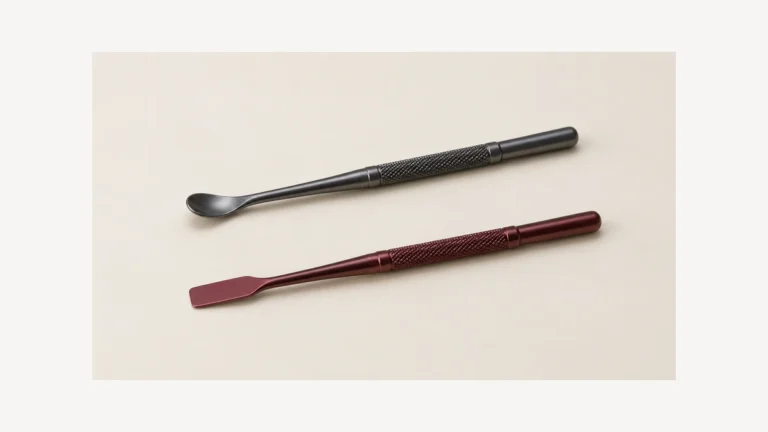
A loose dab scoop can resemble a kitchen, craft or cosmetic tool closely enough to be misidentified. A curved end tells you what the shape looks like; it does not identify the maker, material or intended conditions. If you are sorting a tool drawer, start by keeping unknown pieces separate from identified accessories. There is no reason to test an unmarked tool with material or heat to find out what it is. Its outline and any original packaging provide a much better starting point.
🔍 1. A Scoop Describes an End Shape, Not a Full Specification
Calling something a “scoop” tells you about the geometry of one end: there’s a concave surface capable of holding a small cavity. It says nothing about the metal or alloy behind that shape, how it responds to heat, or whether it was built for any particular routine. A listing titled “dab scoop” is naming a profile, not certifying a use case. This matters because buyers researching a fuller dab tool kit often assume the scoop label implies a matched spec sheet, when in practice it only confirms the curve exists.
In a discussion about a scoop-and-point tool, suggestions included a dab accessory, but the owner recognized a likely connection to latte-art equipment after replies supplied that context. The important detail is that identification changed when information about its origin appeared. The outline alone had supported several guesses. A similar object in another drawer would still need its own identification; the outcome of that one thread does not assign every scoop-and-point tool to the same application.
🧩 2. Curved Scoops and Flat Scrapers Are Different Outlines
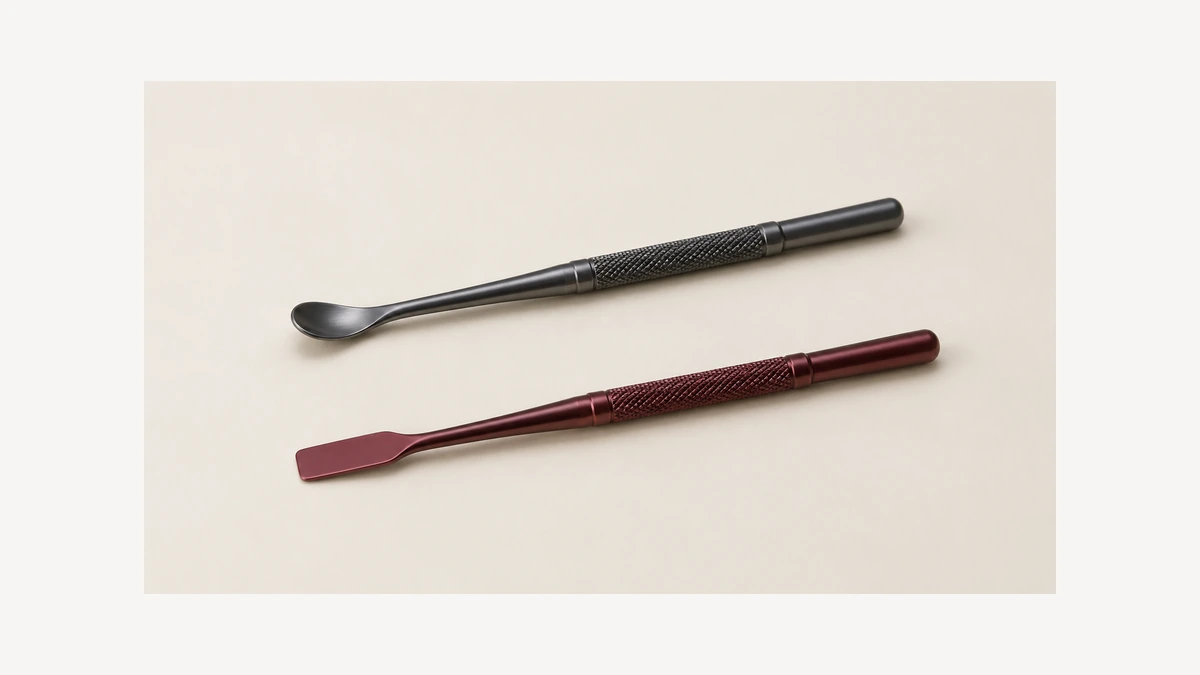
Two outlines get grouped under loose “dab tool” language even though they behave differently as empty-part shapes. A curved scoop has a cupped, concave face that forms a shallow cavity; a flat scraper has a straight or lightly angled edge with no cavity at all. The scoop profile is built to hold a small amount of space within its curve, while the scraper profile is built around a thin edge that meets a flat surface. These are not interchangeable terms describing the same end — they describe two different cross-sections.
Width and reach are the easiest features to compare when the tool is sitting empty in front of you. A wider, deeper scoop end reads differently than a narrow, shallow one, and a long scraper blade covers a different surface area than a short one. None of these measurements by themselves confirm what the tool was designed for, but they’re useful starting points when trying to separate one unmarked piece from another that looks similar at a glance.
📏 3. The Other End Needs Its Own Identity
Double-ended tools are common precisely because a single handle can carry two distinct working shapes, and each end deserves to be identified on its own rather than assumed from its partner. A scoop on one side doesn’t tell you what the opposite end looks like or does. Some opposite ends taper to a point, some flatten into a blade, and some repeat the same curve in miniature. Treating the second end as a known quantity just because the first end is recognizable is a common source of misidentification.
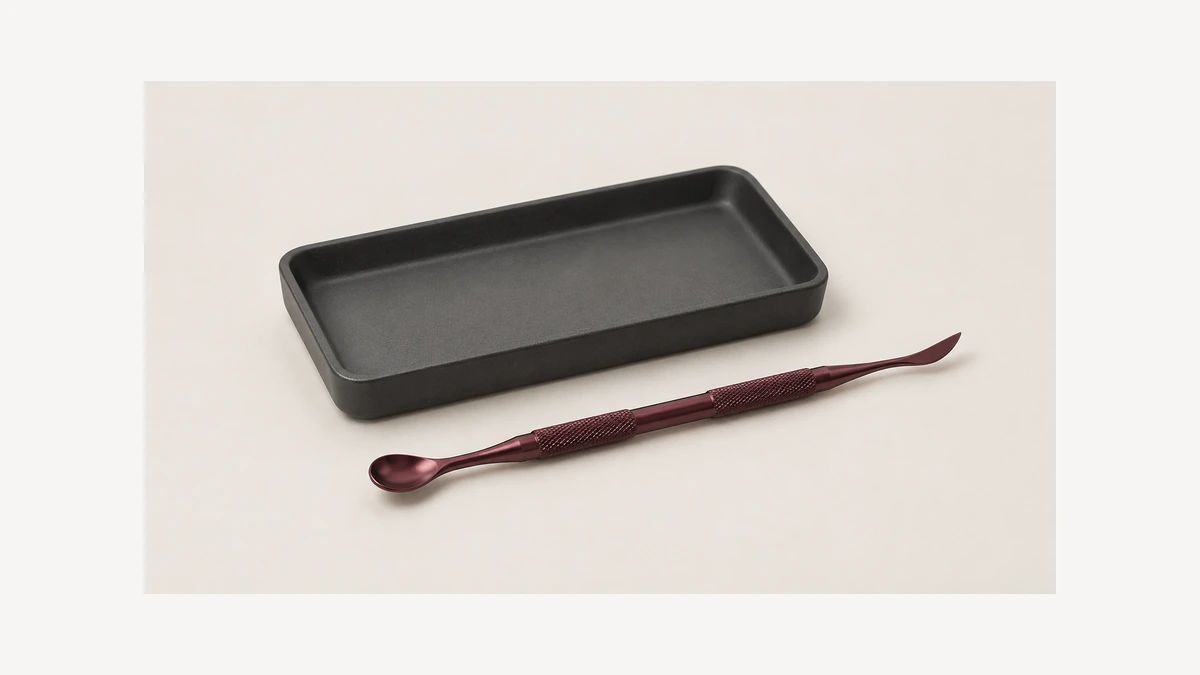
One maker’s own product description, for a tool called Scoop Dogg, is a useful example of how specific a shape description can be without extending into broader claims. According to the manufacturer’s page, the piece is double-sided, with a curved scooper on one end and a curved arrow point on the other. That description confirms two things: the tool has two distinct, intentionally shaped ends, and the shapes themselves are curved rather than flat or straight. It does not state a material grade, a temperature rating, or any universal application, and nothing beyond those two shape descriptions should be inferred from it.
🔎 4. Similar Kitchen and Craft Tools Cause Confusion
Outside of any niche marketplace, there’s no shortage of small metal implements that pair a cupped scoop with a pointed or angled opposite end. Cosmetic spatulas, nail-art picks, ceramics trimming tools, and miscellaneous kitchen utensils all draw from a similar design vocabulary, because a curved cavity paired with a narrow point is a practical, general-purpose combination. That overlap is exactly why resemblance alone can’t settle what drawer a given tool came from.
Casual conversation tends to blur these categories even further. In one thread, someone referred to a soft spatula as a dab tool, and other commenters pushed back, pointing out that a scoop or scraper is a different kind of implement than a part meant to make direct contact with a heated surface. The disagreement itself is the useful part: it shows that even people handling these tools daily don’t always agree on where one category ends and another begins, which is reason enough to avoid assuming identity from a photo or a casual label.
🔧 5. Handle Clearance and Separate Storage
A rigid double-ended tool does not have its own tips collide simply because its handle is short. What changes in storage is where the complete tool sits relative to neighboring objects and the case walls. A short recess may press against one end, while a narrow recess may not accommodate a wider scoop. Those are fit questions about an empty tool and its carrier. They do not establish anything about the material grade or whether a particular tip is meant to be removable.
Because each end is functionally independent, giving them separate space in storage is a straightforward way to protect both shapes. This is the same logic covered in more detail in a guide on glass dabber marks and storage, where contact points between tools and other surfaces are a recurring source of visible wear. A tool with two distinct ends benefits from the same separation principle, just applied to its own two tips rather than to a group of different tools.
⚠️ 6. A Stand Changes Where the End Rests
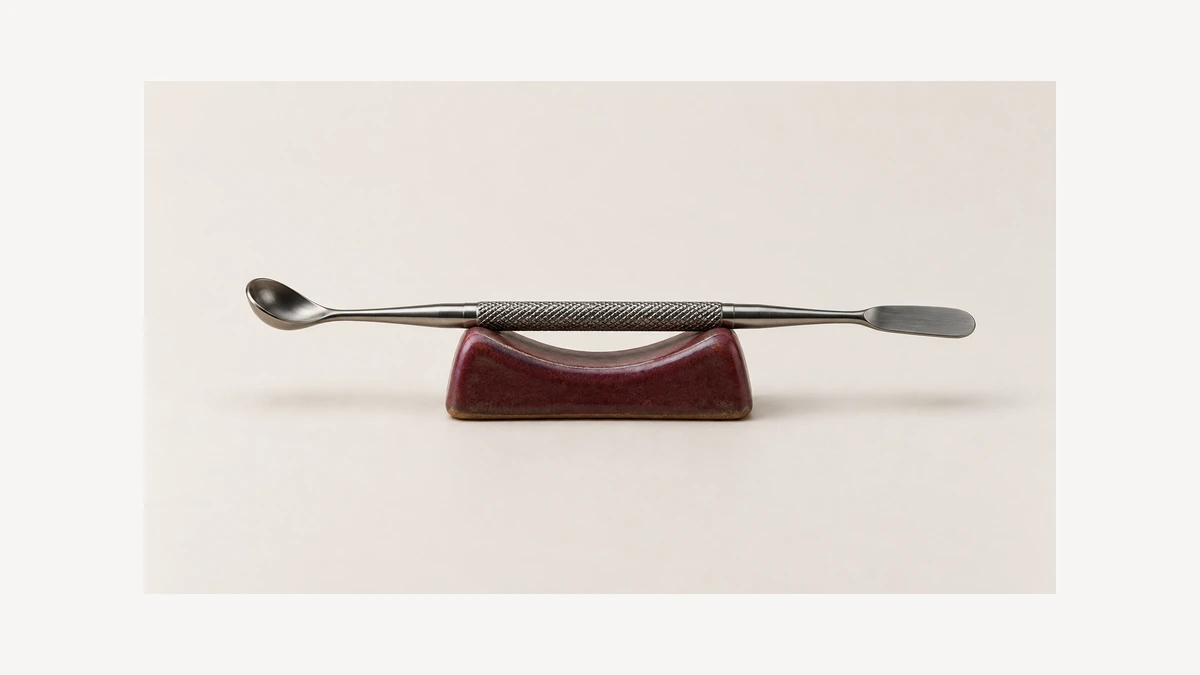
A rest can support a tool at the handle while leaving an end above the table, but not every stand produces that arrangement with every tool. The actual contact points depend on both shapes. A maker’s discussion of finished accessories includes a reader noticing an elevated working end. That observation explains why resting position interests owners; it does not prove that a different tool will balance the same way, or that the stand prevents contamination, damage or an accidental drop.
A stand’s main contribution to identification and care is keeping the ends apart from incidental contact, which is the same clearance logic covered in section five, just extended to the surface the tool sits on rather than the tools around it. Anyone weighing a stand as part of their setup can find a broader rundown in the existing dab tool stand guide, which addresses resting position and clearance in more depth.
📋 7. Visible Damage Is More Useful Than a Shiny Finish
A scratch, an uneven edge or a loose joint gives you something specific to describe, but it does not reveal how often the tool was handled or exactly what caused the mark. A polished tool can also have a defect. Record the location instead of assigning a grade from its shine: the inside curve, outer lip, transition into the shaft or joint between a tip and handle. Stop using a damaged or unidentified piece while the maker or supplier clarifies its condition and intended care.
This is a deliberately narrow claim. Visible wear doesn’t establish a temperature rating, a cleaning method, or a safety threshold for any particular tool — it only gives a more honest read on use history than a glossy, unmarked surface would. Treating a shiny finish as a stand-in for quality or origin skips past the more reliable evidence sitting in front of you.
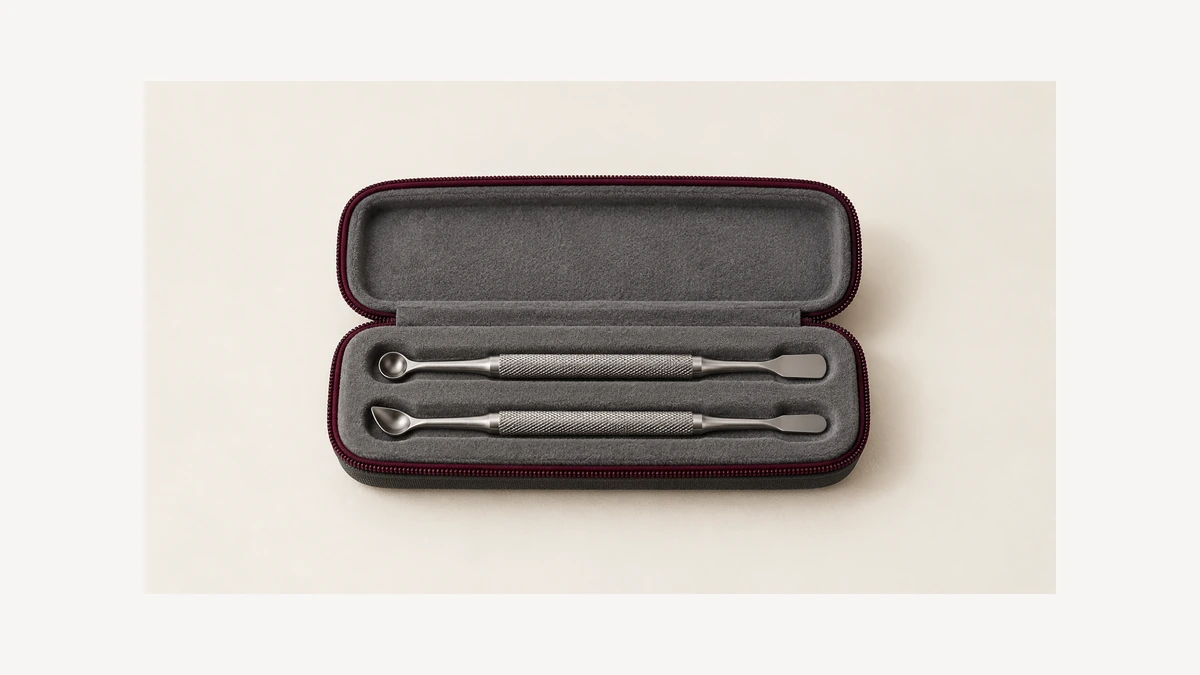
Consider an open case containing two unmarked tools with similar handles. One has a shallow curved end; the other has a flat blade that only looks curved because the photograph was taken at an angle. Put each empty tool against a plain background and describe both ends separately. A side view and a face view can communicate the outline without testing it on a surface or a substance. Keep those observations distinct from an identification. If the original set diagram is available, match the complete tool rather than just its most familiar end.
A case diagram can also explain why a recess that appears empty was never intended for that particular accessory. A deep scoop may sit above the surrounding liner when placed in a recess shaped for a flat tip. Do not close the lid against it to find out whether it fits. The relevant observation is that the tool is not resting within the intended space. Preserve that distinction when describing the case: a missing tool and a tool placed in the wrong recess are different problems, even though both can make a kit appear incomplete.
For a two-part accessory, the handle material and the end material can also be different. A decorative exterior does not identify an unseen joint, and an end that appears to be one piece may still be attached to the shaft. Do not twist or pull to test whether it separates. Check whether the actual care instructions identify a removable tip. If they do not, leave the joint alone while asking about the part. This matters when arranging storage, because a carrier that grips a decorative handle should not be assumed to support an attached end against pressure.
Care information should distinguish an accessible surface from an assembled handle or joint. Permission to wipe an exterior does not mean the complete tool may be immersed, heated or treated with a solvent. For an unmarked found object, there may be no reliable care procedure to adopt until its origin is known. Keep it separate from confirmed accessories and record what is missing: the maker reference, the intended application or the care instructions. That is a useful outcome of identification even when it does not produce a final name.
🗂️ 8. Keep the Tool Identity with Its Care Instructions
Keep a confirmed accessory with its own packaging or care information. If it has two different ends, retain a description of both rather than writing only scoop on a storage label. Include any known maker identity and the model or part reference from the original record; do not infer one from a similar online photograph. A plain outline description is still useful for sorting unknown objects, provided it remains an observation and is not turned into an invented material specification.
When a tool’s origin isn’t known, the honest position is to stop at what the shape itself can confirm and leave the rest unresolved rather than borrowing care instructions from a different, better-documented piece. An unmarked scoop-and-point tool found loose in a drawer doesn’t inherit the specifications of a tool it merely resembles, and assuming otherwise is how mismatched care routines end up damaging a piece that was never built to the assumed standard in the first place.