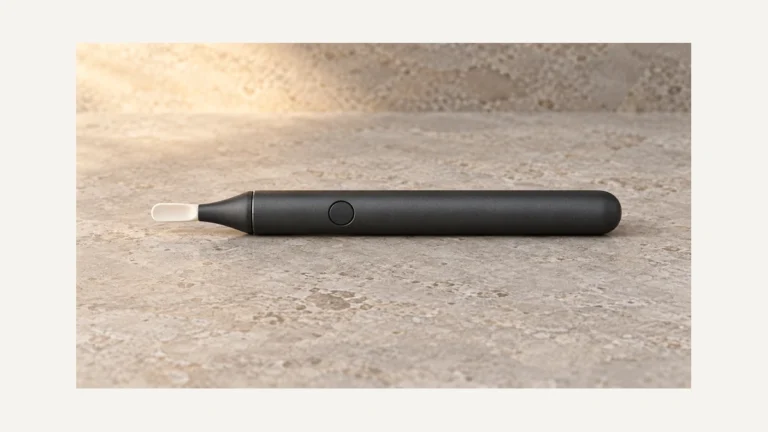
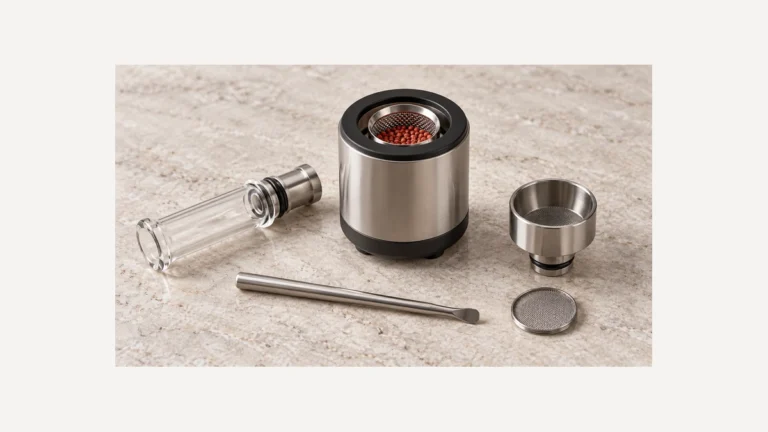
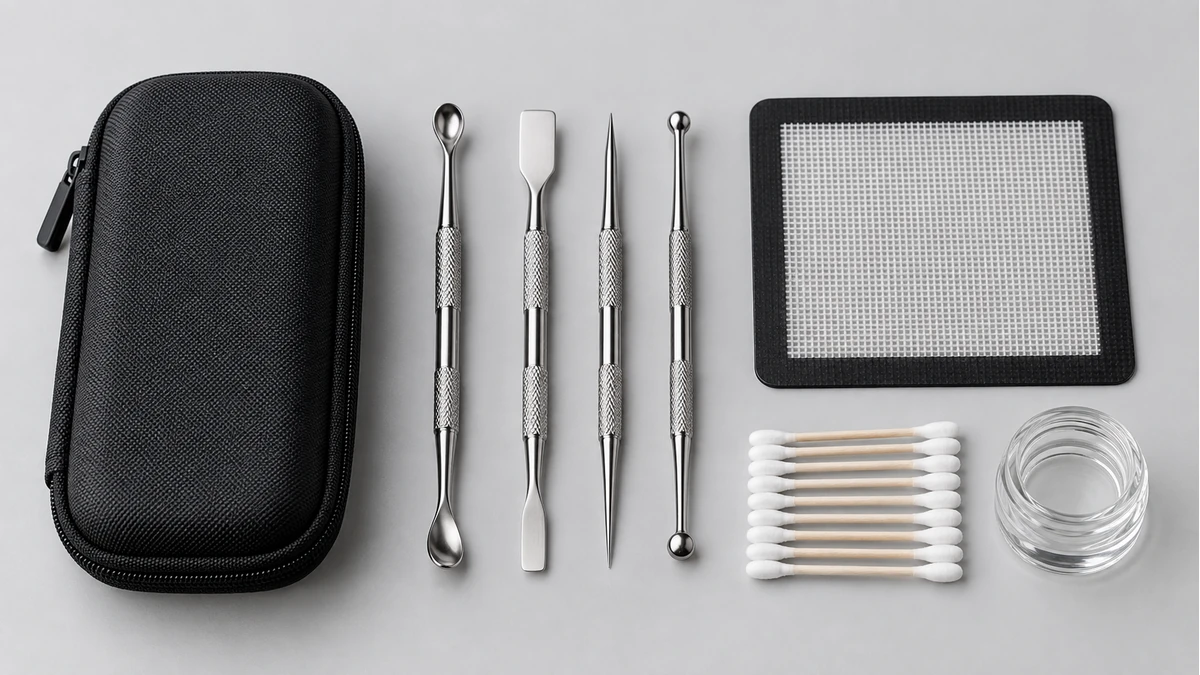
A dab tool kit is really a small collection of separate decisions bundled into one box: a pick or paddle for loading, a dish or mat to set things on, a container with a lid, and sometimes a brush or swab for cleanup. The word “kit” implies a matched set, but most of the pieces inside a typical kit were never engineered to work together — they were packaged together because they’re cheap to mold or stamp as a group. That distinction matters more than how many pieces are in the box.
The better way to shop is component by component. Ask what each tool touches, how hot that surface gets, whether the material is actually verifiable, and whether the piece can be cleaned without cross-contaminating the others. A five-piece kit where every tool answers those questions clearly is more useful than a twelve-piece kit where half the pieces are filler shapes with no stated material at all.
This guide walks through the parts of a dab tool kit in the order they usually get used — loading, contact surface, cleanup, storage, and transport — and explains what to check at each stage. It skips consumption technique entirely and focuses on the hardware itself: what it’s made of, what it’s rated to touch, and how it holds up to repeated cleaning.
🧰 1. Loading Profiles: Match Tip Shape to the Material in Front of You
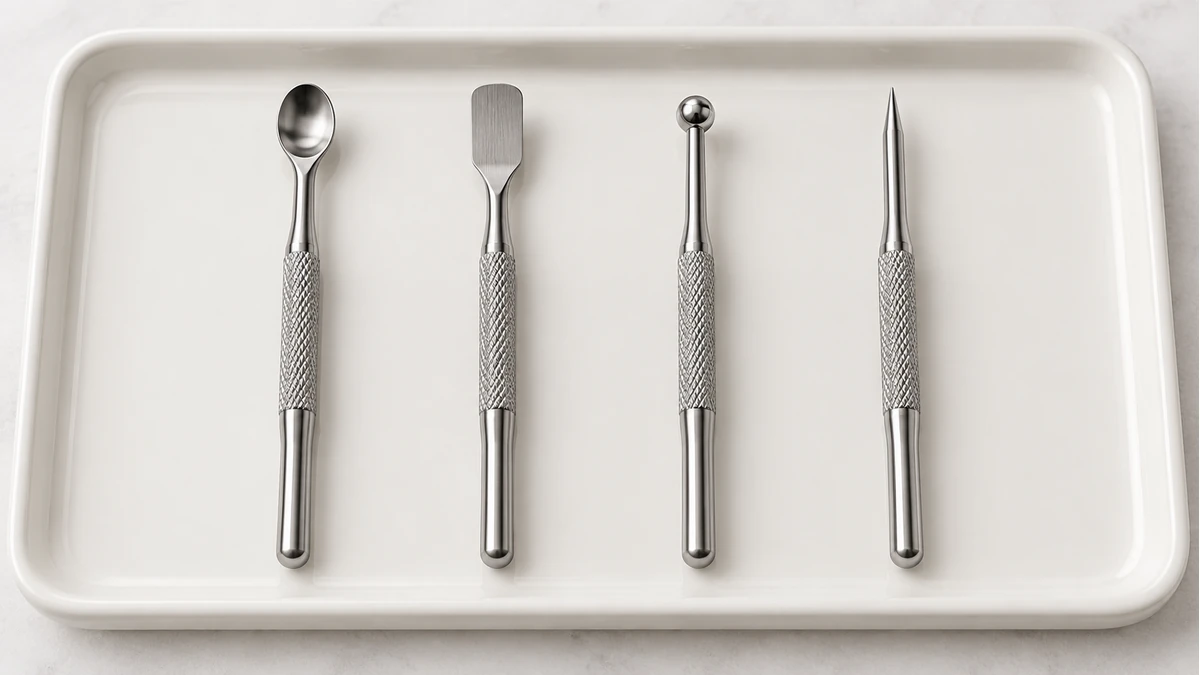
Most kits ship with two or three tip shapes: a flat paddle, a pointed dabber, and sometimes a small spoon or scoop. These shapes exist because different consistencies behave differently on a tool. A thick, waxy material clings to a flat paddle the way peanut butter clings to a butter knife — it needs a broad, low-friction surface to release cleanly. A softer, more fluid material behaves more like honey on a spoon, where a scoop shape controls the amount picked up instead of letting it run off the sides.
A pointed dabber sits between these two. It’s built for precision placement rather than volume, similar to how a soldering pick is shaped to touch one spot without disturbing everything around it. If a kit only includes pointed tools, it’s really only solving one part of the loading problem.
The practical takeaway is to look at the actual tip geometry in a kit, not just the tool count. A kit with three identical pointed tips in different lengths isn’t offering three loading profiles — it’s offering one profile three times. A useful kit has at least one flat or paddle-style tip and one scoop or dish-style tip, because those two shapes cover the two ends of the consistency range most people encounter.
🔍 2. Verified Material Identity: Why “Titanium-Looking” Isn’t Titanium
The single most common complaint about budget dab tool kits isn’t shape — it’s uncertainty about what the metal actually is. A tool can be polished to look like titanium or stainless steel and still be an unspecified alloy underneath. Visual similarity is not chemical identity, the same way a chrome-plated toy wrench looks like a real one but isn’t forged from the same steel.
This matters because unverified alloys may have an alloy or coating that is not identified in the listing. A listing that says “premium metal” or “medical grade” without naming a grade — such as 304 or 316 stainless, or a specific titanium grade — is making a marketing claim, not a material claim. The absence of a grade number is itself information.
🧭 2.1 Reading a Declared Grade Without Guessing
A stamped grade can help only when it is traceable to the product documentation. Appearance, weight, magnet response, or a marketplace adjective cannot identify an alloy on their own. If the seller does not declare the material clearly, treat the composition as unknown rather than reverse-engineering it from a photograph.
A simple magnet test can also offer a rough signal: many austenitic stainless steels and titanium are non-magnetic or only weakly magnetic, while some cheaper ferrous alloys used as substitutes will attract a magnet more strongly. This isn’t a substitute for a lab test and won’t confirm an exact alloy, but it’s a low-effort way to flag a tool that clearly doesn’t match its description. If a “titanium” tool grabs a refrigerator magnet firmly, that’s worth questioning rather than ignoring.
🌡️ 3. Cool-Surface Contact vs. Heated-Surface Contact
Not every tool in a kit touches a heated surface, and treating them all the same is where a lot of confusion starts. A loading tip that only ever touches room-temperature material is a cool-surface tool. A tool that’s brought near or applied to a heated nail or banger is a heated-surface tool, and those two categories have different requirements.
A cool-surface tool mainly needs to resist staining and be easy to wipe down — think of it like a butter knife that only ever spreads at room temperature. A heated-surface tool needs to tolerate rapid temperature swings without warping, discoloring permanently, or shedding material, so the declared material and intended contact conditions need to match the job.
Kits rarely label which tools fall into which category, so it’s worth inspecting the shaft and tip design yourself. A thin, decorative handle with a lightweight tip is a signal the tool was designed for cool-surface loading, not for repeated contact near a heated component. Using a cool-surface tool as if it were a heated-surface tool is one of the more common ways people end up with a warped or discolored tip within a few uses — not because the metal was defective, but because the tool was never rated for that kind of thermal cycling in the first place.
🧵 4. Swabs and Cleaning Access Points
Swabs are the smallest item in most kits and the easiest to overlook, but they solve a real access problem: getting into a recessed joint, a narrow bucket, or a curved surface that a flat cloth can’t reach. Think of a swab the same way you’d think of a cotton swab for a camera lens — it’s not there to do heavy cleaning, it’s there to reach a spot nothing else can.
A kit’s swabs are worth checking for two things: whether the tip is tightly wound (loose cotton sheds fibers into the exact surfaces you’re trying to clean) and whether the shaft is long enough to reach the depth of the pieces you actually own. A three-inch swab is fine for a shallow dish but won’t reach the bottom of a deep joint, the way a short zip tie won’t reach around a thick bundle of cables.
If a kit doesn’t include swabs at all, that’s not necessarily a dealbreaker, since standard cotton swabs from a drugstore cover most of the same access points. But if a kit advertises swabs as a feature, it’s reasonable to expect a tight weave and a shaft length suited to more than one joint size.
🟦 5. Mats and Surface Protection Between Tools and Countertops
A silicone mat’s job is straightforward: give tools and small pieces a stable, non-slip surface that also protects the counter or table underneath. It functions the same way a silicone baking mat protects a countertop from a hot pan — it’s a buffer layer, not a functional tool in itself.
The two things that separate a useful mat from a filler item are surface texture and edge definition. A mat with a slightly raised lip keeps small pieces from rolling off the edge, similar to a cookie sheet’s rim keeping loose items contained. A completely flat mat with no lip works fine on a level table but offers nothing extra over a folded towel.
Mat material also matters for cleaning. Food-grade silicone tolerates repeated wiping and mild cleaning agents without degrading, while a thin rubber or vinyl substitute can start to crack or discolor after repeated exposure to solvents used for cleanup. If a kit doesn’t specify the mat material, treat it the same way you’d treat an unmarked metal tool — as an unverified claim rather than a settled fact.
🧴 6. Small Containers and Caps for Storage
Containers and caps exist to solve a sealing problem, not a display problem. A glass or silicone container with a well-fitted lid keeps material isolated from air and from the residue on other tools, the same way a spice jar with a loose lid lets contents dry out or pick up odors from a shared cabinet.
Lid fit is the detail most kits skimp on. A cap that screws on with visible gaps or that pops off with light pressure isn’t sealing anything — it’s just resting on top. Press-fit lids should require a firm push to seat and a firm pull to remove, similar to a well-made food storage container lid rather than a disposable cup lid.
Container material also affects cleaning. Glass and food-grade silicone can typically handle repeated wipe-downs, while some soft plastics can absorb odors or discolor over time in a way that’s hard to reverse. Read more about custom dab-tool geometry. covers this kind of storage-material comparison in more detail if you’re weighing glass against silicone for a specific container size.
🧽 7. Cleaning Separation: Keeping Build-Up Tools Apart From Precision Tools
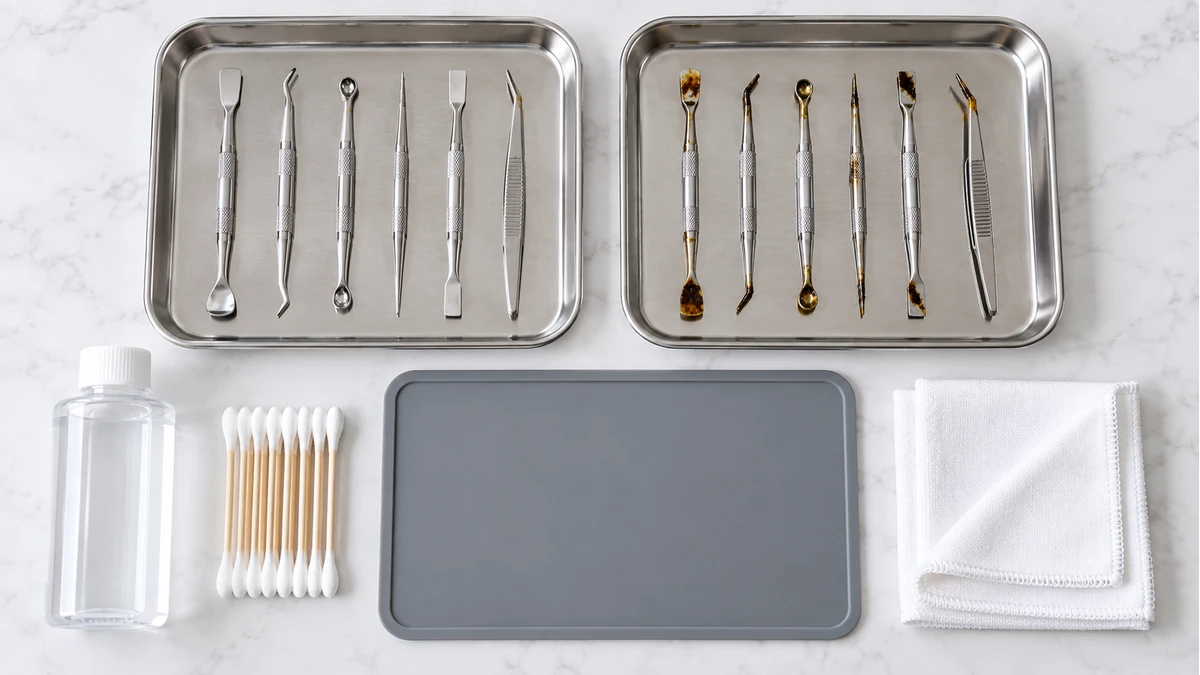
One detail that gets missed in almost every all-in-one kit is cross-contamination between tools that handle heavy residue and tools meant to stay precise. A scraper or pick used to clear built-up residue from a banger or nail accumulates carbon and film the way a grill scraper accumulates char — it’s doing its job, but it’s now the dirtiest tool in the box.
If that same scraper gets tossed into the same compartment as a clean loading tip, the loading tip picks up residue by contact, not by use. This is the same reason a kitchen keeps a separate brush for oven cleaning versus dishwashing — mixing the two just moves grime from one job to the next.
A well-organized kit either separates heavy-cleaning tools into their own compartment or clearly indicates which tools are meant for buildup removal versus precision loading. If a kit provides no separation at all, it’s worth creating one yourself with a small zip pouch or a second container, rather than storing every tool loose in a single tin.
🎒 8. Travel Organization: Compartment Layout Over Piece Count
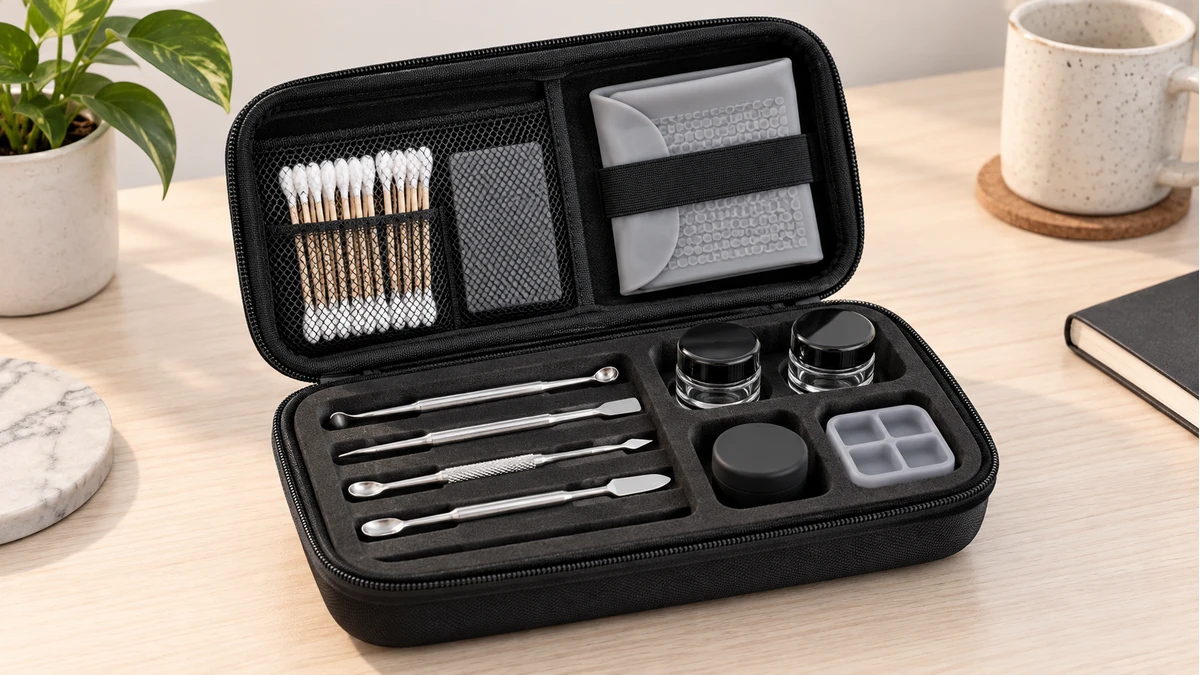
When a kit is meant to travel, compartment layout matters more than how many tools came in the box. A rigid case with individual slots holds each tool in place the way a camera bag holds lenses — nothing shifts, nothing scratches its neighbor, and residue stays contained to the compartment it started in.
A soft pouch with everything loose inside works fine for a single tool and a container, but once you add a mat, a container, and a couple of swabs, loose storage turns into a jumble where the mat picks up residue from the tools and the tools scratch each other in transit — similar to tossing loose keys and coins into the same pocket as a phone.
🧳 8.1 What to Check Before Packing a Kit for Travel
- Does each tool have its own slot, or do multiple tools share one compartment?
- Is there a dedicated, sealed spot for the container so it can’t tip or leak against other items?
- Is the case rigid enough to prevent the mat from folding against a tool tip during transit?
- Is there a separate slot for any tool used for heavy cleaning, apart from precision tools?
Read more about heated loading tools. has a closer look at compact case layouts if you’re comparing hard-shell versus soft-pouch options for regular travel. And if you’re building out storage for containers specifically, Read more about swab reach and lint control. walks through sizing considerations for small sealed jars.
| Component | Cool-surface use | Heated-surface use | Key check |
|---|---|---|---|
| Loading tip | Yes | Sometimes | Tip shape matches material consistency |
| Metal pick/scraper | No | Yes | Declared alloy grade, not just “titanium-look” |
| Swab | Yes | No | Tight weave, shaft length for joint depth |
| Mat | Yes | No (buffer only) | Material tolerates cleaning agents |
| Container/cap | Yes | No | Lid seals firmly, material resists odor absorption |
Choosing a dab tool kit comes down to matching each piece to the job it’s actually built for, rather than counting pieces in a box. If a listing names a specific alloy grade, shows a clearly defined loading tip alongside a heated-surface pick, includes a mat and container with stated materials, and organizes those pieces into separate compartments, it’s addressing the real variables that determine how the kit performs and how easy it is to keep clean. A kit that’s vague on all of those points — regardless of how many tools it includes — is asking you to trust an unverified claim on every single component at once.