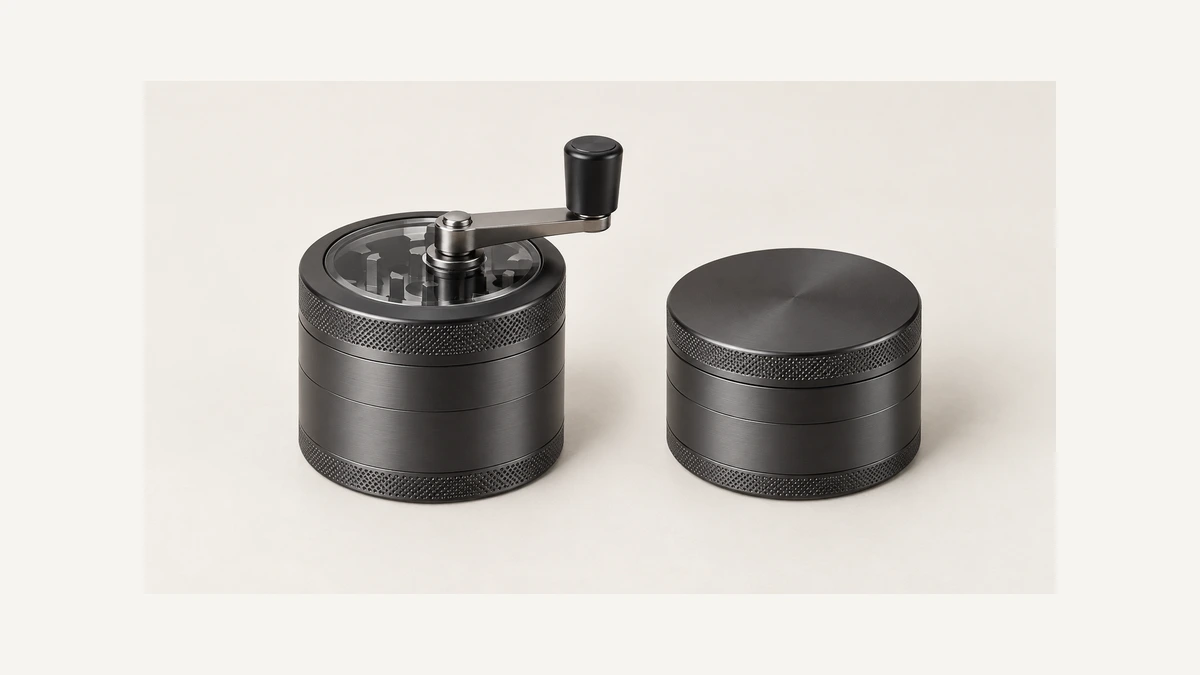
A handle herb grinder changes where your hand does the turning. Instead of gripping a lid and twisting it against the base, you move a crank around a central attachment. For an empty accessory, that leaves three distinct mechanical questions: does the knob rotate smoothly, does the crank drive the teeth, and can you hold the body steady? A handle that spins freely while the cutting parts stay still is a different problem from a chamber that resists movement. Understanding that difference is more useful than assuming every crank is either an upgrade or a weak point.
🔄 1. What a Handle Herb Grinder Changes
The conventional layout described in the two-piece herb grinder guide lets your fingers turn the lid directly. A crank places an arm and attachment between your hand and the rotating part. The attraction is the different motion, rather than an automatic improvement in grinding quality. Some people prefer following a knob around a circle; others prefer holding a broad lid. Either way, you still need to hold or support the lower body. A handle does not make the accessory a one-handed appliance, and a smooth crank does not tell you whether the chamber underneath is clear. Think of the hand position and the drive connection as two separate design details.
⚙️ 2. Handle Radius and Turning Effort
The handle on a crank grinder isn’t just a lever for show — its length and how it’s gripped change how much effort the hand feels during each turn, and how far the hand travels to complete a rotation. This isn’t about one geometry being superior to another; it’s about how force, distance, and angle combine at the shaft, which basic rotational mechanics describes well.
🔎 2.1 The Physics in Plain Terms
OpenStax explains torque using the applied force, its distance from the pivot and its direction. A force perpendicular to the crank arm turns it effectively; a force directed straight along the arm toward or away from the shaft does not produce the same turning effect. A longer arm can produce the same torque with less perpendicular force, while requiring your hand to travel around a larger circle. That explains a leverage tradeoff, not a guarantee of effortless grinding. A crank still has to transfer the turning load through its attachment, and a blocked chamber is not a reason to keep increasing that load.
🔎 2.2 Free-Turning Knob vs Fixed Arm
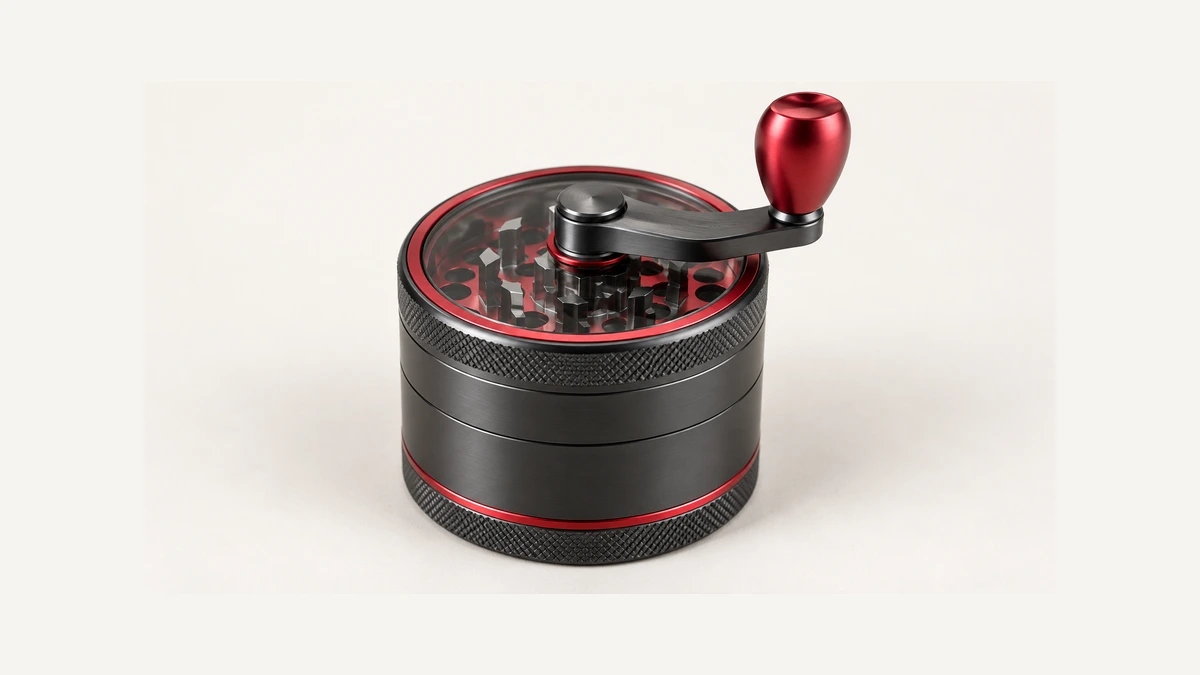
A free-turning knob rotates around its own attachment as the crank arm travels around the grinder. Your hand follows the crank’s circular path; the knob allows that movement without requiring the same grip surface to turn rigidly inside your fingers. A fixed grip presents a different contact surface, although the arm still follows its circle.
Neither arrangement tells you how securely the arm is connected to the central shaft. Inspect the knob and the shaft separately: sideways movement at the knob is not the same as the whole arm shifting at its center. A knob can have some intended rotational clearance, so movement should be compared with the actual design rather than labeled wear from a photo. If a grip binds, cracks or detaches, treat it as a part-condition issue instead of compensating with a tighter pinch.
✋ 3. Supporting the Body While You Crank
The body needs a stable hold while the crank moves. A tabletop may support its weight, but that does not necessarily prevent it from rotating or rocking under the force at the handle. Keep fingers on a suitable gripping area away from the moving arm, and give the crank enough clearance to complete its path.
The same principle applies to a twist-lid grinder: the lower section has to resist the turning motion. Do not assume that a twist automatically presses the sections together or that a crank always tips the body. Body shape, base contact and your grip change the situation. A grinder that rocks on a soft surface may feel very different on a firm, clean surface, even though the crank mechanism is unchanged.
🔎 4. Lid Rotation vs Central Driven Teeth
A handle on top does not reveal which part rotates underneath. Depending on the design, a crank may drive a lid carrying teeth or a separate rotating cutting component inside the lid. The useful observation is the relationship between handle movement and the intended driven part, checked with the empty accessory as its instructions allow.
Do not assume hidden gears, a particular shaft material or a specific tooth motion from the outside silhouette. A rotating center assembly does not automatically pull all material toward the center, and a rotating lid does not establish a particular grind result. What matters for inspection is that the connection transfers motion as intended without unexpected slipping, rubbing or visible separation. A clear window can help you see that movement, but it is not a specification of the drive construction.
🛠️ 5. When the Crank Spins But the Chamber Doesn’t
In a 2019 owner discussion, someone reported a stripped crank drive, while another owner described longer use with a different accessory. Those experiences raise a useful question without establishing a failure rate: is the handle still connected to the part it should turn? If the crank moves but the intended driven part does not, a loose or damaged attachment is one possibility. If the movement stops under resistance, something may be obstructing the mechanism.
Neither symptom provides a complete diagnosis by itself. Check the empty, clean assembly without forcing it. A part that visibly shifts, slips or separates needs its own assessment. Another owner cannot confirm that the same screw, shaft or coupling is fitted to your grinder, even if the external handle looks similar.
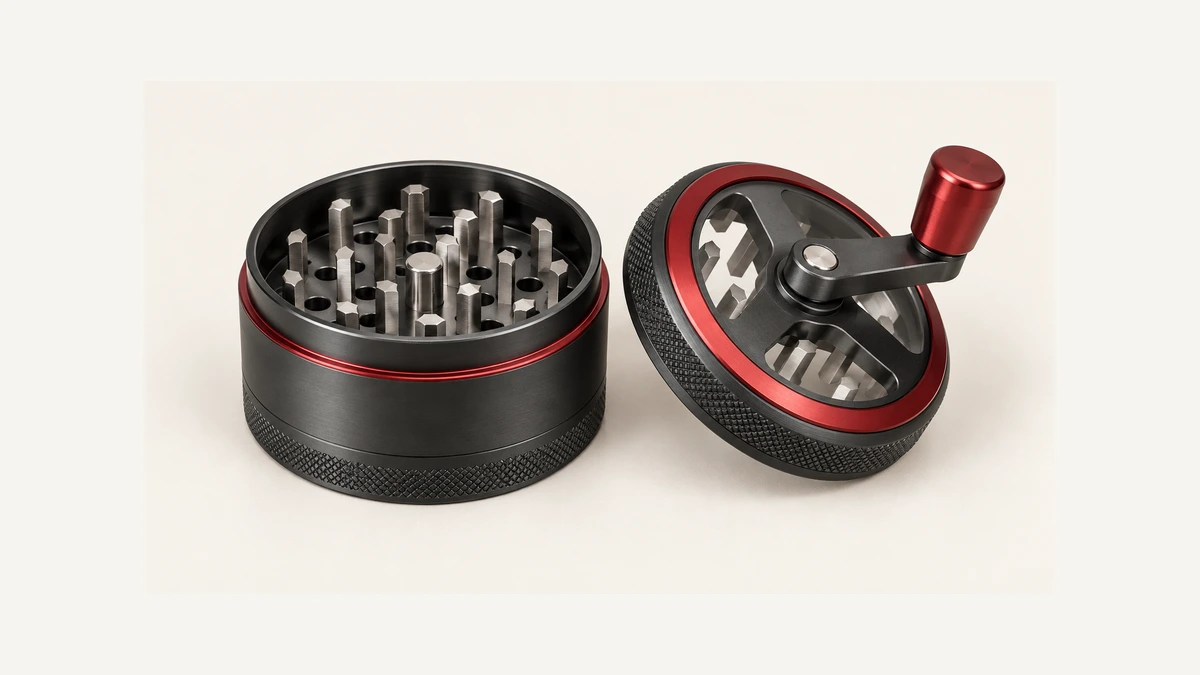
🧽 6. What a Clean, Empty Chamber Tells You
An empty chamber removes the current load as one variable. After permitted cleaning and complete drying, inspect accessible teeth, the perimeter and the drive attachment. If the mechanism catches at the same position while empty, leftover debris, physical damage or misalignment may still need attention.
If it turns but the driven component does not follow, look at the intended attachment rather than brushing the teeth repeatedly. There is no universal resistance value for a healthy crank, and an empty check cannot diagnose every fault. Use it to describe what moves and where the movement stops. Keep fingers away from exposed cutting surfaces during inspection, and stop rather than forcing a resistant mechanism or trying to straighten a bent arm while it is assembled.
🧩 7. The Drive and Lower Compartments Are Separate
The crank describes how motion reaches a rotating component. A screen, where fitted, belongs to a separate lower compartment. Its condition is not established by a smooth handle. A window, drawer and central attachment likewise describe different parts; none should be used as a substitute for identifying another component.
In the 2019 owner discussion, one participant described continued crank operation alongside dissatisfaction with a lower screen. That account does not establish a mechanical cause or a performance rating. The useful distinction is between the drive and the compartment beneath it. This article does not provide material preparation, particle collection or yield-improvement instructions. For empty-hardware inspection, record which component moves and which accessible part shows damage or debris. A handle description alone does not specify every section of the accessory.
🔍 8. Lid Windows and Everyday Maintenance
A clear lid window is a viewing surface, not necessarily an open cutout. Its material and attachment affect the permitted cleaning method. It may expose the top of the chamber while leaving the underside of the driven component hidden. Use that view to check what is actually visible, rather than treating a clean window as proof that the mechanism beneath it is clean.
A soft brush can reach loose particles on accessible teeth and edges, but it should not be pushed into a bearing, sealed joint or inaccessible drive recess. Follow the accessory’s care instructions for adhered residue. Whole-assembly soaking is not a default for a grinder with an acrylic window, separate knob or bonded parts. Clean the handle grip too: a tidy cutting chamber does not remove residue from the part your fingers hold.
🎒 9. The Handle Itself: Storage and Protrusion
The handle changes the storage outline as well as the turning motion. Measure the accessory with its arm and knob in their intended storage position. A case sized only to the body’s diameter may press against the crank when closed, while a loose compartment can let the knob strike nearby objects. Do not assume the handle folds or detaches unless the design actually provides for it.
A 2022 discussion of crank grinders with collection drawers combines concerns about the handle assembly with opinions about an additional dispensing feature. The drawer and crank remain separate mechanisms. If your accessory has both, its storage space needs to accommodate both without putting pressure on either. A carrying case should protect the protruding arm rather than use it to hold the grinder in place.
🔄 10. Where a Crank Fits Among Other Formats
A crank is a manual drive, so it belongs between a directly twisted lid and the motorized arrangements covered in the automatic weed grinder guide. A motor changes the source of motion; it does not remove every maintenance task. Chamber capacity is another separate choice, explained in the extra-large herb grinder guide. A wider body and a longer crank are different dimensions, even if both make the accessory look larger. When describing a crank grinder, note the hand motion, the rotating component and the storage outline. Those details explain how the handle changes the accessory without promising a particular result from its diameter or material label.
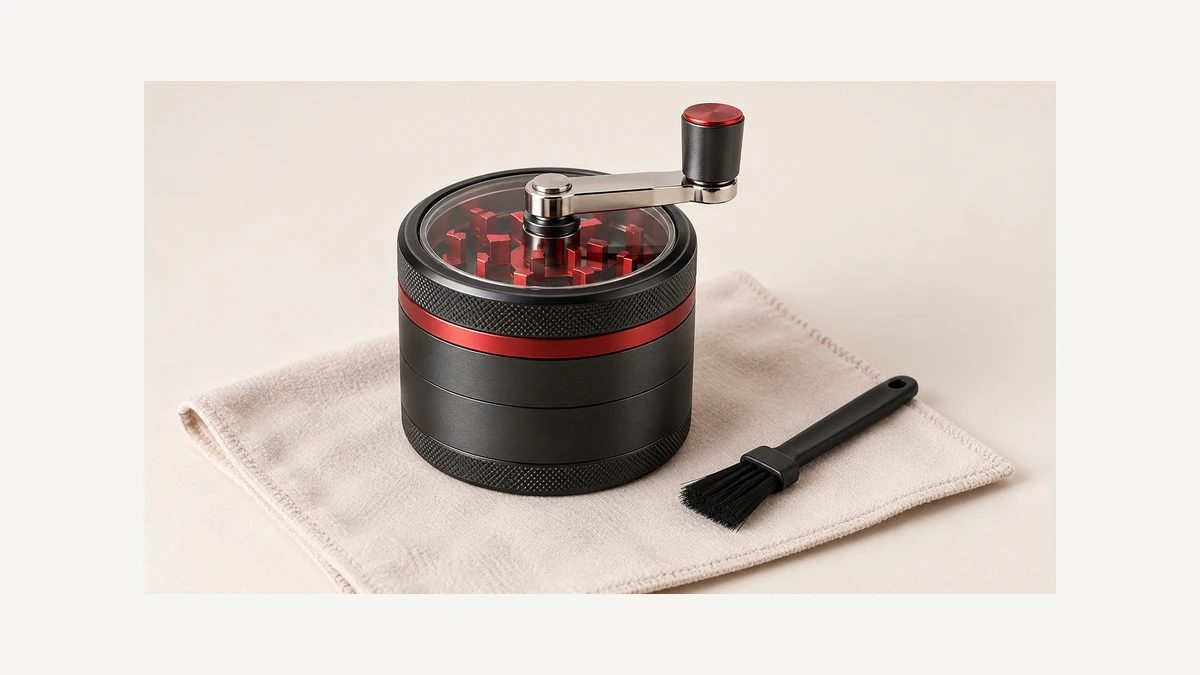
🔧 11. Check the Knob, Arm and Drive Separately
There are three places to look when a crank feels loose. The small knob may move around its own pivot, the arm may move at its central attachment, or the intended driven component may no longer follow the handle. Saying “the handle wobbles” can describe any of those. A useful support photo shows the whole accessory and the particular joint that moves, rather than only a close-up of the teeth.
A fastener visible on the top is not automatically an adjustment screw. It may retain several parts or belong to an assembly that is not intended for user disassembly. Check the actual care instructions before removing it. The same applies to a handle that appears removable: appearance alone does not explain how it is retained. Keep the crank as designed rather than fitting a longer improvised arm to overcome resistance.
The distinction also helps with cleaning. A film on the exterior knob calls for the grip’s permitted care method; debris at an accessible chamber edge belongs to the grinding area. A slipping attachment needs assessment of the connection. Repeating the same cleaning pass across the teeth cannot resolve every one of those conditions. Once you can name the affected part, the next step becomes much more specific.
Also look at the space around the moving arm. A tall knob can be easy to see yet leave little clearance for fingers near the lid. A wider body can offer more room to hold the base while making a short crank feel cramped. Those are fit observations you can make without comparing grind claims. Hold the empty accessory in its intended position and notice whether the grip area, arm path and lid edge leave room for both hands. That describes the actual handling arrangement much better than overall height alone.