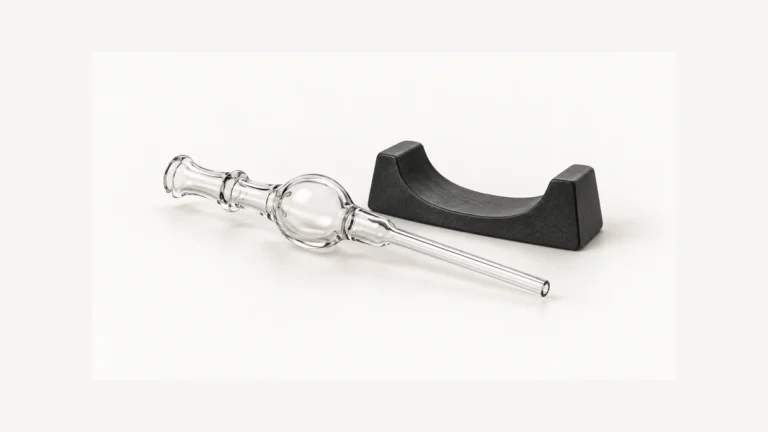
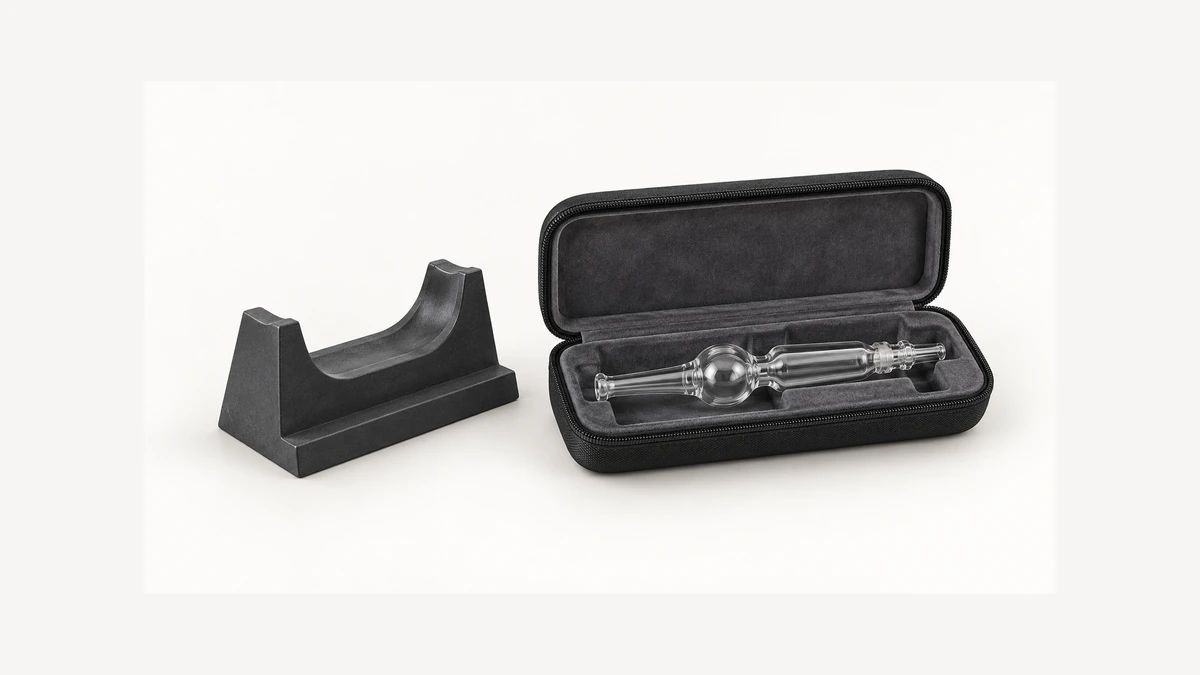
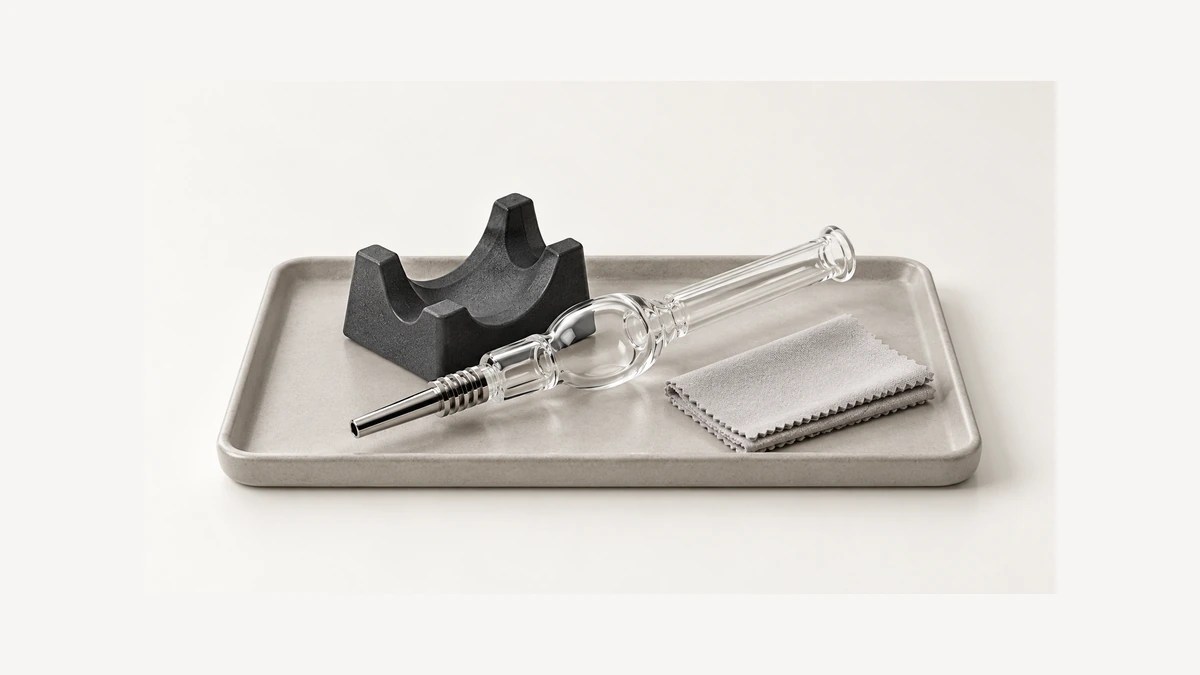
A nectar collector stand may support a body, receive a particular connector or hold a named tip vertically. Those are different arrangements. The word stand does not tell you which part carries the weight, whether the tip touches anything or whether the accessory is intended only for display.
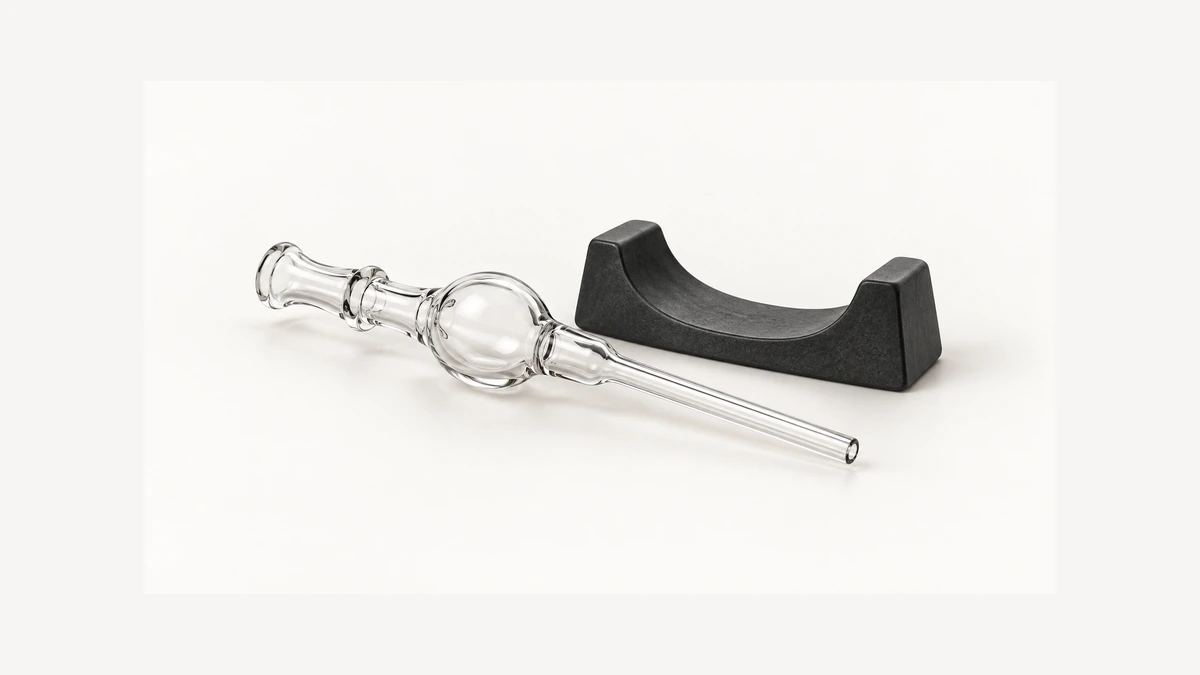
This article concerns empty, cool hardware and passive storage. It explains support, clearance and the limits of an accessory description, without product recommendations, construction instructions or guidance on consuming any substance. A display accessory should not be assumed to be a hot rest simply because the equipment fits into it.
🧩 1. Identify what the stand is intended to hold
A holder for a small dab tool is not automatically a holder for the collector body. A rack for separate tips may not support an assembled glass piece. Before interpreting a photograph, find the exact part the accessory description names and compare that with the equipment you already own.
There is a documented example of why that wording matters. The Nectar Collector Wine Stem Stand description calls it a vertical glass display stand and identifies the brand’s own Stinger tips as compatible. This is a specific interface statement. It is not a universal promise about other tips, bodies or brands, and the description does not state a hot-rest rating.
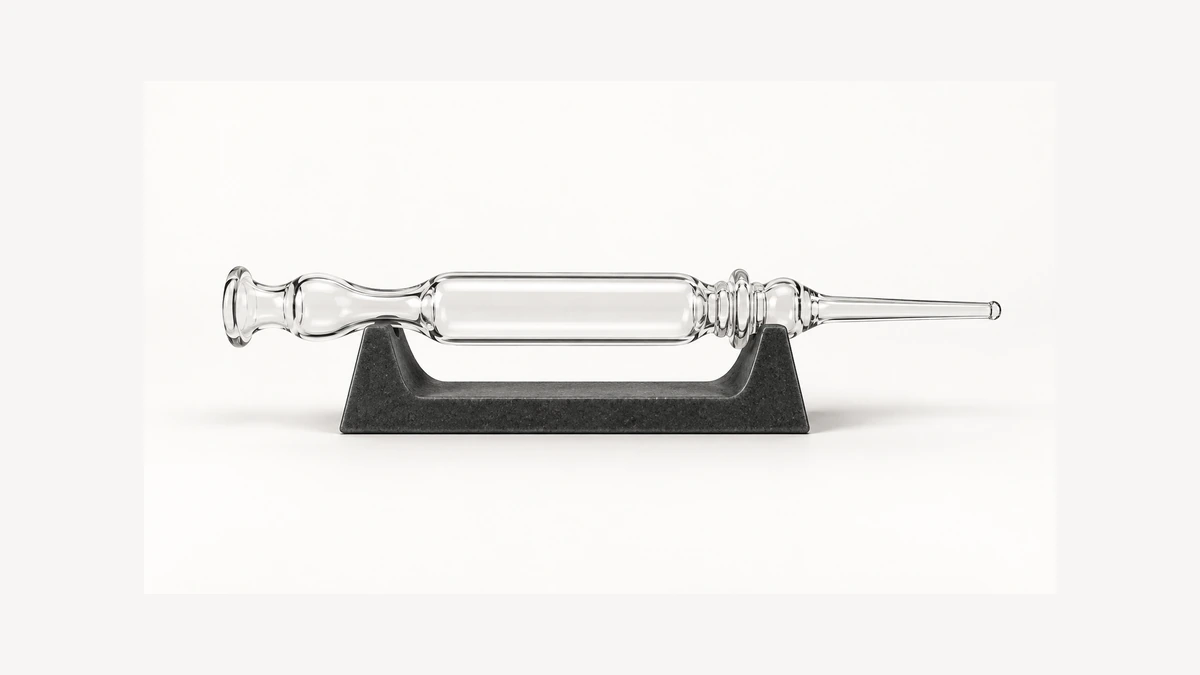
A photograph can make two support arrangements look similar. One accessory may receive an intended fitting, while another cradles an exterior body section. Do not assume they share a load path because both leave the mouthpiece pointing upward. The maker’s part names and diagram should settle which arrangement was intended.
Our glass straw and collector-body guide can help identify the components. Use the names for your particular construction when asking about a stand. “It fits the narrow bit” is less useful than identifying the exact connector or body section involved.
📐 2. Body support and connector support are different
For a cradle designed to support the exterior body, look at where the body is intended to rest. A broad section and a narrow projecting component are not interchangeable contact points. Do not move the equipment along a cradle until an unintended fitting happens to carry the weight.
For an accessory designed to receive a named connector, follow that specific interface description instead. This is why “never let any tip touch any stand” would be too broad: some documented display arrangements are built around a particular fitting. The correct boundary comes from the designed interface, not an assumed rule for every stand.
Consider a hypothetical horizontal cradle intended for a thick central body. If a different-shaped collector rests only on a narrow projection, its ability to sit there does not establish a match. The visible contact is different from the intended contact. Stop short of treating that arrangement as approved storage.
Do not balance an unfamiliar assembly by adding weights, bending a fitting or tightening a joint beyond its instructions. Those changes do not verify the original combination. Ask whether the stand was intended for the exact assembled shape, including any removable components that remain attached during storage.
🎯 3. Clearance means more than a gap above the table
In a body-supporting cradle, clearance is the visible space around projecting parts that are not intended to carry the load. Check the stand itself as well as the tabletop. A tip might clear the desk while touching a sidewall, a nearby object or the edge of another stored component.
This is a geometry observation, not a temperature calculation. A visible gap cannot establish how quickly a part cools, whether a stand tolerates heat or whether a surface is suitable for a recently heated component. This article’s examples begin with equipment already cool and empty.
A Reddit discussion about an improvised holder includes a commenter asking about contact between the tip and plastic. The question identifies an uncertainty owners notice. It does not provide a verified material rating, a cooling interval or a design that should be copied.
For a hypothetical desk cradle, imagine that the central body rests where intended but the projecting end nearly touches the wall behind it. Moving a nearby object may reveal the clearance issue more clearly; it does not change the stand’s documented compatibility. Do not use repeated placement of a delicate part as a way of testing how little space is enough.
⚖️ 4. Look at the assembled arrangement, not the empty stand
An empty accessory sitting flat tells you little about the complete arrangement. The collector’s shape, any attached components and the place where the stand sits all affect what the stored assembly looks like. A wide-looking base in a photograph is not a stability rating.
A discussion about a collector with a separate stand contains a reply describing difficulty finding something to lean a similar piece against. That is an account of awkward storage. It does not establish a measured tipping threshold or prove that a particular accessory solves the problem.
Use ordinary visual checks within the documented storage arrangement. Is the base on a level, unobstructed surface? Is a cable, cloth or another object trapped beneath it? Does the assembly sit as shown in the instructions? An obstruction is worth correcting, but the absence of one does not certify a mismatched stand.
Do not perform a push, shake or tilt test with glass equipment to establish how much disturbance it will withstand. If a combination appears unstable in its intended position, stop relying on it and ask the manufacturer about the fit. There is no need to discover the tipping point by reaching it.
🏺 5. A repurposed container is an unresolved fit question
A cup or decorative object may seem convenient because it is already on the shelf. Its ability to contain part of a collector does not identify the intended support point. Nor does it tell you whether the assembly will lean, contact a hard rim or be difficult to remove without catching a projection.
In a discussion about a repurposed cup holder, a commenter worried about knocking the entire arrangement down. The owner’s enthusiasm and the commenter’s concern are both anecdotal. Neither turns the container into a tested storage accessory.
Do not turn a photograph of an improvisation into a build plan. There is no general recommendation here to drill a block, pack a cup, add adhesive or modify a stand. Those actions introduce new contact materials and shapes without resolving whether the original equipment is being supported as intended.
A dedicated accessory also needs a specific fit description. The label dedicated does not excuse a loose interface or an undocumented load point. What matters for understanding the arrangement is the identified component and the manufacturer’s stated use, rather than whether the object began life as a display stand or something else.
🧼 6. Keep stand care separate from component care
A stand and the collector it supports may have different cleaning instructions. The stand may include a surface coating, a liner, feet or another attached part. Do not assume that a glass-component cleaning method also applies to the complete accessory.
Our guide to collector parts and their separate care addresses the component side of the question. It does not establish a cleaning recipe for a stand made from a different material. Read each object’s instructions and keep their care tasks separate.
For example, a removable component may be undergoing its documented care while an empty stand is wiped according to its own directions. Putting the component back before both tasks are complete is not a shortcut to storage readiness. Do not use the stand as an improvised drying rack unless its documentation includes that role.
If residue or debris is visible at a support point, do not force the equipment against it to make the fit appear normal. Follow the stand’s care instructions and inspect the accessible area again. A persistent obstruction, damaged liner or changed contact surface is a specific question for the maker, not a reason to scrape or reshape the support.
📦 7. Shelf support and enclosed storage have different limits
A stand leaves equipment exposed to its surroundings. A case encloses it. Neither description tells you everything about fit, but the distinction helps explain why an arrangement that looks suitable on a clear shelf may not be suitable inside a bag or a crowded drawer.
Our collector-case guide addresses enclosed storage and the space around separate parts. A display stand should not be treated as a packing insert simply because the complete assembly fits inside an enclosure. Check whether the manufacturer specifies that arrangement.
Imagine a cold, empty collector in its intended cradle on a shelf. Closing a box around that same arrangement could introduce contact at the projecting end or pressure from the lid. This is a hypothetical example of a changed environment, not evidence that a particular case or stand fails.
When moving equipment, use the documented storage method rather than carrying it balanced on an open stand. Do not assume the stand secures the collector against movement unless that function is explicitly described. Likewise, a case does not establish that a component has cooled, dried or remained undamaged before it was enclosed.
It can help to sketch the contact points for your own question: body against cradle, named connector against its receiver, and any projecting part that remains unsupported. The sketch is a description, not a modification plan. If it differs from the maker’s illustration, explain that difference rather than trying to make the equipment conform by force.
Keep the answer with the exact accessory details. A later change of body, tip or attached component can change the question again. Compatibility information remains attached to the stated combination; it should not become a general assurance passed along with an unidentified stand.
📝 8. Ask a fit question the manufacturer can answer
Provide the exact collector model, the stand identification and a description of the component you intend it to support. If the equipment has several configurations, specify which parts remain attached in the storage arrangement. A compatibility answer for one configuration should not silently become an answer for another.
Useful questions include which surface is intended to carry the load, whether a particular connector is part of the support interface and whether the accessory is documented for display only. Ask separately about any claimed hot-rest function; do not infer one from a material name or an open space around the tip.
Include a photograph of an empty stand and the relevant equipment separately if showing the assembled fit would require balancing it precariously. Describe any existing chip, split, distorted liner or loose component before further handling. Do not demonstrate instability with a push or a drop.
A precise answer may be that the accessory supports only a named fitting, or that it is not specified for the body in question. That is more useful than a broad assurance that all stands work. For a body cradle, preserve the intended contact and clearance; for a connector display, follow the named interface. In both cases, a clear description does more than the word stand alone.