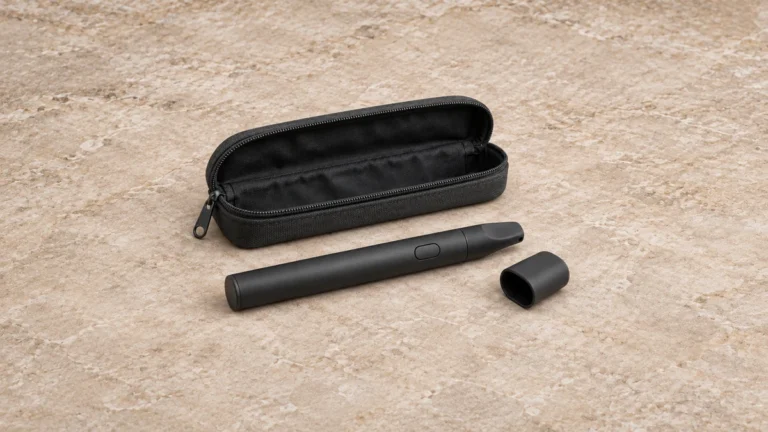
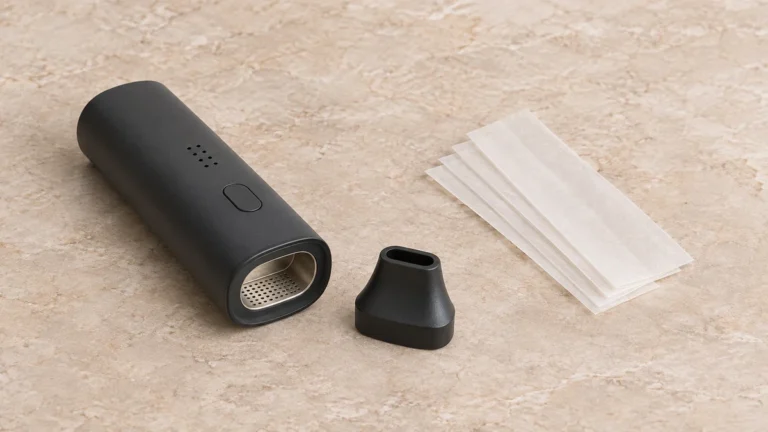
A nectar collector puts the working tip at the end of the piece you hold. A conventional dab rig puts a separate nail or banger on a supported glass body. That difference changes which part moves, which connection carries its weight and what comes apart for cleaning. Water and battery power are additional features; neither one reliably separates every collector from every rig.
This becomes practical when a piece breaks. Someone with a damaged collector and two unused replacement tips may wonder whether those tips belong on a small rig instead. The answer starts at the connection and the intended assembly, rather than at the names of the materials. A quartz tip and a quartz banger can serve different positions even though both listings say quartz.
🧭 1. Compare the Complete Assemblies
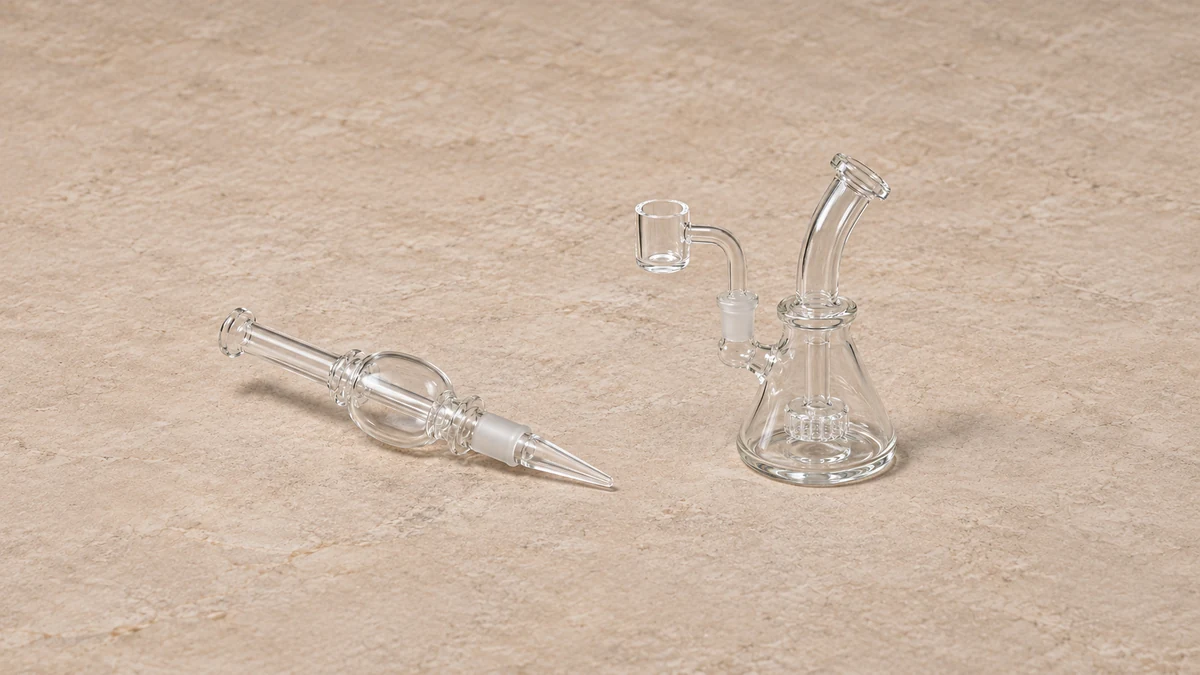
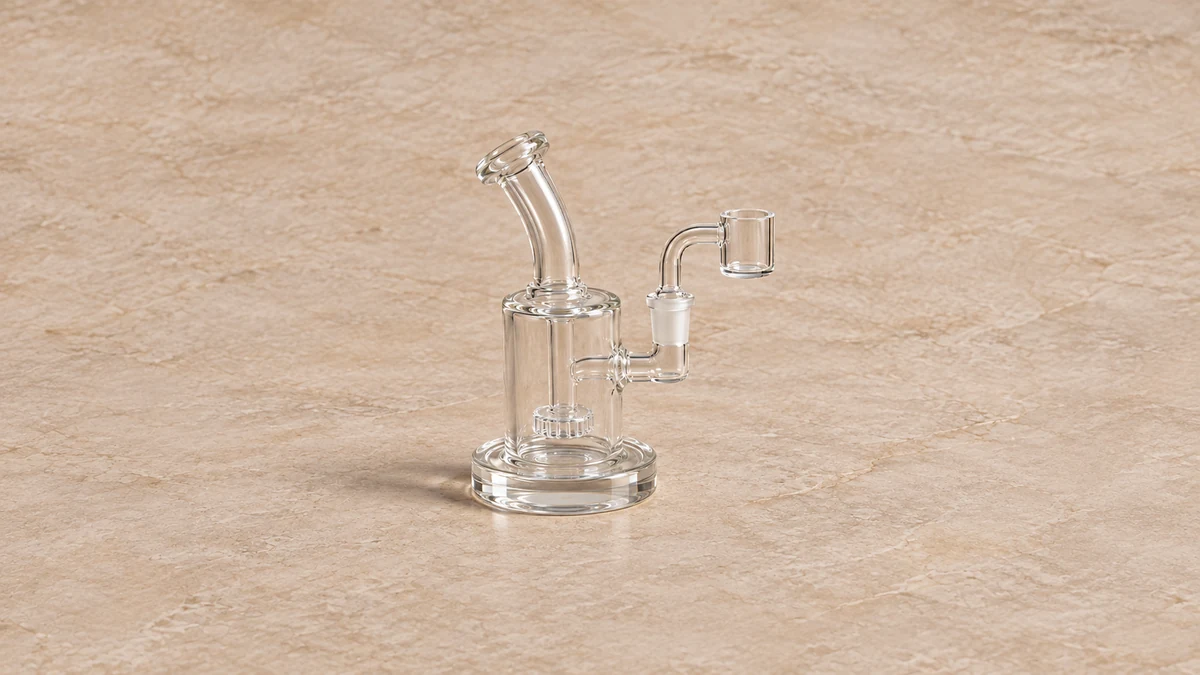
Place the two descriptions in physical order. A collector normally has a mouth end, a body or passage and a working tip at the opposite end. A conventional glass rig has a mouthpiece, a body with a water chamber and a side connection that supports a separate heated component. Some parts are integrated into the glass; others are removable. The complete arrangement matters more than the silhouette in the first product photograph.
🔍 1.1 The Working End Is the First Clue
On a collector, the tip belongs to the handheld assembly. On a bucket-banger rig, the bucket sits off to the side of the glass body, attached through a joint. This gives a useful way to sort an unfamiliar photograph without assuming anything about performance. Locate the working surface, follow its connection back to the body and identify what supports it. A close-up of the mouthpiece alone cannot answer those questions.
The distinction also helps with parts terminology. A collector tip may be a hollow glass or quartz component, a metal component or an electrically heated assembly. A banger has a bucket, neck and connector. Calling either piece the coil can obscure whether the replacement contains an electrical heater at all. Our glass nectar collector guide explains the fixed-tip and detachable-tip forms separately.
🫧 1.2 Water Does Not Separate Every Collector From Every Rig
A simple dry straw is only one collector format. Water-equipped collector bodies and separate bubbler attachments also exist. Huni Badger’s Honeybird cleaning instructions, for example, describe a removable bubbler and its adapter as separate components. That is evidence for a particular water-equipped arrangement, rather than proof that every collector has the same connection or construction. A collector with water remains a collector assembly with additional parts to identify.
Likewise, calling something a rig does not describe its entire heat source. A glass body can be paired with an external heated component, while an electric rig can combine a powered base, removable chamber and separate glass. Comparisons that reduce the choice to “collector without water” versus “rig with water” leave out real hardware. First establish the layout; then add the water and power features that the specific product actually has.
🖐️ 2. Where the Hot Part Moves
The collector’s working end travels with its body when the whole assembly is moved. A conventional rig’s banger stays attached to the glass body while that body remains supported on a table. Neither description promises that a surface has cooled, or that a particular grip is insulated. It simply identifies where the working end will be when the equipment is put down, lifted or placed near other objects.
⚖️ 2.1 Hand Support and Table Support
For a collector, ask where the body can rest without placing its tip against the surface underneath. A separate stand may support the body while leaving the working end clear. Its shape must match the intended support location; a hole or notch of approximately the right size does not establish that match. The collector stand guide separates body support from support at a connector.
For a rig, look at the base together with the side attachment. A compact body can occupy little table space yet have a banger projecting beyond its footprint. Additional adapters can move that projection farther away. Those are visible geometry questions, not a ranking of large versus small rigs. An empty body photographed without its normal attachment can hide the part of the arrangement most likely to contact another object.
📐 2.2 Clearance Around the Working End
Clearance includes the route a component takes when it is removed. A collector tip may need room to slide away from its body, whereas a threaded attachment needs space to turn. A rig banger may lift from a tapered joint. These are different motions. Shelves, case foam and nearby glass can obstruct them even if the assembled equipment appears to fit comfortably in the available space.
Keep these observations limited to cool, unpowered hardware and the maker’s documented removable parts. A visible seam is not automatically an instruction to pull. Some apparent joints are fixed during manufacture. If the permitted separation is unclear, a photograph of the complete assembly and the suspected connection is more useful to support staff than a description that says only the end will not come off.
🔗 3. A Spare Tip Is Not a Spare Banger
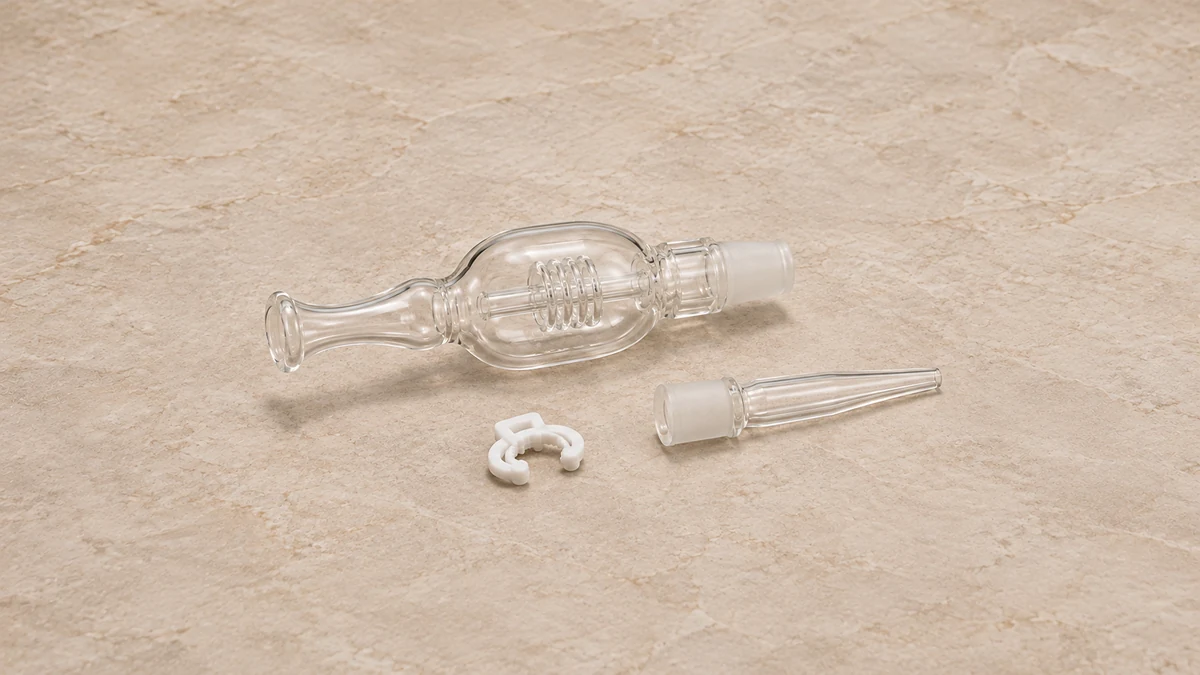
Returning to the broken-collector example, the spare tips do not determine which new body will accept them. The connection must be identified first. A collector tip can have a tapered or threaded connector that does not match the rig’s receiving joint. Its retaining shoulder can also belong to a different assembly. Shared material and a similar-looking opening do not make those components interchangeable.
🧩 3.1 Read Both Mating Surfaces
For a tapered connection, compare the male and female surfaces and the documented joint size. For a threaded connection, the exact model and thread specification matter; an outside diameter alone does not describe the thread. Keep the original packaging or part number with a spare. A clear picture of the connector is useful, but perspective can make different dimensions look deceptively alike.
A rig adds its own fit questions. The joint’s orientation affects where an attached bucket will sit, and an adapter changes the assembled geometry. Our dab rig adapter guide explains size, gender, angle and attachment load. An adapter listing should name the connections it joins. It should not be treated as a general promise that any loose collector tip can become a rig attachment.
For example, keep the tip and the original clip together when recording a broken collector. Take one photograph of the complete surviving parts and another of the tip connector. A picture of the taper alone can omit the shoulder where the clip belongs; a picture of the whole tip can hide the mating surface. If a replacement body is offered, its listing needs to identify the supported tip connection. If only a different complete format is available, the spare tips remain separate spares rather than evidence that the new rig is compatible.
🪢 3.2 Clips and Threads Retain Different Connections
A retaining clip works with a connection designed to accept it. It does not create a matching taper, repair chipped glass or convert a loose joint into a verified fit. A threaded attachment relies on its intended mating thread and seating surfaces. These differences matter when a replacement arrives without the same clip or collar shown beside the original part.
Describe what is missing before substituting another accessory. “The tip fits the opening but the original clip is absent” is a different problem from “the tip will not enter the opening.” So is a thread that starts but does not seat as documented. Keeping those observations separate prevents a retention question from turning into an improvised modification of a part that was never matched to the body.
🔋 4. Add Electric Versions Without Losing the Distinction
An electric collector places a powered heater at its working end. An electric rig can place a removable chamber on a base and connect that chamber’s air route to separate glass. Both may use batteries, yet the assemblies remain different. A charging port establishes a charging connection, not compatibility between the heater from one format and the powered body of the other.
The service boundary is especially useful here. Huni Badger publishes separate instructions for its HuniTip and Honeybird attachment. Puffco’s current Peak support documentation separately addresses the chamber, base and glass. Those are model-specific examples of a broader maintenance question: which component contains electronics, which is a removable attachment and which cleaning procedure belongs to each? Their instructions cannot be exchanged simply because both devices are electric.
🧼 5. Compare Access for Cleaning
Neither a small component count nor a large opening guarantees easy cleaning. Access depends on the actual passage, its bends and the parts the owner may remove. A collector with one continuous narrow bore can have fewer components than a rig while providing less direct access to the middle. A rig’s wide chamber can coexist with a narrow neck or fixed internal passage.
🕳️ 5.1 A Narrow Bore and a Wide Bucket
The bucket of a conventional banger is open at the top, while a collector tip has a passage through its working end. A tool that reaches one surface may not follow the other passage. Look at the complete route before deciding that an existing brush or swab will reach it. A metal pick that happens to enter an opening is not evidence that it can follow the path without contacting another surface.
Residue near an opening and a restriction farther inside are also different observations. Photograph the accessible area and identify which approved parts have already been removed. Do not assume a dark mark diagnoses material failure, or that clearing the visible opening repairs damage elsewhere. Cracks, missing fragments and a joint that no longer seats need a condition assessment rather than a more aggressive generic cleaning routine.
💧 5.2 Water Attachments Need Their Own Care Plan
A water-equipped collector adds a chamber that must be handled separately from any powered body. The same distinction appears in an electric rig with removable glass. Puffco’s Peak instructions specify removing the glass from the base for its glass-cleaning procedure and keeping liquid away from the base’s connection area. That example supports separating the components; it does not authorize the same procedure for every collector or every rig.
Keep the exact attachment’s instructions with it, especially when the main device and the glass were obtained separately. Seals, adapters and coatings may belong to different care procedures. Once cleaning is complete, storage still requires the condition specified by the manufacturer, including drying where required. A case that closes successfully cannot establish that a hidden passage is dry or that a powered connection is ready for reassembly.
🧳 6. Compare the Packed Hardware
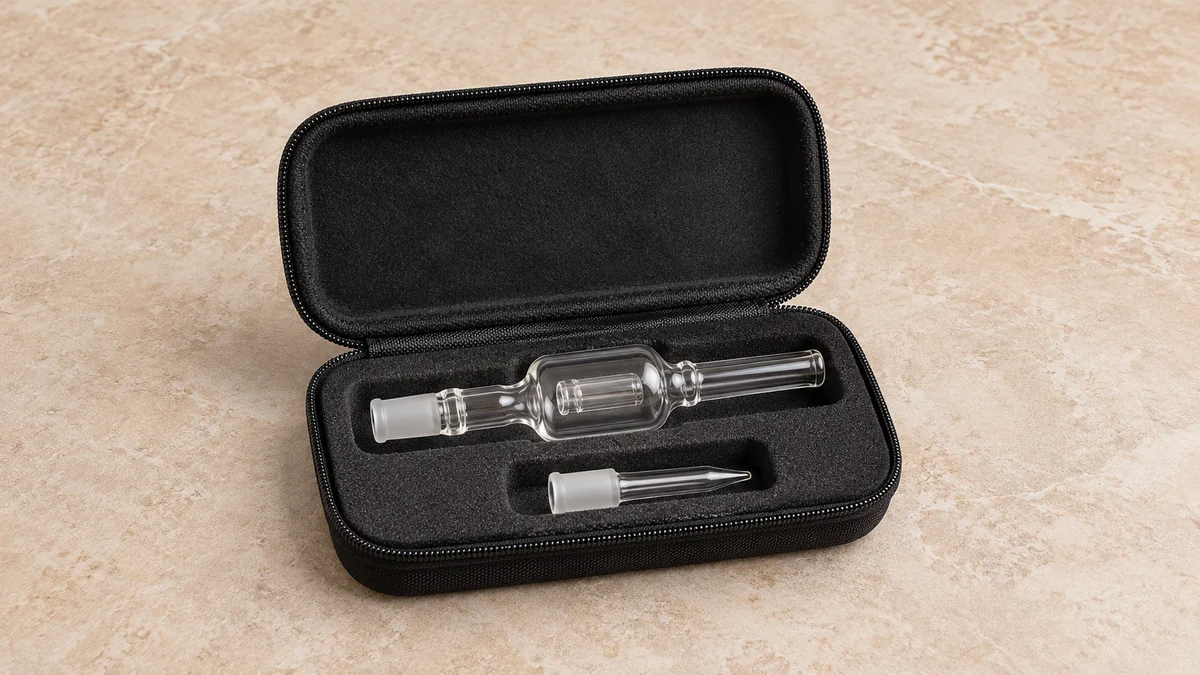
The packed arrangement may differ substantially from the assembled outline. A collector with a detachable tip can occupy several separate recesses. A rig may need protection around its side joint, neck and loose banger. Comparing the length of a bare straw with the height of an assembled rig leaves out those loose pieces and the space needed to keep them from contacting one another.
📦 6.1 Account for Loose Parts
Count the objects that remain after the permitted disassembly: body, working tip or banger, cap, adapter, retaining piece and any cable or separate power accessory. The count is specific to the arrangement. More pieces do not automatically mean more difficulty, but each piece needs an identifiable place. A tiny clip disappearing into a general accessory pocket can create a very different problem from a large glass body that lacks adequate support.
Use only fully cooled equipment for a storage-fit check. Look for contact at projections and connector ends, not just space around the broadest part. Closing a case should not require using its lid to push a component into position. If the original case no longer matches after an attachment change, that is a change in the packed assembly, even when the central body itself is unchanged.
🛠️ 7. Work Through a Broken-Glass Example
Suppose the collector body is broken but the detachable tip appears intact. Preserve its identity and ask whether the manufacturer lists a replacement body for that exact connection. If the alternative is a rig, evaluate that rig as a separate complete assembly rather than assuming the spare tip is its starting component. The useful comparison is between supported replacement paths, not between two photographs with similar glass colors.
Now reverse the situation: a rig’s banger is damaged while the body remains intact. Identify the body’s joint, the banger’s connector and the required assembled orientation. A collector tip elsewhere in the drawer does not answer those questions. Damage to the mating glass also matters; a new attachment cannot establish that the body connection it enters is sound. Keep damaged components separate while obtaining the correct assessment.
✅ 8. Describe the Format Before Comparing It
A useful collector-versus-rig description names the working end, its support, its connection, any water attachment and the power arrangement. Add which parts are removable and where they go when stored. That small parts map answers real ownership questions that “portable” or “traditional” cannot settle. It also gives a manufacturer enough context to discuss a replacement without guessing which assembly is actually on your desk.