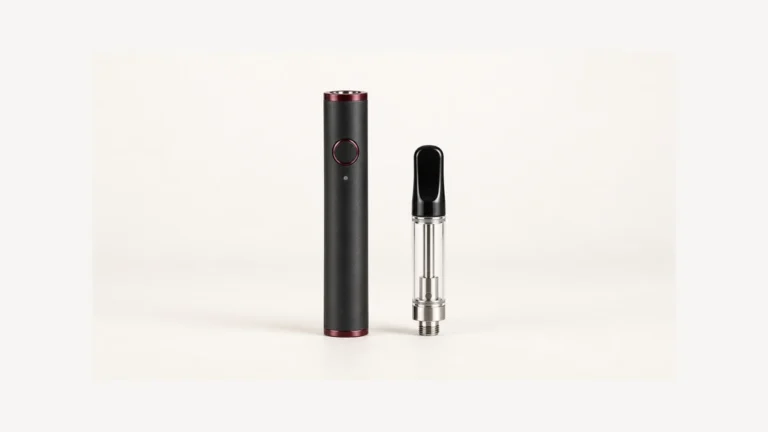
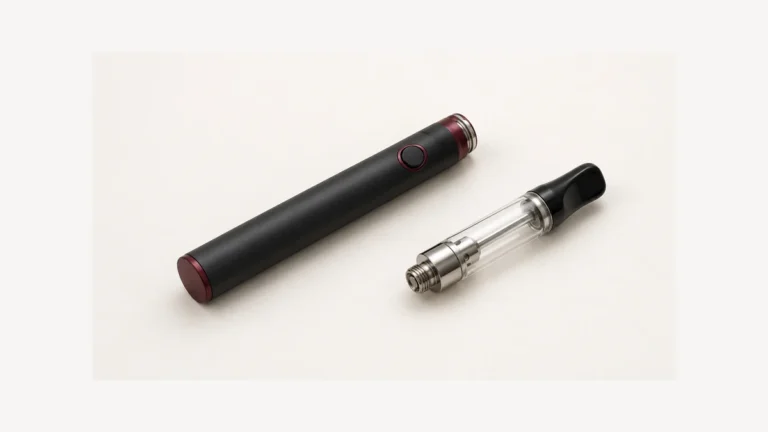
A vape mouthpiece that turns in its socket and a complete top that lifts off the body present different questions. Start by naming the moving connection. Small movement alone does not establish a fault, and a familiar-looking replacement does not establish compatibility. The device’s own part drawing and the way the fit has changed matter more than a general verdict that the top feels loose.
🔍 1. Where the Movement Actually Starts on a Vape Mouthpiece
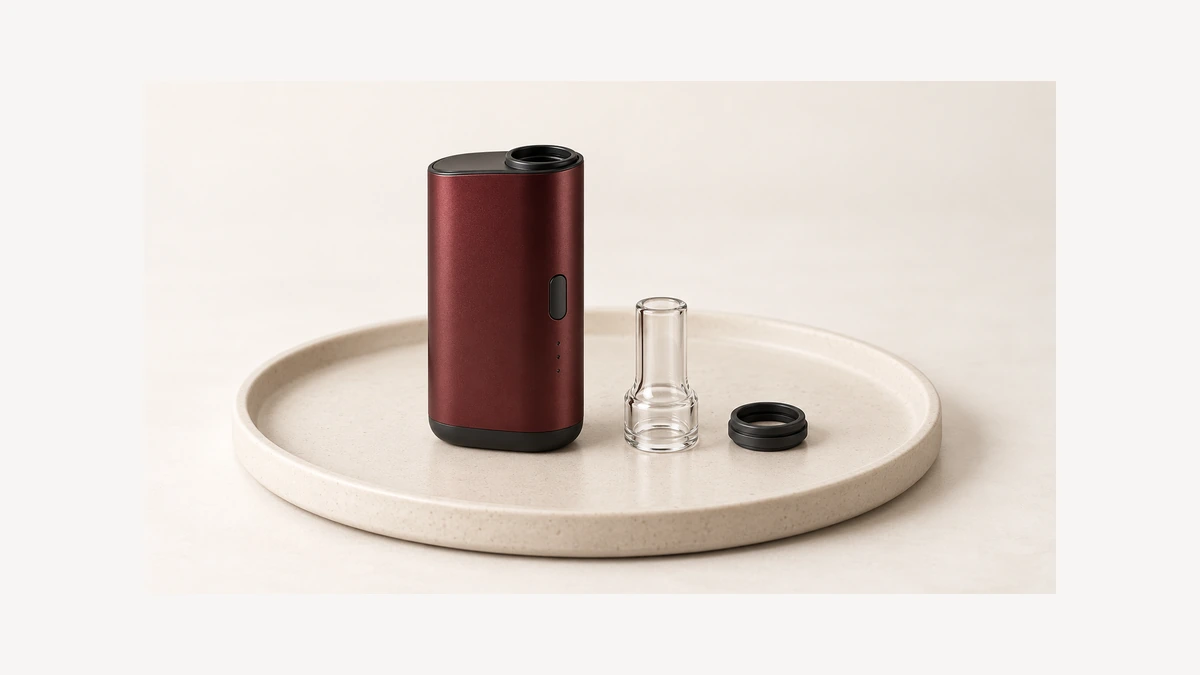
Picture a short glass tube held inside a cap, with that cap attached to a larger cooling assembly. There may be several boundaries within a few centimeters. The tube-to-cap boundary is one; the cap-to-base boundary is another; the complete assembly-to-device connection is a third. This is an example of a nested layout, not a description of every vaporizer. A cartridge with a sealed top is a different construction and should not be treated as a removable-stem assembly.
Use observations you already have: did just the short tube change position, or did the cap and tube lift together? A photograph of the disconnected, cool component can help locate that boundary. Do not pull harder to find out which seam releases. If the manual does not identify a connection as user-removable, a visible line around it is not permission to open it.
🔄 2. A Rotating Stem Is Different from a Lifting Top
Some designs deliberately allow a mouthpiece to rotate or fold. In those designs the specified motion is part of the interface, like the movement of a hinged cover. But an apparently similar movement on an unidentified part cannot be declared normal from that analogy. The relevant question is whether the exact manual describes that motion and whether it is the same motion the owner noticed before.
A top that now lifts away when it previously stayed attached deserves a different description from a stem that swivels in place. Record whether an entire assembly separated or only one component shifted. Neither observation, by itself, identifies a worn ring, a damaged latch or an incorrectly seated cap. It tells you where to start the identification, without turning a guess into a diagnosis.
| Already observed movement | Useful distinction |
|---|---|
| Short stem turns while its carrier stays attached | Identify stem-to-carrier movement; compare with the specified swivel or fixed fit. |
| Stem and carrier lift together | Identify assembly-to-body separation; do not assume the inner ring is the cause. |
| Replacement stops short of its former position | Confirm exact part and carrier identity before applying more force. |
Glass-based airpath designs raise a related but separate question, since airflow geometry and O-ring placement there follow their own logic; a closer look at that side of the topic is covered in this dab pen glass guide.
Imagine two photographs from different owners. In the first, a short tube appears slightly angled but its surrounding cap remains in the same position. In the second, the entire cap is visibly raised above the device. Calling both a loose mouthpiece hides the important difference. The second photograph concerns the lower attachment; replacing only the short tube would not address that observed boundary. The first still needs its own documented fit before the angle can be judged.
In one Reddit discussion, the owner clarified exactly this kind of confusion: the ring held its component, while the larger assembly would not stay attached. That clarification is useful reader language, not proof of the cause or a failure rate for the model. The broader lesson is to locate the movement before naming the replacement.
🧩 3. A Seal Ring and a Retaining Feature Do Different Jobs
A seal and a retaining feature describe different jobs, even when one physical part contributes to both. A sealing interface closes an intended gap; a retaining interface keeps components attached. Depending on the design, a ring can contribute friction as well as sealing, while a cap, catch or separate fastening feature provides another part of the retention. Seeing a rubber ring does not tell you which of those jobs it performs in that assembly.
A ring can be doing its sealing job perfectly while a separate retaining feature wears down, and the reverse is also true. One documented example makes this split explicit: Storz & Bickel’s own assembly guidance names the mouthpiece, the seal rings, and the cooling-unit cap and base as distinct parts, and specifically notes that the rings need to be seated properly for the assembly to sit correctly (Storz & Bickel, Disassembling/Assembling). That single, narrow example is specific to one brand’s own stated part breakdown, not a universal disassembly sequence for other devices.
This distinction keeps a helpful observation from becoming an unsupported conclusion. A ring may look present while the assembly still does not stay attached. Conversely, a top can stay in position without that visual observation proving the intended seal. An owner can report either condition; confirming the sealing and retention functions requires the actual design information, not an assumption that one proves the other.
🔁 4. What a Similar-Looking Replacement Can Leave Out
When a top assembly stops seating correctly, the instinct is to replace whatever part looks like the culprit. A replacement stem, cap, or ring that looks the same from the outside can still miss the dimension that actually matters: the exact diameter of a retaining lip, the thickness of a ring, or the depth of a groove it needs to sit inside. A part can slide in and look correct while still lacking the precise fit the original had, and the gap only shows up once the owner tries to use the assembly as a whole.
Exact replacement identity matters at the joint hidden below the visible tip. A listing photograph may show the familiar lip shape while omitting the underside, the retaining shoulder or the separate carrier that the part is intended to fit. Check whether the replacement name refers to the short mouthpiece alone, a complete cap, or a kit containing a ring as well. Those are different replacement scopes.
The same identity problem shows up in other mouthpiece categories. Lip and bore geometry on a glass water-pipe mouthpiece follows its own set of design decisions that do not transfer to a nested dry-herb stack, which is explored separately in this bong mouthpiece guide.
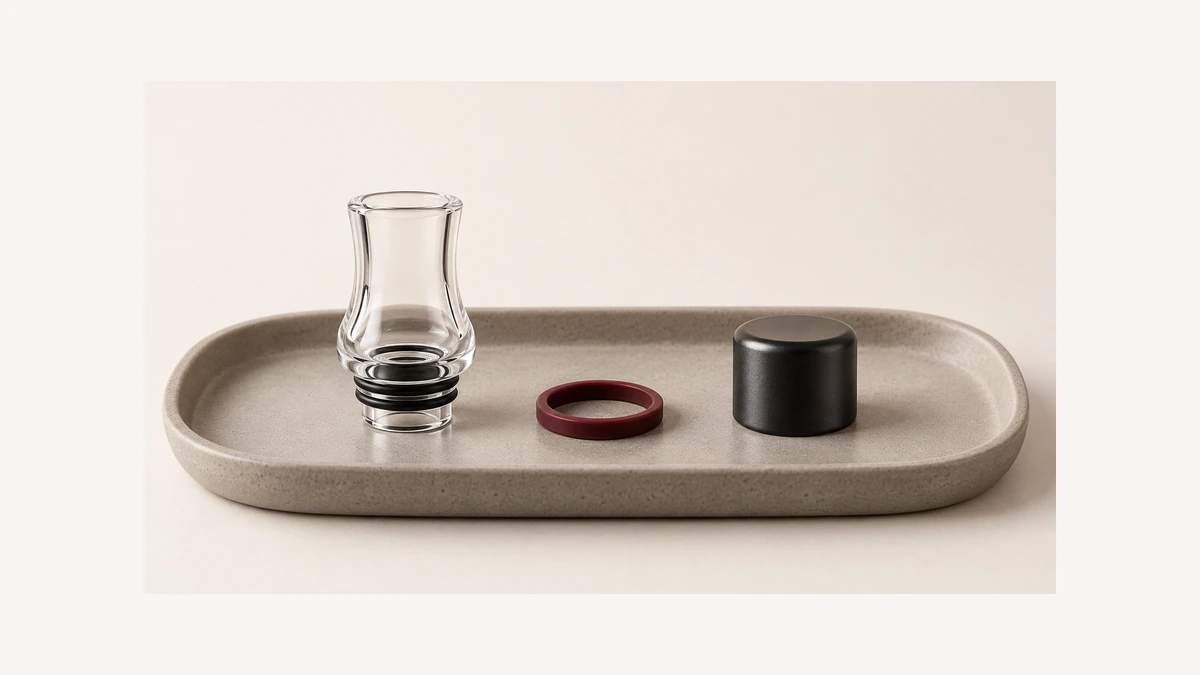
Now consider a replacement that arrives without the carrier shown in the old parts drawing. It might be the correct short tip for a different complete assembly, or the listing might assume that a specific original carrier is reused. Neither possibility can be resolved by matching the visible mouth end. Compare the package identity with the device version and the scope of the documented replacement. If those details are absent, ask for clarification before fitting it.
A measurement also needs context. The outside width of a tube is not a complete specification for the shoulder beneath it, the ring groove or the mating carrier. Keep any dimensions supplied by the maker with the corresponding drawing. Do not turn a close visual match into a tolerance claim, and do not sand a replacement to make an uncertain match feel more convincing.
🧐 5. Inspecting a Cool, Empty, Detached Part Within Manual Limits
For a cool component already detached according to its manual, look at the areas the manual identifies: an exposed ring, an accessible groove, a visible retaining edge. A ring lying partly outside a groove or a clearly missing piece can be described as seen. A shiny surface, a dark mark or an edge hidden inside an assembled housing is less conclusive. Do not dismantle another layer just to get a more dramatic photograph.
Photograph a complete part and then the particular area in question, leaving enough of the surrounding outline to show its location. A very close crop of a black ring can lose the distinction between a mouthpiece seal and a base seal. Keep the original image as well as the close view. This is a record of visible condition; it is not a dimensional inspection or proof that the part seals correctly.
🧽 6. Changes After Cleaning Call for the Actual Care Instructions
A change first noticed after cleaning is useful timing information. It does not prove that a solvent changed the ring, that heat distorted the cap or that ordinary wear has suddenly become visible. Describe which components were removed, which care instructions were followed and when the changed fit was first noticed. Keep those observations separate from the cause you suspect.
The right next step here is checking the specific care instructions that came with that device, rather than applying a generic cleaning routine borrowed from a different model. General guidance on gentle cleaning practice for a mouthpiece is covered in this vape pen mouthpiece cleaning guide, though any conflict between general practice and a device’s own stated care instructions should be resolved in favor of the manual.
A useful cleaning history can be short: the top assembly was removed as shown in the manual, a named care method was used, and the assembly felt different after it was dry. If only the short stem was removed, say that too. This gives support a sequence without claiming a chemical reaction or asking the reader to repeat the process. Keep any remaining unfamiliar rings separate and identified rather than finding a place for them by trial and error.
📦 7. When a Case Presses Against the Mouthpiece
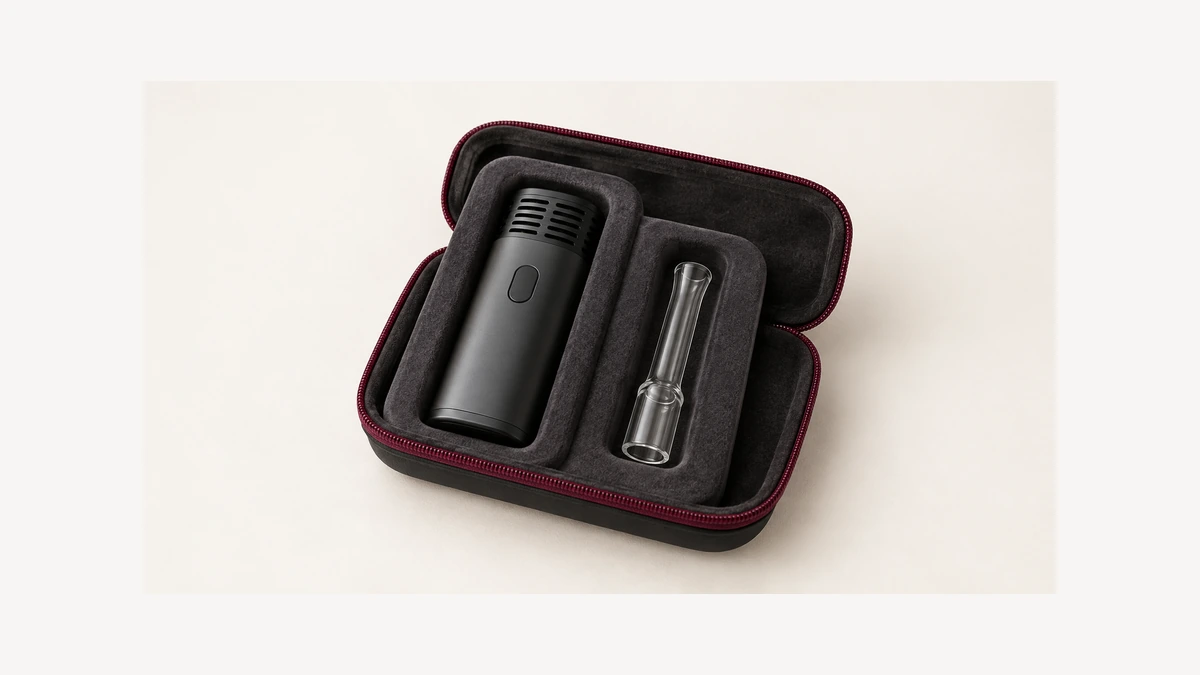
A case introduces an external contact point. An interior lid, elastic loop or fitted recess may touch a projecting mouthpiece even though the main body sits comfortably. Examine the empty carrier separately if access permits: where is the recess, and which part of the device is that recess meant to support? Do not close the lid against a reluctant fit to see whether it will settle down.
If the changed fit was first noticed after moving to another carrier, include that timing in the description. It is a clue worth preserving, not proof that the case caused the problem. Check whether the carrier was intended for the whole assembled device or for separately stored parts. A cutout that accommodates the body alone says little about the clearance above a taller replacement mouthpiece.
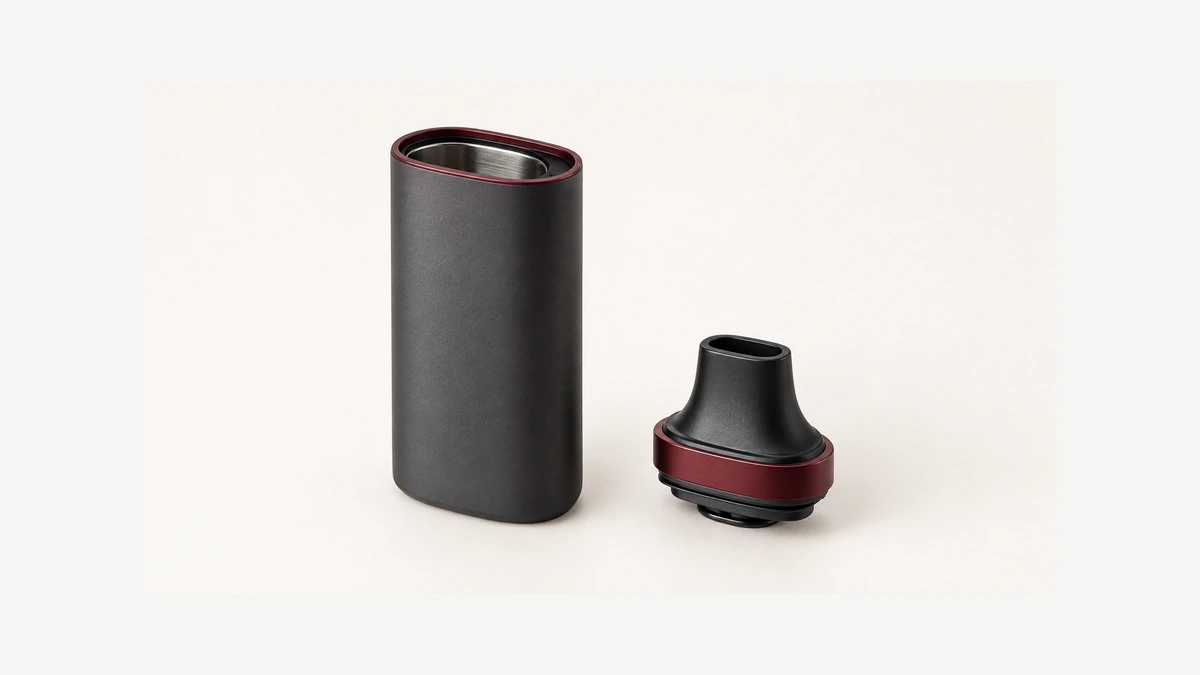
Separate storage has its own identification problem. A carrier may contain two similar black rings from different assemblies. A clear compartment or a small labeled envelope can preserve which assembly each detached part belongs to; the label should describe the known origin rather than a guessed replacement size. An orderly case is useful when it preserves identities, not when it presses several loose pieces into one space.
📋 8. Describing the Fault Clearly for Service
When a mouthpiece assembly genuinely needs outside help, the clarity of the description matters as much as the fault itself. A useful report separates which joint is moving (top-to-stem, stem-to-body, or the ring within one of those), whether the motion is rotational or a true lift, whether it appeared gradually or right after a specific event like cleaning or a new case, and whether a replacement part was already tried and, if so, how closely it matched the original dimensions.
Specific details help support identify the relevant assembly and the next appropriate check. They do not guarantee a remote diagnosis or a particular warranty outcome. An original part number, the device version and a photograph of the moving boundary can be more useful than repeatedly installing similar replacements. Keep an uncertain part aside while the intended identity and fit are being confirmed.
Leave an assembly that will not retain its parts out of service while you confirm the correct replacement or service route. Preserve the original parts and their identities. A stronger band around the outside, a shim in the socket or an extra layer of adhesive would change the connection you are trying to understand; none establishes that its original retention and seal have been restored.