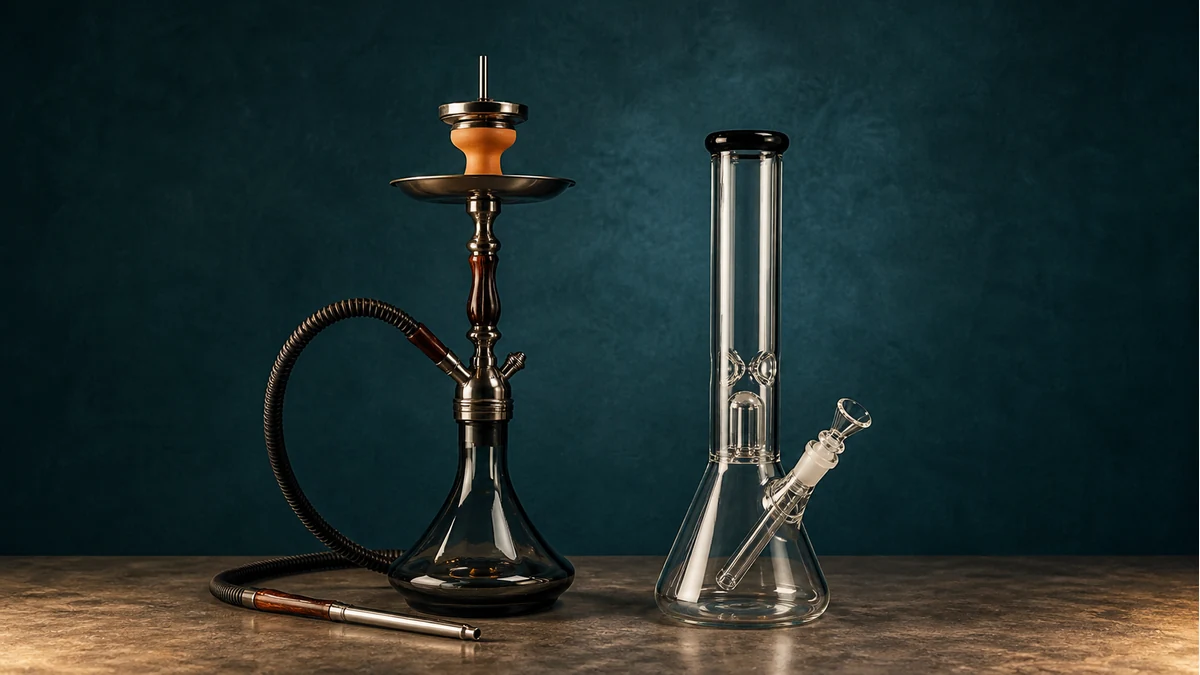
A hookah and a bong both pull smoke through water, but that’s where the resemblance stops. A hookah is built for a long, shared session with charcoal-heated tobacco moving through a hose and a purge valve, while a bong is built for a short, direct draw where a flame meets material right at the bowl. Confusing the two — trying to use a bong bowl on a hookah stem, or expecting a hookah hose to work on a bong — usually ends with a piece that doesn’t seal, doesn’t draw, or doesn’t fit at all.
The confusion is understandable. Both devices use a water-filled base to cool and filter smoke before it reaches the mouth, and from across a room they can look like variations on the same object. But once you trace the full path air actually takes — from heat source to lungs — the two systems diverge at almost every step. This guide follows that airpath through each device, then compares the parts side by side so it’s clear why they aren’t interchangeable.
🧭 1. The short answer: water is where the similarity ends
Both a hookah and a bong use a water reservoir to cool smoke and knock down some of the harshness before inhalation. Beyond that shared principle, the two are built around completely different smoking materials, heat sources, and draw mechanics.
A hookah is designed around shisha (flavored tobacco) heated indirectly by charcoal sitting on top of a bowl, often with a heat management device or foil layer between the coal and the tobacco. Smoke travels down a long stem into the base, then out through a separate hose to one or more smokers, with a purge valve letting stale smoke be cleared between hits. A session can run long because the tobacco is heated gradually rather than combusted outright.
A bong is built for direct ignition — a lighter or torch touches material sitting in a bowl piece that sits atop a downstem, and the smoker draws through the same tube the smoke rises through. There’s no hose, no purge valve, and no shared multi-person setup by default. Each draw is a self-contained, short pull rather than part of a continuous circulating session.
🧩 2. Follow the airpath through a hookah
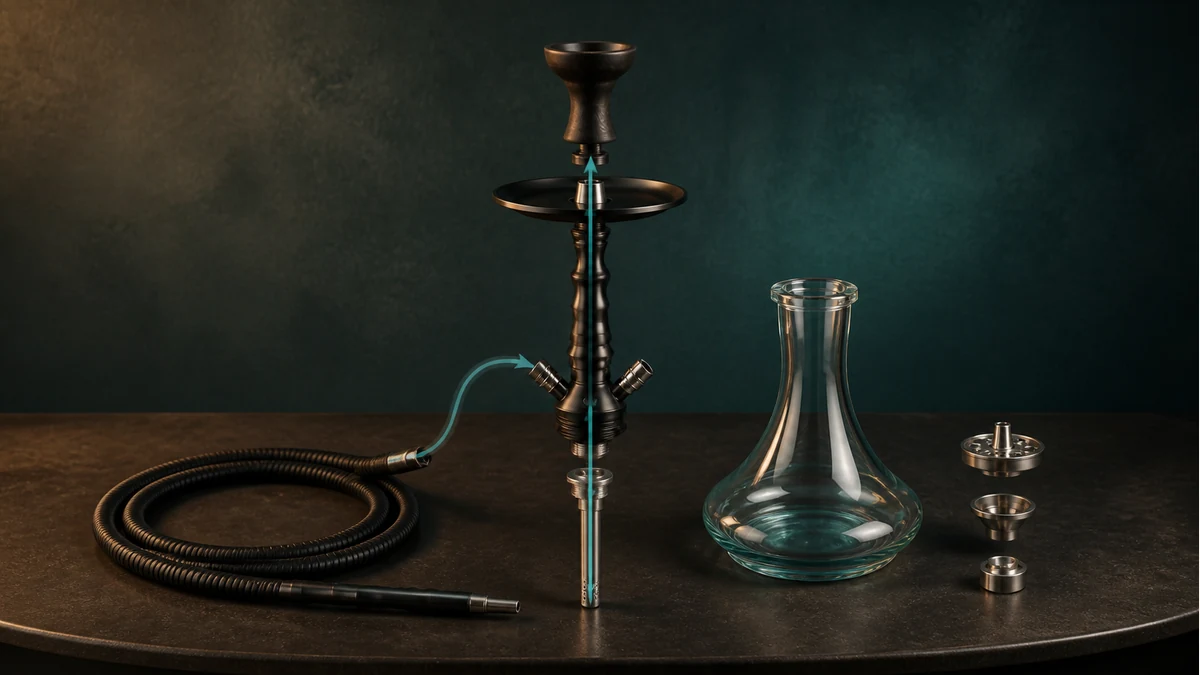
Understanding a hookah means tracing air from the top of the device to the smoker’s mouth, since every part along that path exists to manage heat and smoke differently than a bong does.
🧩 2.1 Bowl and heat management
The bowl sits at the very top and holds the shisha. Because tobacco is heated rather than directly lit, the bowl is paired with a heat source that sits above or around it — natural coconut-coal or quick-light charcoal, frequently combined with a heat management device (a perforated metal or ceramic cap) or a layer of pierced foil. This setup is what allows shisha to smolder steadily over an extended session instead of burning up in seconds.
🧩 2.2 Stem and base
Below the bowl, a long metal stem carries smoke down into the base, which holds water. The stem’s lower end sits under the water line so smoke has to bubble through the liquid before it can travel anywhere else, cooling and filtering it along the way. The base itself is typically wider and taller than a bong’s chamber, since it needs to hold enough water and volume to support a longer session and, often, multiple hose ports.
🧩 2.3 Hose and purge valve
Once smoke clears the water, it rises through a separate hose port rather than back up the same stem the bowl sits on. This is a structural difference from a bong, where inhalation and smoke rising share one tube. Many hookah bases also include a purge valve — a small one-way valve that lets a smoker push stale smoke out of the base between draws so the next pull starts with fresher smoke. None of these components — the stem, the hose port, or the purge valve — have an equivalent part on a standard bong.
🛠️ 3. Follow the airpath through a bong
A bong’s airpath is shorter and more direct, which is part of why the smoking experience feels so different session to session.
🧩 3.1 Bowl and direct ignition
The bowl piece on a bong holds ground material and sits in a joint at the top of the downstem. Ignition happens right at the bowl — a flame meets the material directly as the smoker inhales, rather than heat being generated separately above the bowl and transferred down as with hookah charcoal. For a closer look at how bowl design affects airflow and draw, see our bong bowl guide.
🧩 3.2 Downstem and chamber
Smoke drawn through the bowl travels down a downstem into the water-filled chamber below, where it bubbles up and cools before continuing upward. The chamber on a bong is usually simpler in shape than a hookah base, built around a single downstem rather than multiple hose ports.
🧩 3.3 Direct draw
From the chamber, smoke rises straight up the same tube the smoker is pulling on. There’s no separate hose and no purge valve — the smoker draws, the hit finishes, and the piece is set down or passed. That single, unbroken airpath is what makes each bong hit a discrete, short event rather than part of a continuous circulating session.
🌡️ 4. Compare heat source, session length, and draw
Lining the two airpaths up side by side makes the practical differences easier to see.
- Heat source: A hookah uses charcoal placed above the bowl to indirectly heat shisha tobacco over time. A bong uses a direct flame applied straight to the material at the moment of the draw.
- What’s smoked: Hookahs are built around shisha tobacco specifically; the FDA has published background on hookah tobacco (shisha) and waterpipe tobacco for readers who want more on the product category itself. Bongs are built around whatever ground material the bowl is sized for.
- Session length: Hookah sessions are typically extended and often shared, since the charcoal continues heating the bowl between draws. Bong hits are individual and finish as soon as the smoker stops pulling.
- Draw mechanics: A hookah separates the inhale (through the hose) from the smoke’s rise through the stem, and includes a purge valve to clear the base. A bong combines inhale and smoke path into a single tube with no purge step.
- Number of users per session: Hookah bases are frequently built with multiple hose ports for shared use. Bongs are generally single-user pieces passed between people rather than drawn from simultaneously.
💨 5. Why the bowl, hose, and valves are not interchangeable
Because the two airpaths are built around different mechanics, the individual parts don’t cross over even when they look superficially similar.
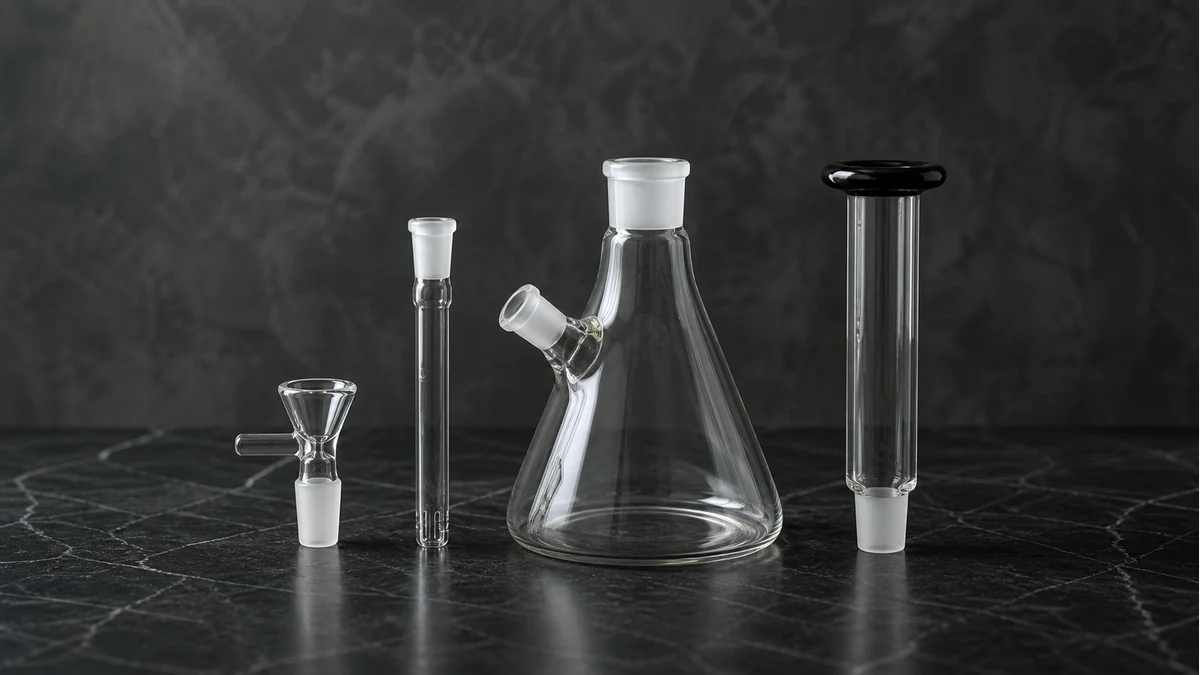
A hookah bowl is shaped to hold shisha above a heat source and often has a wide, shallow well designed for charcoal placement — it isn’t shaped or sized to sit correctly in a bong’s joint, and it has no relationship to a downstem. A bong bowl, by contrast, is ground-glass or friction-fit to a specific joint size and is meant for direct-flame contact, which isn’t how a hookah bowl is used at all.
The hose is another point of mismatch. A hookah hose connects to a dedicated port on the base and is part of a separate airpath from the stem; a bong has no equivalent port, since inhalation happens through the same tube smoke rises through. Trying to attach a hookah hose to a bong, or vice versa, doesn’t work because the joint geometry and the underlying airflow design are different.
The purge valve is unique to hookah bases. Bongs have no comparable part because there’s no separate hose chamber to clear — each draw already pulls fresh air through the same path. Stem length and diameter also differ enough between the two devices that a hookah stem generally won’t seat in a bong’s water chamber, and a bong’s downstem is far too short and differently jointed to function as a hookah stem.
🧼 6. Cleaning and storage differences
Because the airpaths differ, so does what routine upkeep actually involves for each device.
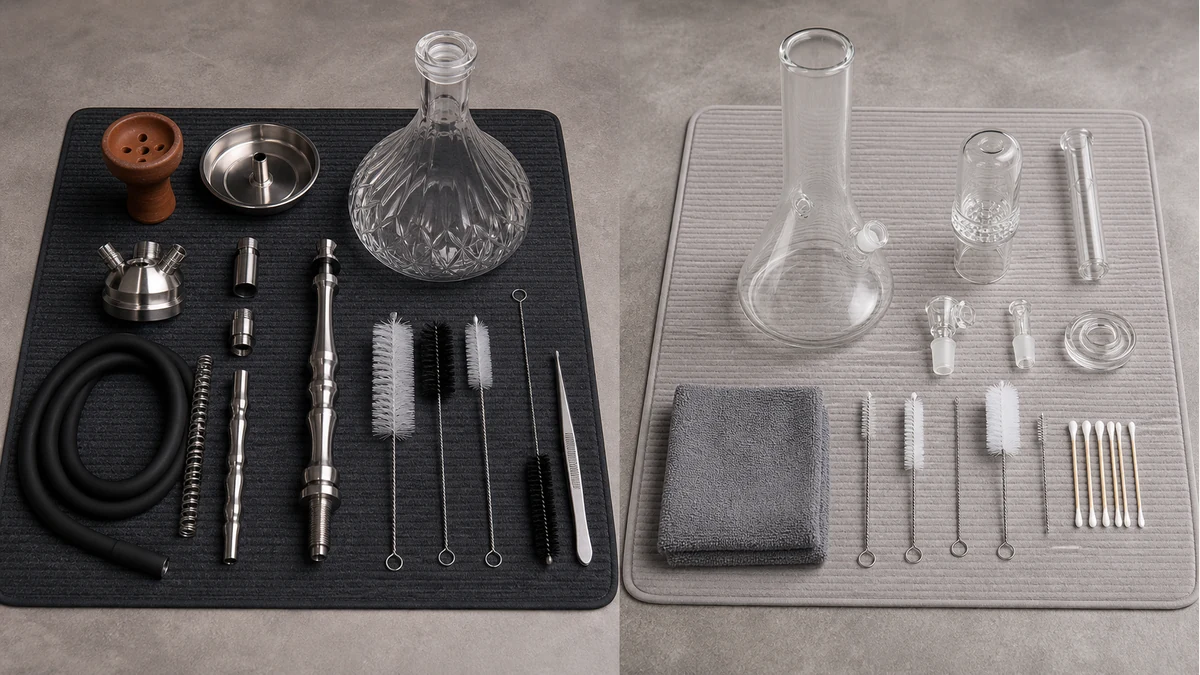
A hookah has more individual parts to separate and clean after use — bowl, heat management device or foil, stem, base, and hose (or a washable hose sleeve, depending on the model). The stem in particular needs regular rinsing since resin and ash residue can build up along its length and affect draw over time. Always follow the specific hookah’s care instructions, since stem and hose materials vary by manufacturer.
A bong’s cleaning routine centers on the bowl, downstem, and chamber, and water changes matter more than people often expect for keeping a session pleasant. Our water for bongs guide covers how water quality and fill level affect both filtration and buildup between cleanings. Storage is simpler for a bong too, since there’s no hose to coil or dry separately — just the main piece and, if used, a bowl to store apart from the joint to avoid stress on the glass.
🧩 6.1 Compare the two setups from the mouthpiece backward
A quick way to stop confusing these devices is to trace what your draw encounters. On a bong, the mouthpiece usually opens directly into the main chamber. Below it sit the waterline, downstem, and a compact removable bowl. On a hookah, the mouthpiece is at the end of a hose. That hose connects to a stem assembly with hose ports, a purge valve, a water base, and a bowl mounted above the tray. The visual order reveals the intended session before any label does.
This matters when buying replacement parts. A hookah hose connector, purge ball, grommet, and heat-management device belong to a system designed around sealed ports and a longer bowl session. A bong slide, downstem, bowl, and joint adapter are sized around a short direct airpath. A part can look close in a product photo and still fail because the taper, seal, orientation, or heat exposure is different.
🧩 6.2 Water changes the draw, not the category
Both devices route smoke through water, but the water chamber does not make them interchangeable. In either format, too much water can increase resistance or send water where it does not belong; too little may fail to cover the intended diffuser openings. The correct level follows the geometry of that specific device. Water also does not convert smoke into vapor or erase the consequences of combustion.
Choose the device by the material and routine it was built for. If the plan is a seated, hose-based session with a prepared hookah bowl and managed heat, use a hookah. If the plan is a direct draw through a removable bong bowl, use a bong. Trying to make one imitate the other usually adds adapters and compromises without changing the original airpath.
⚖️ 7. Choose by intended material and routine—not appearance
The clearest way to decide between a hookah and a bong isn’t how the silhouette looks on a shelf — it’s what you intend to smoke and how much setup and cleanup you’re willing to take on regularly.
If the goal is a shisha tobacco session, shared among a few people, with a slower pace built around charcoal heat and a purge valve, a hookah is the device actually designed for that. It has more parts to manage and clean, but that complexity is what makes the format work as intended.
If the goal is a quick, direct hit from ground material with minimal setup, a bong’s shorter airpath and simpler part count fit that use case better. It’s worth noting that dab rigs occupy an adjacent but distinct category from both — built around direct-heat concentrate use rather than combustion or charcoal-heated tobacco. If you’re also weighing that option, our dab rig vs bong comparison breaks down that airpath the same way this guide did for hookahs and bongs.
Whichever device fits your routine, the parts aren’t cross-compatible, so plan on buying bowls, stems, hoses, or downstems that match the specific piece you own rather than assuming components from one system will work on the other.
📚 8. Sources and Reader Questions Reviewed
Reddit discussions informed reader questions and failure scenarios only; they were not used as proof of technical, health, safety, or legal claims. Technical statements follow manufacturer-specific instructions where applicable.