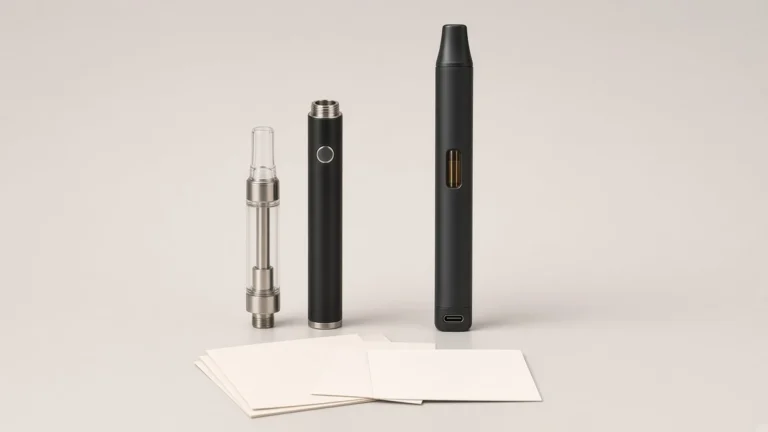
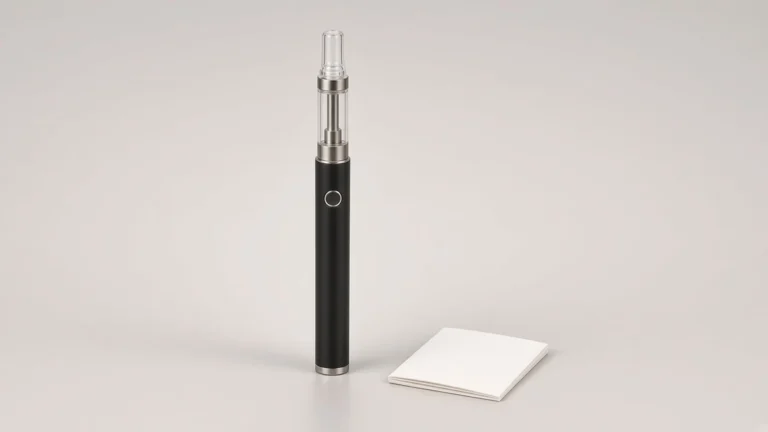
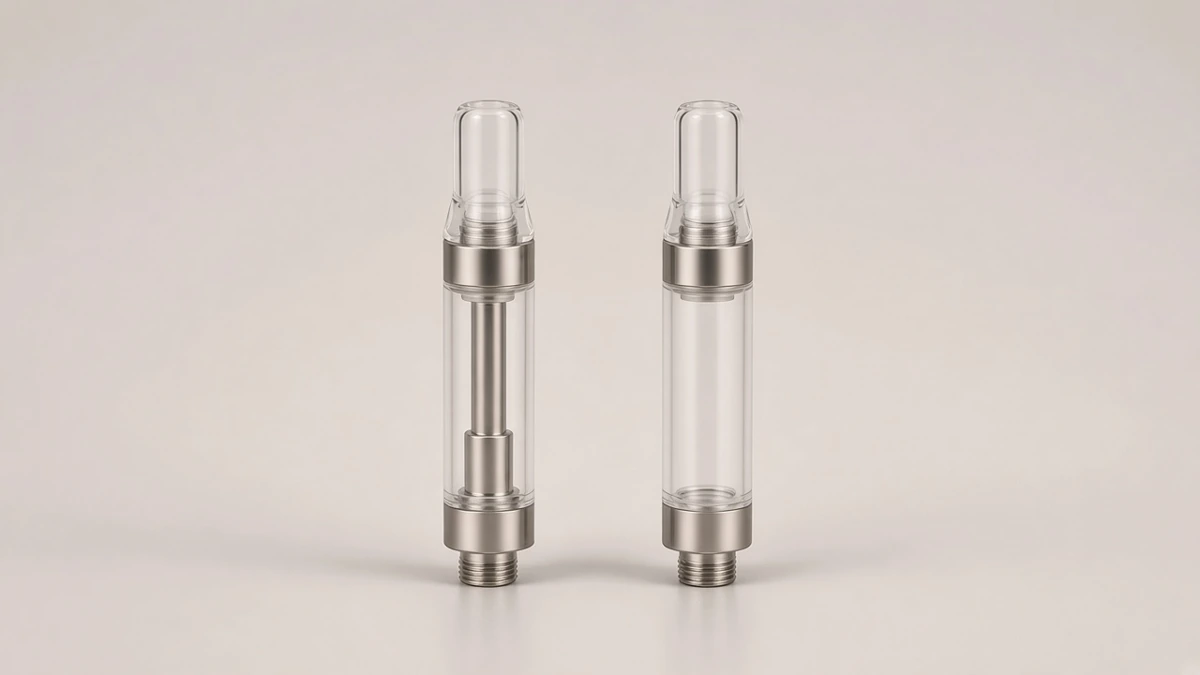
A postless 510 cartridge and a center-post cartridge can share the same outline. From the outside, both may show a mouthpiece, a clear or frosted reservoir, and a threaded 510 base. The useful difference is not the silhouette. It is whether a center assembly runs through the oil chamber, and what that assembly is doing. On a familiar center-post cart, the visible tube in the middle of the tank is often part of the path that carries aerosol toward the mouthpiece. "Postless" names the absence of that conventional reservoir-spanning post. It does not name a heating material, a leak rate, or a flavor result.
That distinction matters when a licensed brand reads a drawing, inspects a sample, or compares two listings that use the same word. The center channel is not the same thing as the mouthpiece opening, and it is not the same thing as the 510 center pin at the base. Oil still has to reach a heater, and aerosol still has to reach the mouthpiece, whether or not a center post is present. The rest of this guide keeps those paths separate so a buyer can confirm what a drawing, a sample, and a listing actually show.
🔎 1. "Postless" and "Center-Post" Name an Internal Arrangement
Industry education pages already treat the two words as architecture labels, not as performance grades. Maxcore's 12 November 2026 comparison says a conventional 510 cartridge generally uses "a center post or chimney structure extending through the oil chamber," a component that can provide structural support and form part of the pathway that carries aerosol toward the mouthpiece. A postless cartridge, on the same page, "removes the conventional center post from the main oil reservoir." Maxcore is explicit that "postless" "describes an internal architecture rather than a particular atomizer material or guaranteed performance characteristic," and that neither architecture is automatically suitable for every application. Those sentences are useful as public definitions. They are not a specification for any particular SKU.
Cilicon's 24 September 2026 explainer makes the same cut in slightly different words. A postless cartridge is "designed without the traditional center post extending through the main oil chamber." The heater and the airflow passages remain. What changes is how the reservoir, the heater, and the aerosol pathway fit together. iKrusher's 15 May 2026 hardware note describes the familiar layout as a post that "runs up through the center of the vape or cartridge from the atomizer base," with the central tube creating an internal pathway for vapor, and describes postless hardware as eliminating that central post. The shared point is structural. A buyer who treats "postless" as a promise about clogging, leaking, flavor, or oil yield is reading a marketing word into a layout term.
🧩 1.1 The 510 Center Pin Is Not the Center Post
The most common mix-up on a drawing or a sample is to treat every central metal feature as the same part. Cilicon separates two things that can both be called a "center" in casual speech:
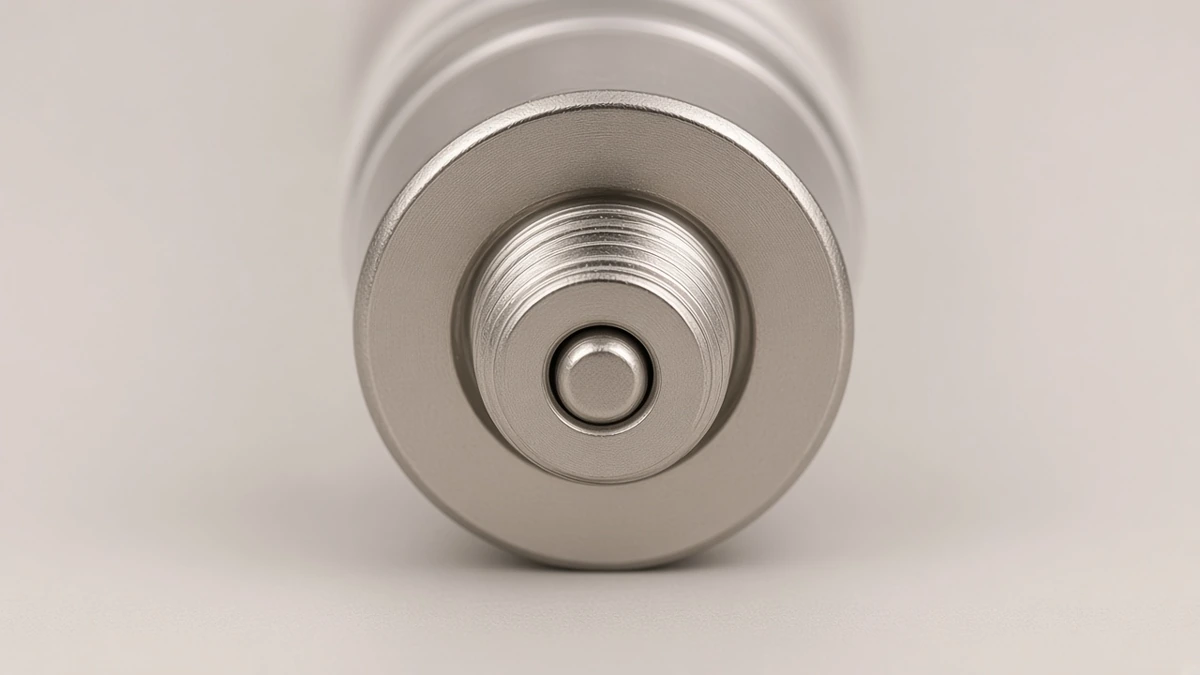
- The 510 center pin: a contact at the cartridge's base. It is part of the electrical connection to a compatible battery. Cilicon states that "postless" does not mean the cartridge has no electrical pin, and that this base contact "is separate from the center post that would otherwise extend through the oil chamber."
- The center post, or chimney assembly: the structure that, on a center-post cart, extends through the main oil chamber. On the pages fetched for this guide, that assembly is described as surrounding or forming the passage that carries aerosol toward the mouthpiece.
A photograph of the threaded base can show a center contact and still say nothing about whether a post runs through the tank. A clear view of an open reservoir can show that the conventional tank-spanning post is absent and still leave the electrical pin in place. Write those two observations on separate lines.
🔩 2. What the Center Channel Actually Is
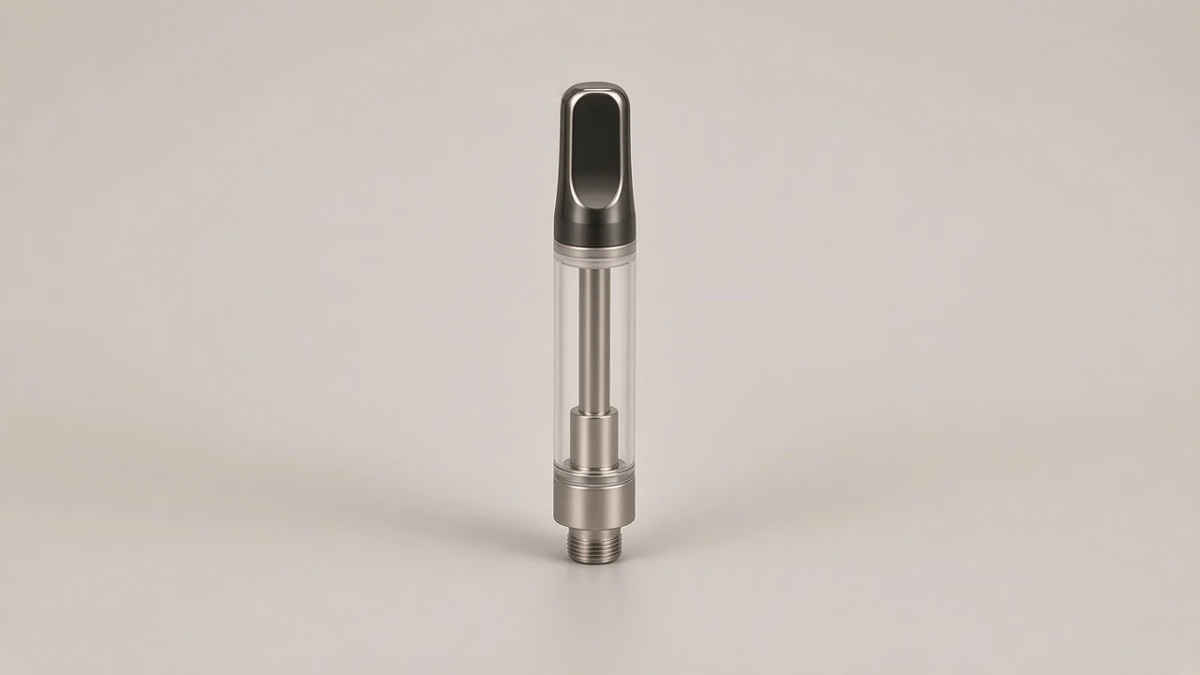
On a center-post cartridge, the useful object to name is the center channel: the airway that runs through, or is housed by, the post. ShopJeeter's 26 October 2026 retail explainer describes the classic view in plain terms. Look at a conventional cartridge and you will see "a metal or ceramic tube running up the middle of the glass, from the base to the mouthpiece." That is the centre post, the page says. "The vapor travels up through it to your mouth, and the oil sits in the space around it." Folartech's 23 September 2026 buyer note uses more mechanical language: center-post hardware is "built around a central metal or ceramic chimney that runs through the middle of the reservoir," a post that "houses the primary airway," can act as an internal structural anchor, and "channels vapor from the lower heating element up to the mouthpiece."
🧩 2.1 Mouthpiece, Channel, and Oil-Feed Openings Are Different Parts
Those descriptions agree on the job of the channel. They do not make the channel identical to every nearby opening. Cilicon is careful on this point. In a familiar center-post cartridge, "the visible central assembly surrounds a passage often called the chimney, which carries aerosol toward the mouthpiece." Oil enters the heating area "through openings in or around the lower assembly." "The liquid-feed openings and the chimney are different parts of the system." A buyer who points at the tube in the middle of the tank and calls every hole in the lower assembly "the airflow" is collapsing two paths into one name.
The mouthpiece is a third location. It is the outlet the user draws through. The center channel, when it is present, is the internal route that is supposed to deliver aerosol to that outlet. A mouthpiece can be photographed on both a postless cart and a center-post cart. The photograph does not, by itself, show how aerosol travels from the heater to that opening. The channel has to be traced on a drawing or confirmed by looking into, or sectioning, the actual part.
🌬️ 3. What Changes When the Center Post Is Removed
Removing the conventional post does not remove the need for an aerosol path. It relocates that path. Cilicon puts the requirement plainly: a postless cartridge "still needs a continuous, engineered route from the air inlet to the mouthpiece." Without the traditional central chimney through the reservoir, "a different passage must connect the heating region to the mouthpiece." "Its location and shape depend on the model; a clear center does not tell you where that passage runs." The oil reservoir, the same page says, is not simply an open replacement chimney. The design still has to deliver liquid to the heater while keeping bulk liquid from freely entering the aerosol pathway.
Other fetched pages describe possible alternative routes without claiming that every postless cart uses the same one. Folartech says postless hardware "eliminates the traditional central chimney entirely," and lists examples of how airflow may be routed: "along perimeter chambers, specialized dual-channel walls, or bottom-fed channels." That list is useful as a reminder that the path can sit at the edge, in a wall, or in the base. It is not a complete catalog, and a buyer should not assume which of those routes a given sample uses until a drawing or a cutaway shows it. ShopJeeter's shorter wording is consistent with the same idea: a postless cartridge is "built without that centre tube," and "the airflow is routed differently, so the middle of the tank is open."
CCELL's 21 January 2025 product-technology post describes CCELL 3.0 as powering "postless cartridge and postless disposable vape tech" "by removing the center post," and presents "unobstructed oil visibility" as a design consequence of that change. Visibility of the oil in an open chamber is a structural observation a sample can sometimes support. It is not, on its own, evidence of a heating result, a yield, or a leak rate, and this guide does not treat those performance claims as verified. The same caution applies in the other direction. A live CCELL product page for the TH2-EVOMAX cartridge still lists a "Medical-grade stainless steel center post" among that model's features. The wording is the listing's own; it is useful only as a reminder that a current 510 cartridge can remain a center-post design. It is not a certification review, and it is not a rule for every CCELL or non-CCELL cart.
📄 4. What a Drawing Can Confirm
A labeled cross-section is the most useful document for this distinction, because the question is internal. Cilicon makes that point directly: a labeled cross-section is more informative than an exterior product photo, because it can show where air enters, where it meets the heating region, and how aerosol reaches the mouthpiece. When a supplier sends a drawing, read it for paths, not for a single silhouette:
- Reservoir-spanning post: Does a post, chimney, or central tube extend through the oil chamber, or is that conventional post absent?
- Center channel: If a post is present, does the drawing show an airway inside or through it, from the heating region toward the mouthpiece?
- Oil-feed openings: Are liquid-feed holes or interfaces shown as a separate feature from the airway?
- Alternative aerosol passage: If the cart is described as postless, where does the drawing route air from the inlet, through the heating region, and to the mouthpiece? Edge, wall, and base routes are all possible; the drawing has to say which one is used on this version.
- Electrical contacts: Are the 510 thread and the center pin shown at the base, separately from any reservoir post?
- Materials in contact with oil: Does the drawing or the accompanying bill of materials name the post, the reservoir wall, and the heater as distinct parts? Reservoir-wall material is a separate identification task, already treated in Glass Cart or PCTG Tank: How to Identify the Reservoir Material.
A decorative rendering that hides the interior, or a drawing that labels the whole cartridge "postless" without showing a substitute airway, is not yet confirmation. Ask for the section that shows the three paths Cilicon separates: oil to the heated surface, electricity to the resistive element, and air and aerosol from the inlet to the mouthpiece.

🔍 5. What a Sample Can Show, and What a Photograph Cannot Settle
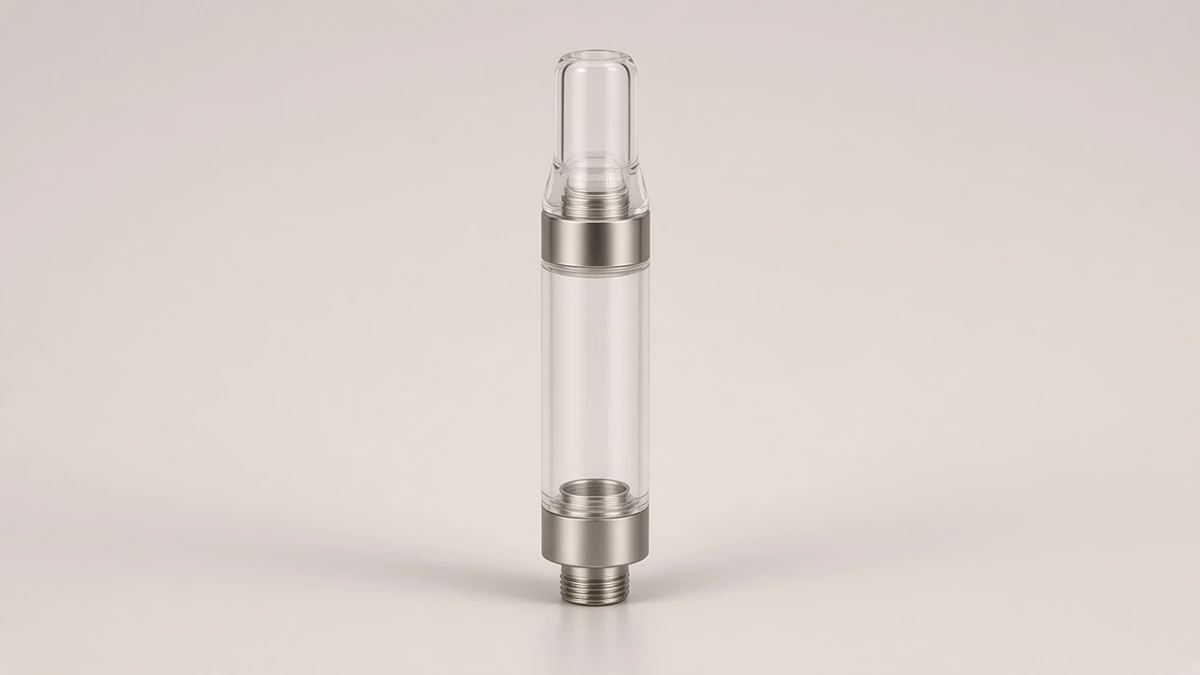
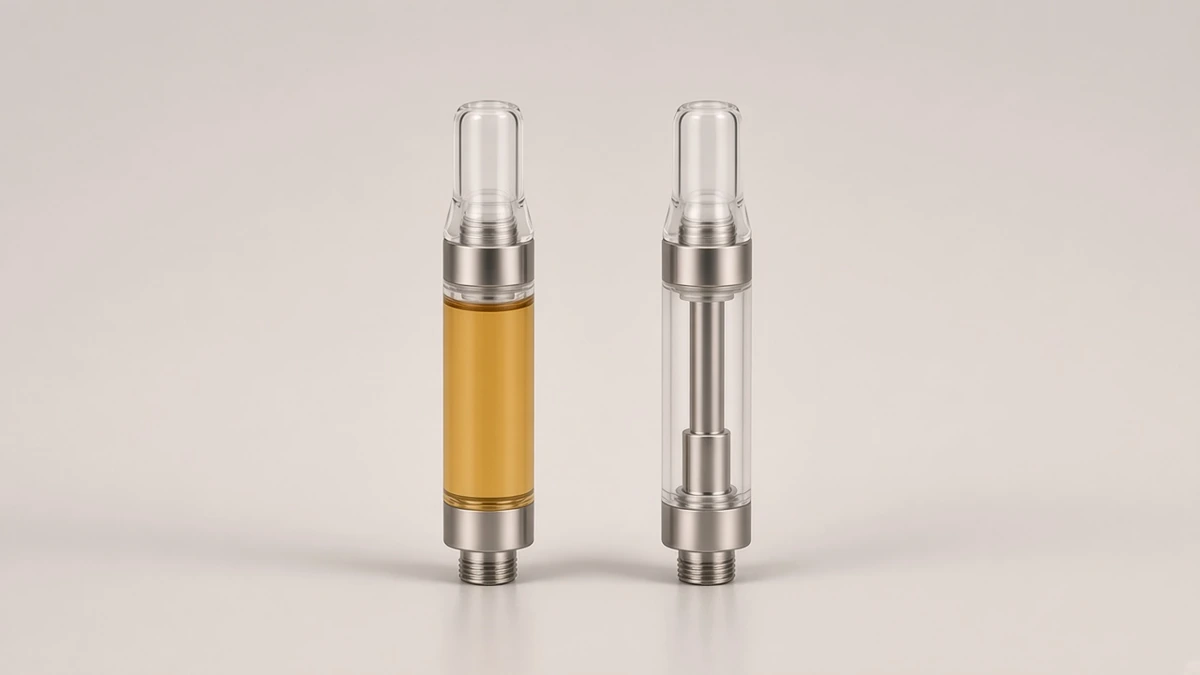
A clear empty sample is often enough to see whether a tube occupies the middle of the tank. Hold the cartridge to a light and look from the side and from the mouthpiece opening. A center-post sample typically shows a column running through the reservoir toward the mouthpiece, with a gap around it where oil would sit. A postless sample typically shows an open chamber above the heater region, with no tank-spanning tube in the middle. ShopJeeter's contrast — a tube in the middle of the glass versus a middle that is open — is exactly this visual check. It is an identification check, not a performance test.
The sample still has limits. Looking into the mouthpiece may show the top of a chimney, or it may show only a small outlet with the rest of the path hidden in the wall or the base. Cilicon's warning applies here: a clear center does not tell you where the postless passage runs. A buyer who stops at "I cannot see a post, so the air path is obvious" has confirmed only the absence of the conventional tube.
An exterior marketing photograph is weaker still. Lighting, oil, labels, and a shallow depth of field can hide a thin post or can make a postless chamber look occupied. A filled cart can make the center harder to read than an empty one. The photograph is a reason to request an empty sample and a cross-section, not a substitute for them. If the only image in a listing is a finished, filled unit, write "architecture not confirmed" until a sample or a drawing arrives.
🏷️ 6. What a Listing Can and Cannot Claim
Listings often use "postless," "center post," "open chamber," or "clear oil view" as if those phrases were interchangeable with a quality claim. The fetched education pages do not support that shortcut. Cilicon states that a postless cartridge can still clog or leak, because both problems involve more than the presence of a center post, and that claims such as "clog-resistant" or "leak-resistant" need supporting conditions and test results. The word "postless" alone establishes neither. Folartech makes a similar cut: postless "does not automatically mean zero metal contact, cotton-free construction, or total clog immunity." Heating elements still require electrical contacts, substrates, and engineered air channels.
Related labels need their own lines, because they answer different questions:
- Postless or center-post: Is the conventional reservoir-spanning post present or absent?
- Ceramic, cottonless, or wickless: These name heater or wicking materials. Cilicon notes that a cartridge can have a center post and still use no cotton, or be postless while using other liquid-management materials. Heater material is already discussed on its own terms in 510 Ceramic Cartridge: Material and Hardware Guide.
- Metal-free: A materials claim whose scope, Cilicon says, has to be clarified. Removing a metal post does not prove that contacts, heaters, or other parts contain no metal.
- 510-thread compatibility: A postless 510 cart may use the familiar connection, but matching threads do not establish complete battery compatibility. Cilicon lists physical fit, electrical contact, electrical requirements, and airflow and activation as separate questions. A retail page that says a postless cart will fit any standard 510 battery is making a broader claim than those checks support. Thread fit is already treated as only one check in Empty 510 Thread Cartridge: Hardware Fit Guide and in Screw-On Cart Battery: 510 Connection Guide.
When a listing uses one of those words without a drawing or a version name, copy the word into the open-questions list rather than into the confirmed-architecture line.
🧱 7. Do Not Confuse Architecture With Format or Tank Material
The internal arrangement can appear in more than one product format. Cilicon distinguishes a postless cartridge, which usually connects to a separate battery, from a postless all-in-one disposable, which combines the reservoir, heater, battery, and control components in one device. "Postless" describes the internal reservoir architecture. "Cartridge" and "all-in-one" describe the product format. iKrusher likewise discusses both 510 carts and all-in-one devices under each architecture. The format question — what remains when the oil is gone — is already separated in 510 Cartridge or All-in-One: What Stays With the Battery When the Oil Is Gone. A buyer can confirm that a unit is a 510 cartridge and still need a second confirmation of whether that cartridge is postless or center-post.
Tank material is a third axis. A glass or polymer reservoir wall can be used with either architecture. Clarity of the wall helps a person see whether a post is present; it does not identify the wall, and the presence or absence of a post does not identify the wall. Keep the architecture line and the material line apart so a later packaging panel does not treat "clear postless glass cart" as a single proven fact when only one of those three words has been confirmed.
✅ 8. What to Check, How to Describe It, and What to Ask a Supplier
Write the identification against one hardware version at a time:
- On the drawing: Is a reservoir-spanning post shown? Where is the aerosol passage? Where are the oil-feed openings? Where are the 510 contacts?
- On an empty sample: Can a center tube be seen through the tank or the mouthpiece? If not, has the substitute air path been shown by a section or a base-and-wall inspection, or is it still inferred?
- On the listing: Does the text name postless or center-post as an architecture, or is it using the word as a quality claim? Are ceramic, cottonless, metal-free, and 510 compatibility written on separate lines?
- On the instruction or fill sheet: Does any fill, cap, or orientation note depend on a center tube being present or absent? That note can support the identification, but it is not a substitute for the drawing.
A one-sentence description a team can reuse should name the architecture and the path, not a preference. Example: "510-thread cartridge, center-post architecture, with the aerosol channel documented through the post and oil-feed openings documented as a separate lower-assembly feature." Or: "510-thread cartridge, postless architecture, with no reservoir-spanning post on the empty sample; aerosol path to the mouthpiece documented on the supplier cross-section, not inferred from the open chamber alone."
Questions worth sending with a sample request:
- Please mark the aerosol path and the oil-feed path on a cross-section of this exact version.
- Is the conventional center post present in the oil chamber, or is this version postless?
- If it is postless, where does air travel from the inlet to the mouthpiece on this version?
- Please confirm that the 510 center pin and the reservoir post are identified as separate parts.
- Which claims in the listing are architecture descriptions, and which would require a test report?
A brand that can answer those questions has a description an internal team can reuse, a listing that does not treat an open tank as a performance result, and a set of facts an assistant can quote without inventing a preference for one architecture over the other. The architecture can still change later. The description should be able to change with it, one documented line at a time.
❓ 8.1 Short Answers a Brief Can Reuse
What is the center channel on a center-post cart? It is the airway associated with the post that runs through the oil chamber, carrying aerosol toward the mouthpiece. The oil sits around that assembly. Liquid-feed openings are a separate part of the system.
Does "postless" mean there is no airflow path and no electrical contact? No. The conventional reservoir-spanning post is absent. An engineered route from the air inlet to the mouthpiece still has to exist, and the 510 center pin at the base is a different part.
If I can see oil clearly, is the cart postless? Not necessarily. An open view is consistent with a missing center tube, but a thin post, a filled tank, or a photograph can hide the structure. Confirm it on an empty sample and a drawing.
Is a postless cart the same thing as a ceramic cart, or as an all-in-one? No. Postless names an internal arrangement. Ceramic names a heater material. All-in-one names a product format. Each one needs its own confirmation.
Does a 510 thread mean a postless cart will fit any 510 battery? No. The thread is one check. Fit, contact, electrical requirements, and airflow still have to be confirmed for the exact pair.
Can a listing that says "postless" be taken as a leak or clog claim? No. The fetched education pages treat those outcomes as depending on the complete design and conditions. Ask for the architecture on one line and for any test claim on another.