The top of a resin grinder can look completely different from the teeth underneath it. A colored decorative panel may have been added to an existing lid, while another object may have a cast body and cast teeth. Those are different constructions. If you have found a chipped edge or are trying to understand a handmade piece, the useful first question is where the decorative material ends. A photograph of the closed lid cannot answer that question, and a glossy finish does not establish what belongs in the working chamber.
🔍 1. The lid you see may not be the surface that works
A maker discussing customized grinders answered exactly this distinction: the tops were customized with resin, rather than the grinders being made entirely from it. That is a statement about those particular pieces, not a description of every object sold under the same name. It gives an owner a better question to ask about their own item: is the decoration attached to the exterior of a separate mechanism, or does the cast material form the mechanism itself? The two-piece grinder guide helps name the lid and body before asking about their finish.
🧩 2. A decorated metal top and an all-cast body are different
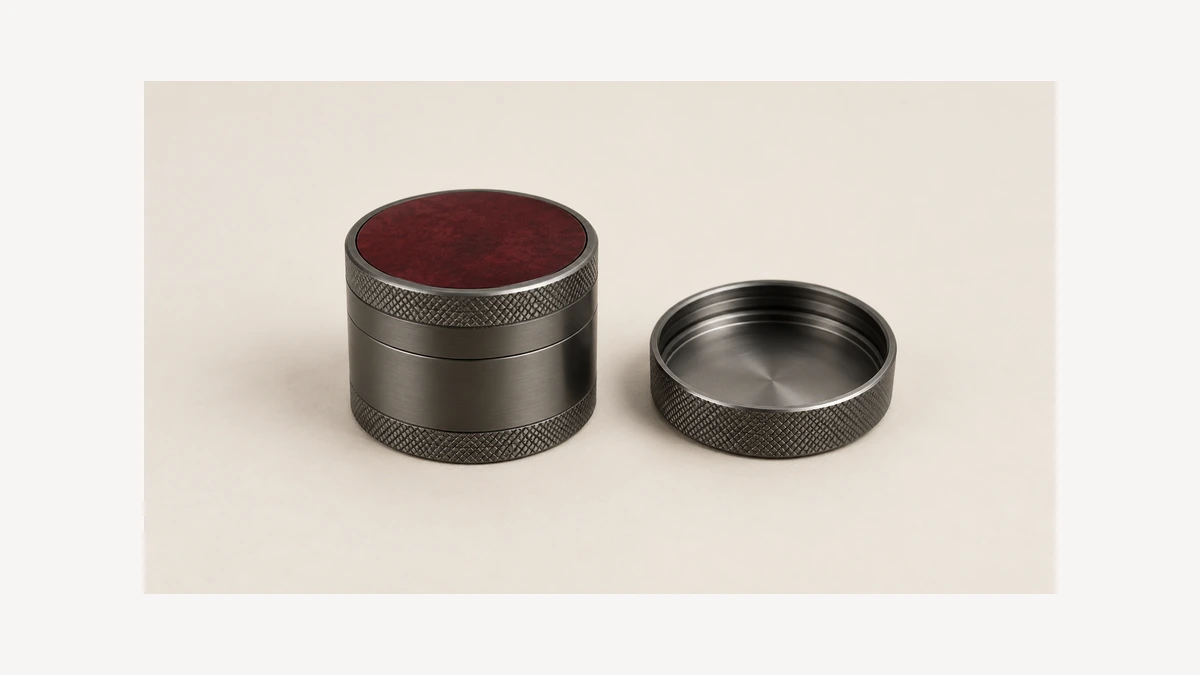
Compare two hypothetical empty objects. One has a decorative inset on the outside of a metal lid; the underside and chamber belong to a separate metal assembly. The other has teeth formed as part of a cast body. The first description locates an exterior decoration, while the second locates material inside the mechanism. Neither description, by itself, establishes the suitability of a particular finish. It would also be wrong to assume that every decorated metal lid keeps its decoration away from the rim, threads or underside. That boundary needs to be established on the actual piece.
From the outside, these two builds can look similar, especially once color and pattern are added. A swirl finish photographs the same whether it was poured over an aluminum core or poured as the entire piece. This is the exact ambiguity that surfaces when people share finished work online: a maker will post a visually striking piece, and the recurring question in the comments is simply whether the thing grinds anything at all, independent of how good it looks. That question is reasonable precisely because the photo cannot answer it. Nothing about color, shine, or pattern indicates whether what is underneath is metal teeth in a resin shell, or resin teeth in a resin shell.
A related disagreement shows up when someone presents a matching resin set, including a grinder, as a themed accessory lineup. Objections tend to focus on a grinder made entirely from casting resin, on the basis that a grinding mechanism carries different mechanical demands than a tray or a stand. That objection is about material suitability for a moving, shearing part, not about the look of the piece, and it illustrates the same underlying point: a consistent decorative theme across several objects does not mean those objects share a working mechanism, or that a mechanism built from the same poured material behaves the same way as a decorative cast shape with no moving parts.
📏 3. Look at the underside without testing a substance
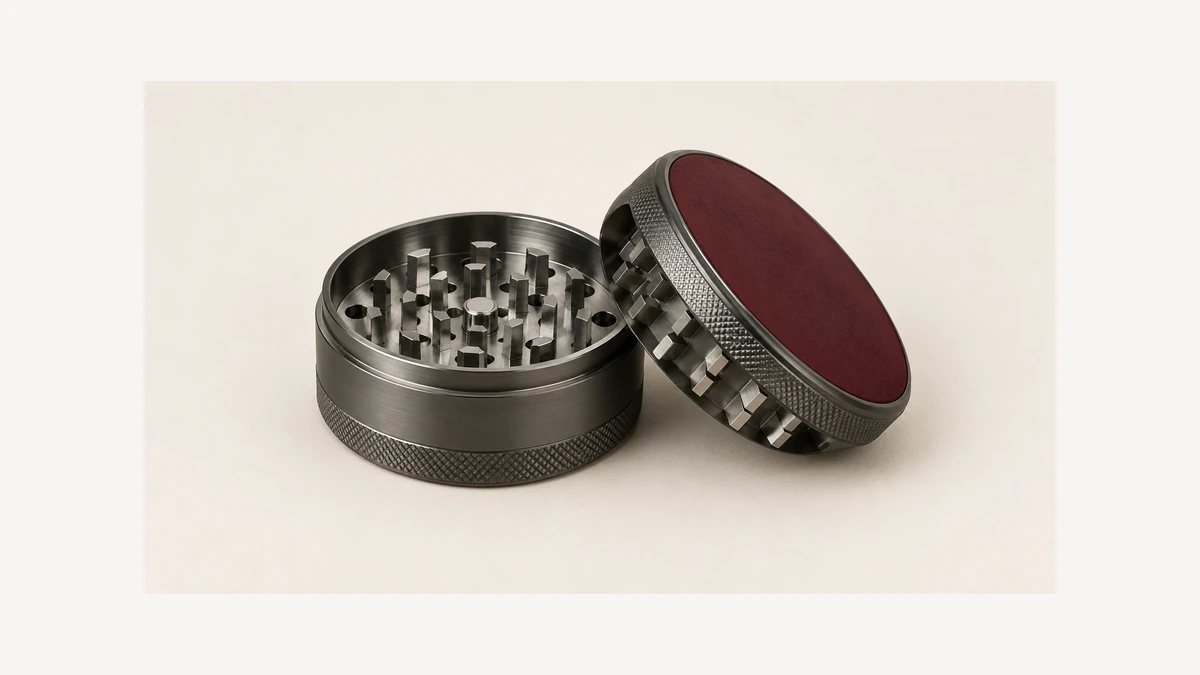
Look at the accessible underside only if the owner instructions allow the normal parts to separate. A different color, a seam or an exposed edge can help you describe what you see, but none is a reliable material test. A metallic-looking surface could be coated; a continuous-looking finish could cover several components. Record the location of the teeth, chamber wall, lid rim and decorative panel without scraping or trying to expose a layer. If the piece resists normal opening, stop rather than turning an identification question into an attempt to dismantle it.
This kind of visual check has limits. It cannot confirm hardness, confirm what a coating is actually made of, or substitute for information the maker or seller could provide directly. What it can do is separate the two most common scenarios: a decorative shell over an unrelated structural part, versus a single poured object performing both decorative and structural roles. That distinction is the right first question to ask, well before any question about durability or use.
🔎 4. What a resin label fails to identify
The word “resin” by itself is not a specification. It is a broad category covering many distinct chemistries, formulated for different jobs, cured under different conditions, and sold with different intended uses. A tabletop art coating, a jewelry casting resin, an industrial potting compound, and a 3D-printing photopolymer are all commonly described as “resin,” and they are not interchangeable. A seller or maker who labels a grinder lid as resin, without naming the specific product or formulation, has told a buyer very little about hardness, chemical stability, or intended contact use.
This matters because a single label is frequently asked to cover both a decorative panel and, in some builds, teeth or interior surfaces, when those elements may not come from the same batch, the same formulation, or even the same manufacturer’s product line at all. A maker clarifying their own build is one of the few reliable ways this gap gets closed: in at least one documented case, a maker explained directly that only the exterior tops of their pieces were resin-customized, while the grinding components themselves were not altered. That kind of direct clarification from the person who actually assembled the piece carries more weight than inferring material composition from a listing photo or a general material name.

🔧 5. Food-contact language has a defined scope
ArtResin describes its own product as an art coating, scratch-resistant rather than scratch-proof. Its food-contact statement applies to its specific formulation when prepared and fully cured as directed. Those are product-specific statements, not a certification of grinder teeth or an unknown coating. The manufacturer’s FAQ provides the conditions for its product. A claim attached to one identified formulation cannot establish the composition of a different handmade item, and a decorative surface is not evidence that any internal component uses that formulation.
The practical takeaway is that a food-contact or low-toxicity claim attached to one company’s cured art coating cannot be transferred to a different resin product, a different manufacturer, an uncured or partially cured surface, or a surface that has never been identified as that specific formulation in the first place. A grinder lid labeled only as “resin” with no brand or product reference gives no basis for assuming any food-contact standard applies to it at all.
⚠️ 6. Visible wear and an unknown finish
A dull patch, a chip at the edge of a panel and a loose fragment inside a chamber are different observations. Describe where the mark is before assigning it a cause. Wear on an exterior decoration should not automatically be dismissed as cosmetic: a lifting panel, loose edge or fragment needs its own assessment. A photo cannot show whether a visible mark is new, whether the underlying part is damaged, or what an unidentified fragment contains. Keep the piece out of service while visible breakdown or loose material is unresolved.
The reasonable response to flaking, chipping, or any visible breakdown of a resin surface inside the working chamber is to stop using that section and ask the maker or seller what the material actually is, rather than continuing to use the piece while guessing. This is not a claim that flaking resin is hazardous in any specific or measured sense; it is simply that an unidentified material coming apart inside a mechanism is a question worth resolving with the person who knows what was used, before deciding anything else about the piece. A seller or maker who can name the specific product, confirm whether it contacts the chamber interior, and confirm cure conditions has given a buyer something to evaluate. A shrug or a one-word “resin” has not.

📋 7. Care instructions for mixed construction
Keep the care instructions for the complete object, rather than borrowing a solvent recipe from a bare metal grinder. A method permitted for one component may not be permitted for its coating, adhesive or decorative inset. The manufacturer must identify that limit for the assembly in front of you. Do not scrape, sand, heat or soak an unknown finish to identify it or make a loose edge look smooth. The coated grinder discussion addresses a different construction, but illustrates why a surface finish and the underlying part need separate care information.
Because resin grinders are not a single standardized product category, there is no universal care instruction that safely applies to all of them. A buyer or owner who wants a defensible care routine needs to know, at minimum, which parts are resin, which parts are metal or another material, and ideally what the specific resin product is, before choosing a cleaning method. Where a grinder includes a handle or external mechanism alongside a resin-finished body, the construction questions overlap with what’s discussed in this handle grinder construction guide, since externally mounted components are another case where decoration and mechanism are built and finished separately.
A useful photo pair shows the outside of the lid and the underside under similar light. Avoid photographing only the decorative face, then asking someone to identify an unseen chamber. If a removable insert is documented, include it in its normal separated position; otherwise leave it in place. Keep identifying labels in the private support record rather than treating them as proof of a different brand’s construction. Even a correct maker identity does not establish whether an object was later customized. A second-hand piece may therefore need both its original hardware information and a description from the person who added the decoration.
Suppose an edge appears to be lifting just above the lid rim. The useful question is whether that edge belongs to an exterior panel, a finish extending across the rim or another component underneath. Do not peel it back to find out. Note the location, keep the piece aside and ask for the assembly’s care or replacement instructions. That gives the maker a concrete condition to address without asking them to certify an entire material category. It also avoids turning a small visible defect into a larger damaged surface during an attempted inspection.
🗂️ 8. Keep the decorative part and mechanism identities separate
If you contact the maker, include a closed view, the normally accessible underside and a close view of the affected edge. Explain whether the piece arrived that way or whether you noticed a change later; do not invent a cause. Ask which parts carry the decoration and whether the damaged section is intended to be replaceable. Keep any original care card with the photographs so the answer remains tied to the actual object. Until the part and its condition are identified, leave that section unused rather than trying to prove its suitability through a trial.